
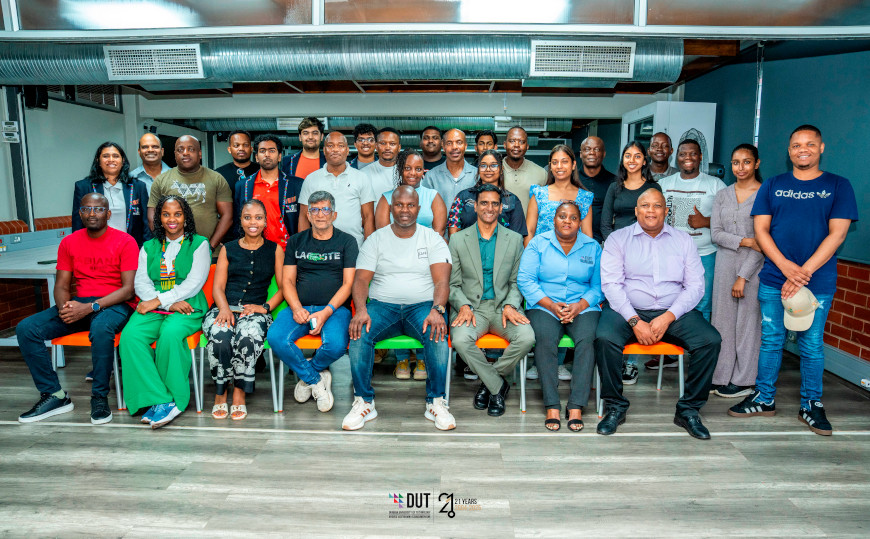
The Department of Information Systems at the Durban University of Technology (DUT) recently hosted 15 Chief Information Officers from the Sector Education and Training Authorities (SETAs) for a landmark event unveiling Africa’s first government Data Lakehouse.
The official welcome was delivered by Professor Nalen Naicker, Head of the Department of Information Systems within the Faculty of Accounting and Informatics at DUT. He is the lead software engineer and programmer for the community engagement project. This was followed by a tour of the laboratories, showcasing the faculty’s world-class facilities.
“The Fifth Industrial Revolution is about human-centric innovation. It is not just about automation and artificial intelligence; it is about using technology ethically and intelligently to improve lives and strengthen institutions. This Data Lakehouse is a perfect example of that vision in action,” explained Professor Naicker.
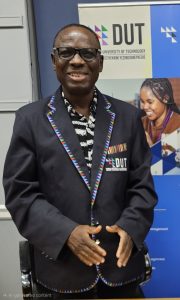
Professor Oludayo Olugbara, Executive Dean of the Faculty of Accounting and Informatics.
This pioneering initiative was spearheaded by Professor Oludayo Olugbara, Executive Dean of the Faculty of Accounting and Informatics, together with Professor Naicker. The Data Lakehouse is a cloud-based business intelligence platform designed for the Fifth Industrial Revolution. The project promises to revolutionise governance by enhancing fiscal accountability and exposing fraudulent activities within the SETA sector.
According to Professor Olugbara, a Data Lakehouse combines the best features of a data lake and a data warehouse, allowing organisations to store massive amounts of raw data while also providing structured, analytics-ready datasets for reporting and decision-making. For government, this means centralised data access, real-time analytics, and increased transparency and accountability.
Centralised data access ensures that all financial, operational, and compliance data from multiple SETAs can be stored in one secure environment. Real-time analytics allow decision-makers to access up-to-date insights, improving efficiency and service delivery. By consolidating data and applying advanced analytics, fraudulent activities and irregular spending can be detected quickly.
“Governments worldwide are under pressure to deliver services efficiently and curb corruption. By integrating advanced analytics and machine learning into a secure cloud environment, we empower decision-makers with real-time insights. This is how technology becomes a tool for trust,” Professor Olugbara emphasised.
Professor Olugbara also highlighted the benefits the Data Lakehouse will have for ordinary South Africans. Improved service delivery will result from faster, data-driven decisions, allowing quicker responses to skills development needs and better allocation of resources. Enhanced transparency will reduce corruption, ensuring that public funds are used for their intended purposes, benefiting communities directly. Streamlining SETA operations will also support economic growth, as more funds can be directed toward training programmes, creating a skilled workforce for South Africa’s evolving economy.
“Our goal is to make governance more efficient and citizen-focused. When technology helps eliminate waste and fraud, every rand saved can be reinvested into education, healthcare, and job creation,” added Professor Olugbara.
The project is not only a technological milestone but also an educational triumph. Professors Naicker and Olugbara have collaborated with a dynamic team of students from the Faculty of Accounting and Informatics, who are registered for the Information and Communications Technology programme. Guided by the Engineering Practice of Innovation Project teaching and learning philosophy, the students have played a critical role in achieving key milestones and deliverables. This approach has yielded exceptional results, combining academic rigour with real-world applications.
“Our students are learning by doing. They are not just programming; they are solving real governance challenges. This experience prepares them for the future of work in a world shaped by the Fifth Industrial Revolution,” said Professor Naicker.
In closing, Professor Naicker thanked the Chief Information Officers for taking the time to attend and looked forward to future collaboration.
The Data Lakehouse project stands as a shining example of DUT’s commitment to driving innovation and contributing to the improvement of South Africa’s government sector. By merging cutting-edge technology with collaborative learning, DUT continues to position itself at the forefront of enhancing governance in South Africa.
Pictured: Chief Information Officers from the Sector Education and Training Authorities and DUT staff members with students.
Dr Prinavin Govender / Siphokazi Dlamini


