
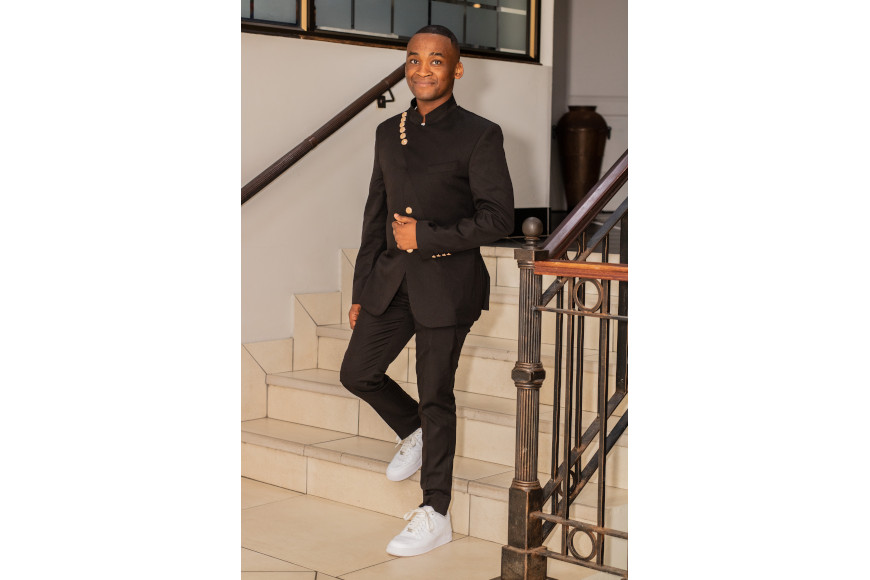
At 28, Nkosikhona Lwazi Dube has become the first person in his family to obtain a university degree and is now preparing to graduate with a Master of Health Sciences in Chiropractic at the Durban University of Technology (DUT).
Originally from eNdwedwe, Dube’s academic journey has been shaped by perseverance, a passion for health and sport, and a determination to give back to the community that raised him. His latest achievement will be celebrated at DUT’s 2026 Spring Graduation.
Moving from a rural community in eNdwedwe to Durban to begin university was a major adjustment. The transition from a quieter rural environment to city life was overwhelming, while communicating in English every day presented another challenge during his first year.
“I struggled because I was not used to speaking English daily,” he recalls. “I spent a lot of time at the Faculty of Health Sciences Language Lab working on my vocabulary, which helped me build the confidence to communicate fluently.”
His determination soon began to show in his academic performance. Fascinated by the human body from a young age, Dube developed a particular interest in Anatomy and went on to achieve distinctions in the subject.
Having experienced some of the challenges faced by students entering university from different backgrounds, he also chose to support others. He served as a tutor in the Basic Medical Science Department and as a Mentor Advisor in the Faculty of Health Sciences, helping students navigate some of the challenges he had experienced himself.
His passion for sport and chiropractic care eventually came together in his Master’s research. His dissertation, titled “The Epidemiology of Soccer-Related Injuries in Adolescent Male Scholars in Ndwedwe District, KwaZulu-Natal”, focused on a subject close to home.
While much of the existing research on soccer-related injuries focuses on high-income countries and urban settings, Dube turned his attention to adolescent soccer players in his own community.
His study involved 233 adolescent soccer players in the Ndwedwe District. He found that 70.4% had experienced a soccer-related injury during their lifetime, while 71.1% of reported injuries occurred during matches. Hard playing surfaces were among the concerns identified in the study, with the knee and foot among the areas most commonly affected.
The research also highlighted gaps in access to medical support. More than 70% of participants reported that there was no medical personnel present when their injuries occurred, while 38.4% received no treatment. These injuries could also place an additional financial burden on families.
Dube believes the findings point to the need for better playing conditions and improved access to medical support for young athletes in rural communities.
His practical experience has complemented his academic work. Dube served as a sports medic for the DUT soccer and rugby teams, an opportunity he describes as pivotal to his professional and personal development.
The experience has strengthened his ambition to establish his own chiropractic practice and, eventually, work with a professional soccer team.
Reflecting on his journey, Dube remains grateful to DUT for the opportunities and support he received along the way.
“I want to express my sincere gratitude to DUT for trusting me with the privilege to work as a sports medic. All of these experiences have shaped me into the professional I am today, both personally and academically,” he said.
His journey from eNdwedwe to postgraduate study has also shaped the message he wants to share with other young people who may doubt what is possible for them.
“A winner is a dreamer who never gives up,” he said, quoting Nelson Mandela. “Where you come from does not limit how far you can go.”
As Dube prepares to cross the stage at DUT’s 2026 Spring Graduation, his achievement represents more than the completion of a Master’s degree. It is a milestone for a first-generation graduate who overcame the challenges of adjusting to university life, found his voice and knowledge in a new environment, and used his experience to support others and contribute to his community.
Picture: Supplied
Nosihle Mthembu


