
The Department of Mathematics under the Faculty of Applied Sciences at Durban University of Technology (DUT) hosted a Research Workshop on Navigating AI Responsibly in Mathematics, bringing together academic staff and researchers to critically engage with the rapidly evolving role of Artificial Intelligence (AI) in higher education. The workshop formed part of the department’s ongoing efforts to respond to technological transformation while strengthening academic integrity, pedagogical innovation, and research excellence within the mathematical sciences.
The workshop created an interactive platform for reflection on how AI is reshaping teaching, learning, assessment, and research practices. It encouraged open dialogue on both the opportunities and risks associated with AI integration in higher education, particularly within disciplines that require precision, logical reasoning, and conceptual depth such as mathematics. The purpose of the event was the use of AI responsibly in academic environments, with particular attention to ethical considerations, academic integrity, data privacy, responsible tool selection, cognitive offloading, and emerging pedagogical strategies.
The workshop was officially opened by Head of Department, Professor Darren Lortan, who welcomed participants and set a reflective tone for the engagement. He emphasised collective responsibility in navigating AI adoption within academia, noting that both staff and students must be equipped to engage thoughtfully with emerging technologies while maintaining academic standards.
Professor Lortan cautioned that AI literacy has become an essential academic competency. “We must ensure that our students and staff are not only using AI but understanding how to use it responsibly and ethically within their academic work,” he said. He further stressed that institutions must take an active role in shaping how AI is integrated into teaching and assessment rather than reacting passively to rapid technological change.
He added that while AI presents opportunities for efficiency, it also challenges traditional notions of assessment and learning. “The university must remain the space where critical thinking is protected, even in an era of automation,” he noted.
Senior Lecturer in Physics, Dr Kevin Reddy, demonstrated how Artificial Intelligence is being integrated into academic administration and teaching support within the Department of Mathematics. He showed how AI tools have been used to generate seating plans for large student cohorts, merge complex datasets from multiple spreadsheets, and streamline administrative tasks such as mark processing and data transfer between institutional systems.
A Senior Lecturer in Physics, Dr Kevin Reddy, demonstrated how Artificial Intelligence is already transforming academic administration and teaching support within the department. He showed how AI tools are being used to generate seating plans, merge large datasets, and streamline mark processing and administrative workflows.
Dr Reddy explained that these processes, which previously required hours of manual effort, can now be completed within minutes. “AI is doing the heavy lifting for us, but only because we are giving it clear, structured instructions. You still need to know exactly what you are doing,” he said.
He further cautioned that the effectiveness of AI depends heavily on the quality of human input, warning that vague or poorly structured prompts can lead to inaccurate results. He emphasised that AI should therefore be viewed as an assistive tool that enhances productivity rather than replacing academic judgement, requiring continuous verification and critical oversight in all applications.
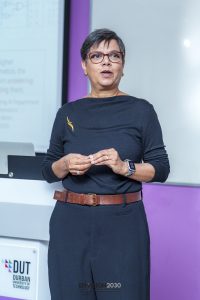
Dr Gita Mistri
Facilitating the workshop, Dr Gita Mistri, Academic Development Practitioner and Senior Lecturer in the Centre for Excellence in Teaching and Learning (CELT), challenged academics to rethink the role of AI in mathematics education, emphasising that AI should be positioned as a support mechanism for enhancing human cognition rather than replacing it. She stressed the importance of distinguishing between ethical and unethical uses of AI, noting that this boundary is often blurred in academic contexts where both students and staff are still learning how to navigate emerging technologies responsibly. “We are at a point where AI is not the issue; the issue is how we choose to engage with it and what we allow it to do for us,” she said.
Dr Mistri further highlighted the concept of cognitive offloading, explaining that while AI can efficiently perform routine or repetitive tasks, lecturers must carefully determine when students should engage in independent problem-solving. She cautioned against overdependence on AI tools, warning that excessive reliance may weaken foundational mathematical understanding and reduce students’ ability to think critically without technological assistance. “If students start outsourcing all thinking to machines, we risk losing the very essence of mathematical reasoning,” she noted.
A key focus was also placed on assessment transformation, with Dr Mistri noting that traditional methods are becoming increasingly vulnerable in the age of generative AI. “We cannot continue assessing students in ways that AI can easily complete. We must assess reasoning, not repetition,” she said. She argued that future assessment must evaluate how students think, not just what they produce.
She further argued that future-ready assessment practices must require students to demonstrate their thinking processes, evaluate AI-generated outputs, and justify their solutions through logical reasoning, ensuring a shift from product-based to process-based evaluation. The workshop also engaged deeply with concerns around academic integrity, particularly the challenges of verifying student authorship in an environment where AI tools are easily accessible.
Concluding her presentation, Dr Mistri stressed that AI should be viewed as a transformative tool that enables higher-order thinking, creativity, and innovation, while also requiring careful academic oversight. She further urged institutions to produce graduates who are not only mathematically competent but also critically engaged with AI systems, reinforcing that AI does not replace mathematical competence but instead demands a higher level of thinking.
The workshop concluded with broader reflections on the future of AI in higher education. Participants acknowledged that Artificial Intelligence is reshaping academic practice across teaching, learning, and administration, particularly in disciplines like mathematics where precision and reasoning are central.
There was consensus that AI is not a replacement for human intelligence but a tool that, when used responsibly, can enhance productivity, support innovation, and enable deeper levels of thinking.
Pictured: Head of Department, Professor Darren Lortan, Academic Development Practitioner Dr Gita Mistri, and staff members from the Department of Mathematics during the Mathematics workshop.
Photographer: S’bonelo Dlamini
Sinamile Sithole


