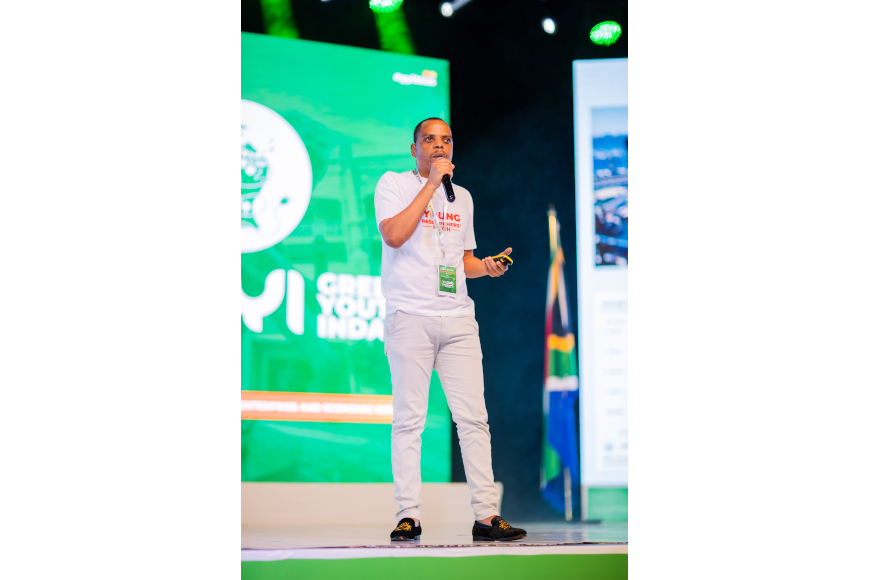
Durban University of Technology (DUT) doctoral researcher Sandile Mondli Mtolo has secured second place in the Young Researchers’ Pitch at the 2026 Green Youth Indaba for his research exploring the use of seawater to produce green hydrogen.
His achievement highlights the work of emerging researchers investigating alternative energy technologies and potential solutions to South Africa’s environmental and resource challenges.
Mtolo’s doctoral study, titled Production of Green Hydrogen by Seawater Electrolysis: Modelling and Simulating Efficiency and Scalability, investigates whether seawater could be used instead of freshwater in hydrogen production. Through modelling and simulation, the research examines the process’s efficiency, economic feasibility and potential for scaling up, with a particular focus on KwaZulu-Natal and Durban.
Green hydrogen is produced by using renewable electricity to split water into hydrogen and oxygen through electrolysis. Hydrogen can then be used as an energy carrier in various applications, including as a fuel and in ammonia production.
Mtolo explained the thinking behind his research: “Green hydrogen is a clean energy carrier produced through the electrolysis of water using renewable energy. My innovation is to use seawater rather than freshwater as the feedstock.”
The approach could help reduce the demand for freshwater in hydrogen production, an important consideration in a country where water resources face increasing pressure. However, seawater electrolysis presents technical challenges, including electrode corrosion, the effects of salinity and energy consumption. Mtolo’s research examines these factors, alongside the role of desalination in managing water quality and the overall sustainability of the process.
The research aligns with four United Nations Sustainable Development Goals (SDGs). These are SDG 7 (Affordable and Clean Energy), through its exploration of green hydrogen production; SDG 6 (Clean Water and Sanitation), through its consideration of alternative water sources; SDG 9 (Industry, Innovation and Infrastructure), through its focus on technological innovation and scalability; and SDG 13 (Climate Action), through the potential contribution of renewable-energy-based hydrogen to lower-carbon energy systems.
Through research of this nature, DUT contributes to the generation of knowledge and the exploration of innovative approaches to energy and water challenges. Mtolo’s work provides an example of how doctoral research can investigate locally relevant questions with potential applications beyond the university.
Reflecting on his achievement at the Green Youth Indaba, Mtolo said the recognition affirmed the value of his work and acknowledged the people supporting his research journey.
“I am thrilled to have placed second out of the top five young researchers. To me, it is a confirmation that my work is making a meaningful contribution, and it also reflects the dedication of my supervisors, who are helping to drive real change in society,” he said.
The event also gave Mtolo an opportunity to present his innovation to a wider audience. He said government officials attending the Indaba were impressed by the research. He added that the Green Youth Indaba supported the winners with hampers and gadgets to improve research efficiency.
At DUT, Mtolo is part of the Green Engineering Research Group (GERG), where he works in green engineering and supports master’s students researching related topics. He is also a part-time lecturer, with a keen interest in helping students understand the role of low-carbon technologies in addressing environmental challenges.
He acknowledged the contribution of his department, research group and supervisors to his progress.
“Our Head of Department, Prof Ngema, has been instrumental in providing research support and space, and the Green Engineering Research Group (GERG) has offered unwavering support. Additionally, my supervisors, Dr EK Tetteh, Prof K Moloi, Dr N Mthombeni, and Prof S Rathilal have given invaluable guidance throughout my studies.”
Alongside his doctoral research, Mtolo has developed technical skills in MATLAB, Python and Aspen, supported by certifications in data science and artificial intelligence. His research output includes three peer-reviewed journal papers and a conference proceedings paper. He also collaborates with the South African National Energy Development Institute (SANEDI).
Looking ahead, Mtolo hopes to move promising ideas from academic investigation towards practical application. His ambitions include establishing a start-up to test, develop and refine the seawater electrolysis process, as well as working as a consultant in the sector.
He is also developing a separate start-up focused on sustainable water generation, which he said ranked among the top five innovations by FSAT Labs and AfricArena.
“I also want to keep teaching DUT students about the importance of zero-carbon and green technologies for our planet. In addition, I aim to make green hydrogen research accessible to the public through appropriate accredited journals,” he said.
As his doctoral work progresses, Mtolo intends to continue investigating direct seawater electrolysis, improved desalination approaches and catalyst development to better understand the technical and practical requirements of producing green hydrogen from seawater.
“Our work is gaining recognition and helping to shape DUT’s future in line with ENVISION2030,” said Mtolo.
His second-place achievement at the Green Youth Indaba is an important milestone in a research journey that brings together energy innovation, water sustainability and the development of future technologies. While further investigation is needed to establish the practical and economic feasibility of seawater-based hydrogen production, Mtolo’s work demonstrates how DUT researchers are exploring new possibilities to address challenges facing South Africa and the wider world.
Pictured: Sandile Mondli Mtolo
Waheeda Peters


