
As part of its ENVISION2030 strategy, Durban University of Technology (DUT) aspires to produce adaptive graduates who will contribute productively to the development of the region, the country, and the world. Through sport, the University continues to nurture discipline, leadership, teamwork and holistic student development.
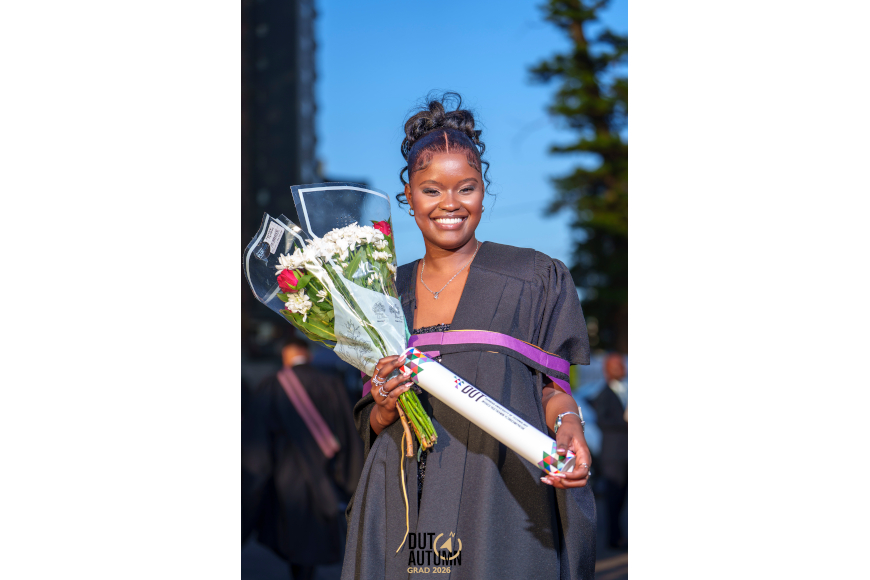
Tiyani Mboweni, a member of the DUT Communications team, recently engaged with DUT sport star Thembekile Mazibuko, who graduated with a Higher Certificate in Sport Management and Science at the 2026 DUT Autumn Graduation Ceremony. She shares her journey in sport, her passion for dance conditioning, and how she lives the DUT Living Values through her involvement in varsity sport.
Name: Thembekile Thumekile Mazibuko
Place of Birth: Nongoma, KwaZulu-Natal
Qualification: Higher Certificate in Sport Management and Science
Q: When did you become part of DUT Sports Management?
A: “I officially became part of the DUT sports family when I enrolled for my Higher Certificate in Sport Management and Science in 2025.”
Q: What sparked your interest in DUT Sports Management?
A: “I have always loved sport, but I realised that passion alone is not enough if you want to build a long-term career. I chose this field at DUT because I wanted to understand the deeper science and management behind athletics. I wanted to gain practical knowledge to turn my passion for netball and athlete development into a sustainable, lifelong career that could also create future job opportunities.”
Q: In terms of the role, you play as a Sports Management and Science student, kindly elaborate on what it entails and how it benefits student sport participants?
A: “As a Sports Management and Science student who also plays netball, my role bridges the gap between theory and actual on-court performance. It involves understanding athlete workload, performance analysis and applying concepts such as dance conditioning to improve agility and core strength. This benefits other students in sport because I can share insights on how to train smarter, recover better and maintain the physical discipline required to compete at a high varsity level.”
Q: Which sport codes are you interested in and why?
A: “Netball is my primary sport and my absolute passion because it is fast paced, highly tactical and relies heavily on teamwork. From my first semester, I immersed myself in varsity sport, balancing my academic studies with my commitment on the netball court. Through my studies, I have also developed an interest in rugby and general fitness conditioning, as I enjoy exploring how specialised training enhances performance across different sporting codes.”
Q: What is the biggest tournament you have participated in?
A: “Participating in major university tournaments and regional netball leagues while representing DUT has been the highlight of my sports journey so far. Competing against top tier talent from other institutions pushes you to your limits and teaches you what it truly takes to perform under pressure.”
Q: Why is it vital for DUT to develop students in sport?
A: “Sport is essential because it teaches life skills that cannot be learned from textbooks alone. When DUT invests in sports development, it nurtures discipline, leadership, resilience and teamwork. It builds holistic individuals who can handle both victory and defeat, aligning with the University’s goal of producing well rounded, productive graduates.”
Q: Who is your role model and why?
A: “My role models are elite athletes and coaches who use sport as a tool for community development and personal growth. I look up to figures in sports science and netball who have shown that academic excellence and athletic performance can go hand in hand, proving that a career in sport is worth pursuing.”
Q: Which ENVISION2030 Living Values do you associate with and why?
A: “I deeply resonate with commitment and respect. My academic journey was not easy, and it took immense commitment to overcome challenges, repeat matric when things became difficult, and continue pushing forward. In sport, respect for coaches, teammates and opponents is fundamental. Living these values has helped me grow as both an athlete and an adaptive individual ready to contribute to society.”
Q: Do you see a future in sport?
A: “Yes, absolutely. My future is entirely anchored in sport. Having completed my Higher Certificate, I am continuing with my degree in Sport. I see a clear future for myself in sports management, athlete training and performance conditioning. I am building the foundation now for sustainable opportunities within the sports industry.”
Q: What impact has sport had on your life?
A: “Sport has shaped my character and given me focus. It taught me how to push through hardship, gave me a sense of belonging at varsity and provided a positive outlet for my energy. It has shown me that failure is never final, it is simply a lesson before your next match or exam.”
Q: How did it feel to graduate at the 2026 DUT Autumn Graduation Ceremony while reflecting on your journey through sport?
A: “It felt completely surreal and deeply emotional. There was a time I almost did not attend my graduation, but stepping onto that stage on 20 May was one of the best decisions I could have made. Looking back at my journey from Nongoma, overcoming academic challenges and balancing late night studies with early morning training, this milestone proves that perseverance pays off. I am incredibly proud to be a DUT graduate, and this is only the beginning.”
Q: Can you suggest ideas to attract spectators to varsity sport?
A: “We can create more match day excitement on campus through student led activations, loud music, half time dance conditioning showcases and giveaways. Collaborating with campus media to share player profiles and behind the scenes content can also help students feel more connected to the teams. Hosting matches during high traffic campus hours and encouraging residence group participation would also create a vibrant and energetic varsity sporting culture.”


