
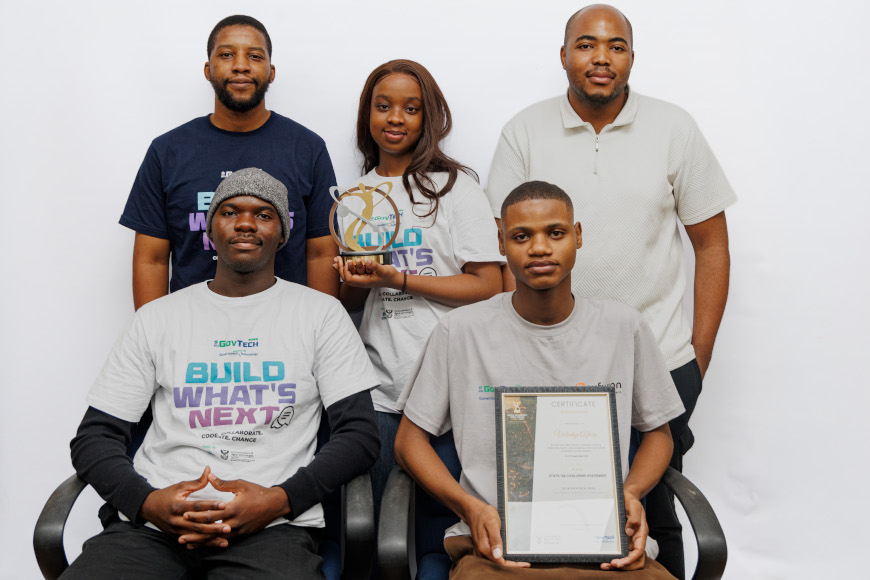
A team of student innovators from the Faculty of Accounting and Informatics (FAI) ARM Lab and the Faculty of Engineering and the Built Environment at the Durban University of Technology (DUT) has emerged as the winner of the GovTech Hackathon after developing an AI-enabled assistant designed to make official statistics more accessible and easier to use.
The students, working in collaboration with student-founded SMME Voltedge Africa through FAI’s ARM Engaged Ecosystem Laboratory, developed Rafiki, an AI-enabled assistant designed to respond to public and media-related queries using information from Statistics South Africa (Stats SA). The winning team comprised Sipho Mokoena, Musawenkosi Magwaza, Thuto Lapheana, Patrick Luhanga and Nosipho Dlamini.
The team identified a challenge faced by citizens, journalists and other users seeking information from official statistics. Answering these questions can require officials to search through numerous publications and statistical releases, even when similar questions have previously been answered. The students set out to develop a system that could retrieve authoritative information quickly while ensuring that responses remained grounded in verified Stats SA data.
Introducing Rafiki during their hackathon presentation, the team explained that the system was designed around a simple principle: if the information is not contained in its approved data sources, it should not invent an answer.
Rafiki uses a data retrieval pipeline that can handle both numerical and textual queries. Numerical questions can be answered through database queries, while questions requiring information from reports and other textual sources can be handled through a vector database. If the required information cannot be found in the available data, Rafiki is designed to refuse to respond rather than generate an unsupported answer.
The system also incorporates an AI governance layer to strengthen the reliability of its responses. Before a media response can be released, Rafiki checks the information through number verification, citation checks and confidence scoring. Responses that meet the required governance rules can then be reviewed and approved by an authorised Stats SA official, creating an audit trail of the decision.
The students demonstrated the system using a media query about whether access to sanitation in South Africa had increased or declined since 2002. Rafiki retrieved information from the available Stats SA data, generated a referenced response and provided an internal review process through which an official could assess and approve the answer.
The team also demonstrated how Rafiki could be accessed through different platforms, including a public-facing portal and a WhatsApp-based interface. Users can submit questions and receive responses based on approved Stats SA data, while the system is designed to prevent users from accessing information or functions outside their authorised level of access.
Another feature demonstrated by the students was Rafiki’s ability to identify knowledge gaps. When asked a question about progress in addressing gender-based violence, for example, the system did not attempt to provide an unsupported answer because the relevant crime analytical data was not included in its available corpus. Instead, it flagged the issue as a potential knowledge gap for Stats SA officials to consider.
The system was also designed to support multilingual interaction, allowing users to communicate with Rafiki in South African languages while retaining the same data retrieval and verification processes.
Sipho Mokoena, founder of Voltedge Africa, explained that the collaboration grew from the company’s connection with DUT and the ARM Engaged Ecosystem Laboratory. The partnership provided students with an opportunity to participate directly in the company’s work while gaining practical experience beyond the classroom.
After the team was selected for the hackathon, Mokoena approached the laboratory to involve other students in the project. The team then spent three days developing and refining their solution, beginning on Thursday, continuing through Friday and submitting their solution on Saturday morning before presenting to the judges later that day.
Their hard work was rewarded at the GovTech Gala Dinner, where the team was announced as the winner and received a trophy and certificate.
Reflecting on the achievement, Mokoena highlighted the contribution of the students who worked alongside him throughout the competition.
“I wanted the other members, because they worked very hard on this project along with me, to actually win the competition. It’s also their project, and they should get all those benefits,” said Mokoena.
The victory has also opened the door to further opportunities for the students. According to Mokoena, the winning project is expected to lead to a longer-term project involving Voltedge Africa, the relevant SETA and Statistics South Africa. He hopes that the students who contributed to the project will be able to continue working on it and gain further professional experience.
“The ideal situation would be to take them on as paid interns so that they can work on the project with us,” said Mokoena, adding that the team would explore ways of ensuring that the students benefit from the opportunities created through the project.
For the students involved in the GovTech Hackathon, the victory represents more than a competition award. It demonstrates how university innovation spaces can connect students with industry, expose them to real-world challenges and create pathways towards further professional opportunities.
Through platforms such as the ARM Engaged Ecosystem Laboratory, FAI continues to create opportunities for students to move beyond theoretical learning and participate in projects that expose them to technology development, entrepreneurship, industry collaboration and the practical application of their skills.
Photographer: Mandisi Mvunelo
Caption: DUT students emerge as the GovTech Hackathon champion.
Sinamile Sithole


