
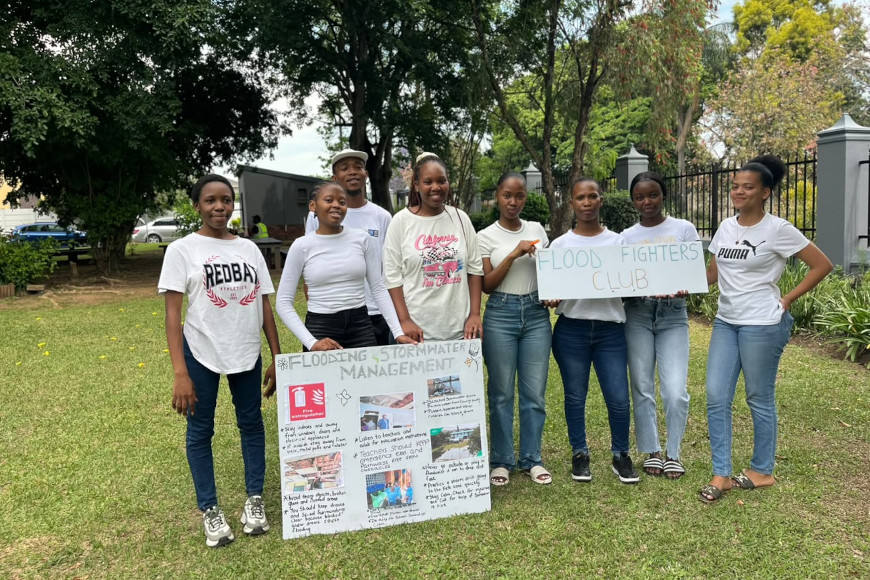
First-year students at the Durban University of Technology (DUT) are demonstrating how creativity and innovation can help address environmental challenges, using the law as a tool to promote sustainability and protect the environment.
The students presented their ideas and projects on 15 October 2026 at the Midlands Campus as part of the Environmental Sustainability and Law (ES&L) Project-Based Learning (PBL) and Design Thinking (DT) Project 2026. The initiative was undertaken by the Department of Applied Law for students enrolled in the Law for Life module.
Spearheaded by the Centre for Excellence in Teaching and Learning (CELT), the project seeks to introduce innovative teaching and learning approaches that encourage creativity, innovation and adaptability. It also supports DUT’s ENVISION2030 perspectives, the National Development Plan 2030, the United Nations Sustainable Development Goals (SDGs) and the University’s recently approved Philosophy of Education, which incorporates Project-Based Learning and Design Thinking.
The Law for Life module introduces first-year students to areas of law that influence everyday life. However, understanding how the law operates beyond the classroom can be challenging when learning is largely confined to theory and textbook case studies. The project addressed this gap by giving students an opportunity to investigate environmental problems in their communities and explore how legal knowledge could inform practical solutions.
As part of their learning, students attended guest lectures facilitated by the innobiz DUT Centre for Entrepreneurship and Innovation, together with a CELT student development practitioner. These engagements exposed them to interdisciplinary and transdisciplinary approaches to environmental sustainability, highlighting the connections between law, innovation, economic development and social and cultural contexts.
Students then conducted fieldwork at schools, tuck shops, taxi ranks and other community spaces to identify environmental challenges and develop recommendations. Their investigations focused on water quality and river pollution, biodiversity loss, waste management and urban sprawl and land use.
The project culminated in a range of creative, practical solutions that demonstrated how students could apply design thinking to problems affecting their communities. Among their initiatives were environmental awareness campaigns that combined public education with clean-up activities across Pietermaritzburg, as well as collaborations with external non-governmental organisations (NGOs).
Other projects included solar-powered software applications designed to monitor environmental issues and detect potential problems before they escalate, a free emergency website for reporting environmental concerns directly to the local municipality, sensor-based bins with colour-coded systems to encourage waste separation, and a flood alarm system. These solutions reflected the students’ efforts to move beyond identifying problems towards developing and testing possible interventions.
Through the process, students strengthened their research, communication, collaboration and critical-thinking skills while learning to approach complex environmental issues from different perspectives. The experience also demonstrated the value of connecting legal education with community engagement and technological innovation.
The student presentations were assessed by a panel comprising Ms Thembelihle Mathaba, an executive member of the Student Women Economic Empowerment Programme; Dr Peter Kalanga, Academic Development Practitioner and Student Support and Development Unit Coordinator; and Mr Minenhle Dlamini, the project leader and lecturer in the Department of Applied Law.
By bringing together environmental law, design thinking and project-based learning, the initiative illustrates how teaching and learning at DUT can equip students to engage meaningfully with societal challenges. It also reinforces the importance of developing graduates who can apply their knowledge creatively, think critically and contribute to more sustainable communities.
Pictured: The Flood Fighters Club presenting their project.
Photo: Supplied.
Minenhle Dlamini


