
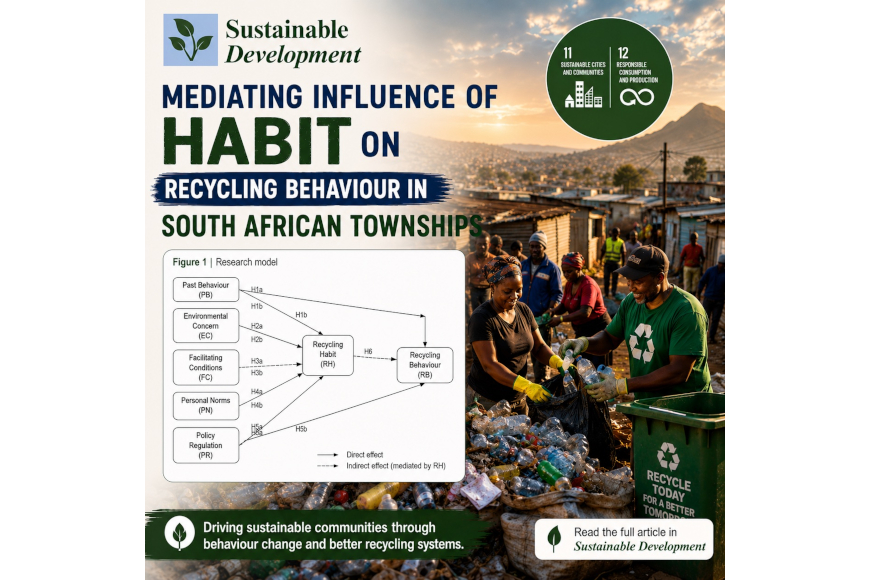
Why do some people recycle regularly while others do not? According to a new study by researchers from the Durban University of Technology (DUT), the Baden-Wuerttemberg Cooperative State University (DHBW) in Germany and Cape Peninsula University of Technology (CPUT), the answer may be simpler than we think: habit.
The study found that recycling is strongly influenced by people’s everyday routines and habits. In fact, habit emerged as one of the most important factors determining whether people recycle consistently.
While environmental awareness, personal values, government policies and access to recycling facilities all play a role, the research found that these factors are often not enough on their own. Instead, people are more likely to recycle when it becomes a normal part of their daily lives.
The findings suggest that creating lasting recycling behaviour requires more than education and regulation. Communities also need practical support and convenient recycling opportunities that help people develop positive recycling habits over time.
The study focused on recycling behaviour in South African township communities and provides valuable insights for policymakers, municipalities, environmental organisations and community leaders working to increase recycling participation and support sustainable development.
Lead researchers Professor Mercy Makhita and Professor Thomas Dobbelstein, who is based at DHBW in Germany and is also an Honorary Research Professor DUT, said the findings highlighted the importance of making recycling easy, accessible and part of everyday life. Professor Dobbelstein currently also serves as Chairperson of the Advisory Board of the DUT Business School and as a Board Member of the Innobiz DUT Centre for Entrepreneurship and Innovation.
The researchers expressed their appreciation to both DHBW and DUT for supporting the project. The study contributes to growing efforts to promote sustainability and strengthen the circular economy in South Africa. The full research article is available as an open-access publication: CLICK HERE TO READ THE RESEARCH ARTICLE
Alan Khan


