
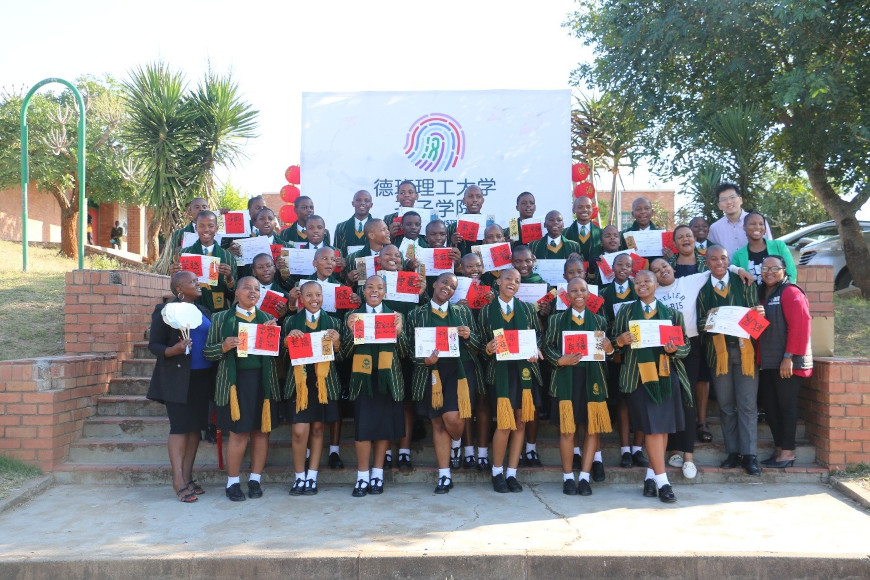
The Durban University of Technology (DUT), through a collaboration between the DUT Confucius Institute (CI) and the Community Engagement Office, has brought Mandarin language and Chinese culture to learners at James Nxumalo Agricultural High School in Ulundi.
The Mandarin Language Programme was officially launched at the school in June 2026, giving Grade 10 learners an opportunity to learn a new language and engage with a different culture while still at school. During the first semester, learners completed 20 online lessons as part of Level 1 of the Mandarin programme.
The initiative forms part of DUT’s commitment to extending meaningful educational opportunities beyond the University and strengthening partnerships with communities and basic education institutions.
The programme brings together the expertise of the DUT Confucius Institute and the Community Engagement Office. The Confucius Institute provides Mandarin language teaching and cultural expertise, while the Community Engagement Office facilitates the relationship with the school and supports the programme as part of DUT’s broader community engagement work.
For learners, the programme provides exposure to a language and culture that may otherwise be difficult to access in their local environment. It also creates opportunities for them to develop confidence, curiosity and a broader understanding of the world beyond their immediate surroundings.
CI Director, Mr Lin Wu (Frank), reflected on the importance of taking Mandarin learning beyond the university environment and creating opportunities for young learners to develop an early interest in Chinese language and culture. The programme also contributes to the Institute’s role in promoting language learning and cultural exchange, while strengthening connections between South African and Chinese communities.
Speaking about the programme, Acting Principal Mrs T. Magubane highlighted the value of exposing learners to different languages and cultures at an early stage. She noted that such opportunities can broaden learners’ perspectives and encourage them to consider possibilities beyond their immediate environment, including travelling to and experiencing other countries.
For the learners, the experience has already sparked greater interest in language and culture. Feedback collected following the first phase of the programme showed that learners had developed greater confidence in learning an unfamiliar language and were beginning to connect language learning with future opportunities.
One learner reflected that learning Mandarin had placed them “one step closer to my life plan,” while another expressed a desire to continue learning the language because of an aspiration to travel and study overseas.
Another learner highlighted the importance of approaching unfamiliar languages with an open mind, saying: “We should not judge other languages just by looking at them. We should give our time and learn them.”
The learners also expressed an interest in continuing with Mandarin lessons and having more opportunities to engage with Chinese language and culture.
Although online delivery has presented challenges, particularly because of internet connectivity in the area, DUT and the school continue to explore practical ways to strengthen the programme and support learners as they progress.
The Mandarin Language Programme demonstrates how university-community partnerships can create opportunities for learners to engage with new languages, cultures and ideas. For the learners at James Nxumalo Agricultural High School, the programme is not only an introduction to Mandarin, but also an opportunity to broaden their perspectives and imagine new possibilities for their futures.
Pictured: James Nxumalo Agricultural High School learners and teachers with the DUT and Confucius Institute team during the programme launch.
Phumzile Xulu


