
The Technology Transfer and Innovation (TTI) Unit at the Durban University of Technology (DUT) recently hosted its 2026 Incubation Review Workshop, held over two days from 9–10 April at the DUT Hotel School on the Ritson Campus.
The workshop provided a dynamic platform for emerging technology innovators to present their ideas, showcase progress, and receive valuable feedback from industry experts and mentors.
Dr Farai Dziike from TTI said the incubation programme is designed to support and nurture innovative ideas, guiding them through development into commercially viable products or businesses, thereby bridging the gap between academic research and the market. It enables participants to transform their concepts into tangible solutions with real-world impact.
Dr Dziike indicated that the incubation programme runs for 12 months and that participants drawn from DUT students, staff, and alumni are selected through a formal application process. Furthermore, priority is given to innovations that demonstrate strong potential for commercialisation and meaningful societal impact. Successful applicants receive funding and comprehensive support from TTI, including mentorship, technical guidance, and business development resources.
“Once admitted, incubatees undergo an induction phase followed by quarterly review sessions. These reviews serve as critical monitoring and evaluation checkpoints, assessing progress, refining strategies, and ensuring that each innovation remains on track toward successful development and market readiness,” he explained.
The main goal of the TTI incubation programme is to cultivate an entrepreneurial mindset among researchers and academics by promoting technology-driven innovation and facilitating the commercialisation of research.
One of the incubatees, Minenhle Ndleko, an Honours student in Engineering Technology in Electronic Engineering, highlighted the significance of the incubation programme in enhancing his management skills, particularly after receiving funding. He emphasised the importance of being responsible and strategic when managing financial resources for innovative projects.
He noted that the programme has greatly improved his pitching abilities, enabling him to communicate his ideas more effectively. Furthermore, the incubation process has supported him in developing and scaling his project from an initial concept to a working prototype.
Currently, he is focused on refining and finalising his prototype, ensuring it meets the required standards and is ready for the next stage of development.
“The incubation has helped me a lot in terms of pitching skills. It has also helped me improve and scale my project from an idea into a prototype so far. Right now, I am busy improving and finalising my prototype,” he said.
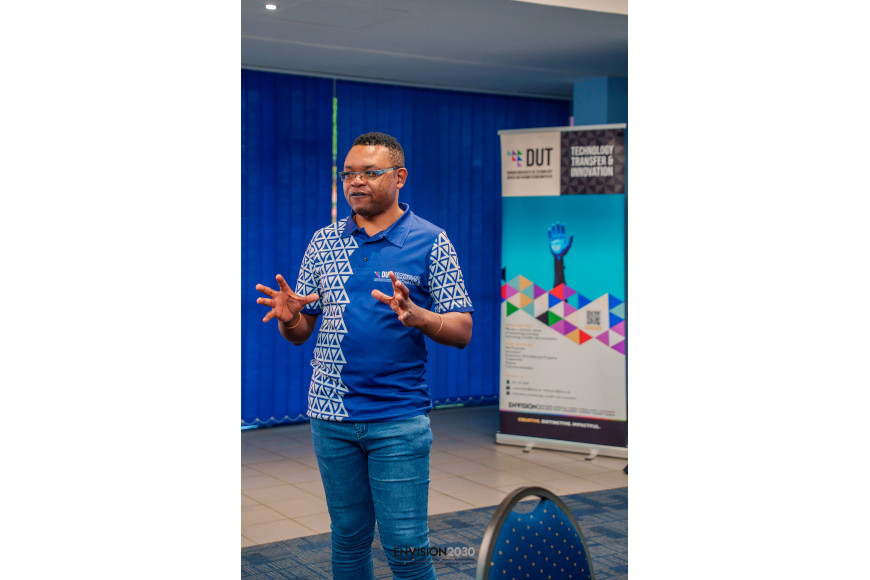
Pictured: Dr Farai Dziike from the Technology Transfer and Innovation (TTI) Unit addressing the students at the Incubation Review Workshop.
Photographer: S’bonelo Dlamini
Vukani Langa


