The innobiz DUT Centre for Entrepreneurship and Innovation recently hosted a Manufacturing of Sanitary Dignity Products and Its Value Chain Workshop, aimed at promoting the participation of women, youth and persons with disabilities in the manufacturing sector and related value chains.
The workshop brought together government departments, development agencies and other key stakeholders to explore the economic opportunities within the sanitary products manufacturing sector, particularly for emerging entrepreneurs and small businesses.
Among the stakeholders sharing their insights were the Department of Women, Youth and Persons with Disabilities; the National Youth Development Agency (NYDA); the Department of Small Business Development and its entity, the Small Enterprise Development and Finance Agency (SEDFA); the Department of Science, Technology and Innovation; the National Empowerment Fund (NEF); and the Women’s Economic Assembly (WECONA).
For innobiz DUT, the engagement reinforced the Centre’s role in advancing entrepreneurship, enterprise development and innovation by connecting emerging businesses with funding opportunities, industry stakeholders, business support and potential markets.
Through collaboration with government departments, development agencies and industry partners, the workshop provided a platform to explore opportunities for SMMEs and cooperatives to participate in manufacturing and strengthen their contribution to the economy.
The discussions also highlighted the importance of looking beyond business creation towards building sustainable enterprises and developing inclusive value chains that contribute to economic growth, in line with the National Development Plan (NDP) 2030.
Ms Mafiki Khoza, Deputy Chairperson of the Women’s Economic Assembly (WECONA), said the organisation firmly believed that women’s economic empowerment should move beyond verbal commitments made at public platforms and translate into tangible economic opportunities.
“Women must not only be beneficiaries and consumers, but they should also become manufacturers, suppliers, innovators, and owners of sustainable businesses. The manufacturing of sanitary dignity products presents an important opportunity to achieve things beyond addressing menstrual health and dignity.
“The sector can stimulate local manufacturing, create employment and promote industrialisation and open doors for women, youth and persons with disabilities owned enterprises. We must look beyond the finished product and recognise opportunities across the entire value chain,” Ms Khoza explained.
Mr Sipiwo Matshoba, Chief Director: Social Empowerment and Participation in the Department of Women, Youth and Persons with Disabilities, explained that since its inception in 2019, the Sanitary Dignity Programme has focused on ensuring that women and girls are able to manage their menstruation safely and with dignity.
In his presentation, Mr Matshoba emphasised the importance of local manufacturers complying with the relevant health and safety standards and guidelines stipulated by the South African Bureau of Standards (SABS) and the South African Health Products Regulatory Authority (SAHPRA).
He also cautioned aspiring entrepreneurs against underestimating the challenges associated with entering the manufacturing sector.
“We also have to speak on some of the challenges present and be realistic about that because we don’t want to come here and peddle a lie if we are going to come with a suggestion that they are going to be entrepreneurs tomorrow.
“We want you to be aware that there is pain as well here and there is no gain without pain, because this industry needs a lot of resilience, patience, because besides just manufacturing you’ve got to also comply with the regulatory authorities by following particular and stringent specifications,” Mr Matshoba highlighted.
Among the challenges he identified were access to finance, machinery, raw materials and markets. However, he noted that entrepreneurs who had demonstrated patience and resilience in the sector had also reaped significant benefits from their businesses.
“The strength of this enterprise is that women will always menstruate, this business is not going to fall anytime soon unless the human race is wiped off the face of the earth. So, it’s one of those enterprises in which if you are serious about it there is guaranteed sustainability,” Mr Matshoba added.
Ms Nonkonzo Nzama from the KwaZulu-Natal Department of Economic Development, Tourism and Environmental Affairs (EDTEA) outlined the support available to small businesses through the department, including training, capacity building, access to infrastructure and funding opportunities through its entities, such as Ithala Bank.
She explained that the department supports the development of SMMEs and cooperatives through various programmes, with particular focus on women, youth and persons with disabilities.
“We deal with the development of SMMEs through various units in our department that deal with enterprise development of SMMEs and cooperatives, including ours which targets women, youth and persons with disabilities.
“We have advertised this programme twice, to invite people in this sector to assist us to develop SMMEs who are responsible for manufacturing because our was on manufacturing. Yes, we do look at people in distribution and warehousing, but we also wanted to focus on manufacturing because the reality is that we don’t have manufacturers.
“We are trying to get more manufacturers, especially black manufacturers because this is a big industry and the market is there,” Ms Nzama said.
Ms Gugulethu Zwane, Deputy Director-General for Institutional Planning at the Department of Science, Technology and Innovation, encouraged aspiring entrepreneurs to recognise their potential and take responsibility for creating their own opportunities.
She reminded participants that their backgrounds should not limit their ambitions and that the choices they make today could shape their future.
“You can achieve whatever you put your mind to despite the circumstances, don’t wait for opportunities to come to you, create them,” Ms Zwane said.
The workshop contributed to the broader objectives of the National Development Plan (NDP) 2030, particularly in promoting inclusive economic growth, skills development, entrepreneurship and the meaningful participation of women, youth and persons with disabilities in the economy.
By bringing government, industry and enterprise development stakeholders together, innobiz DUT continues to create platforms that connect entrepreneurs to opportunities, strengthen value chains and support inclusive economic development.
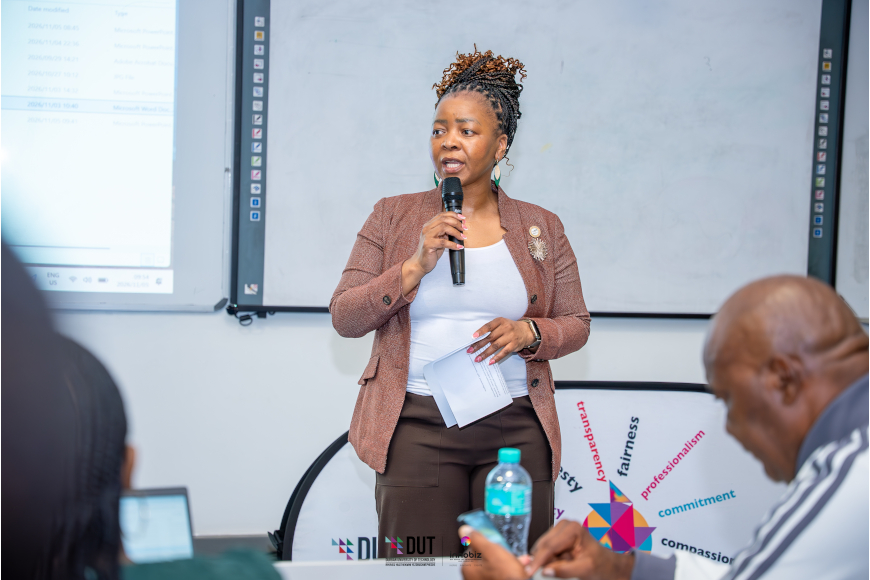
Pictured: Ms Nontokozo Ngcobo, innobiz DUT Centre Manager, speaking at the workshop.
Samkelo Thulasizwe Lesley Mtshali


