
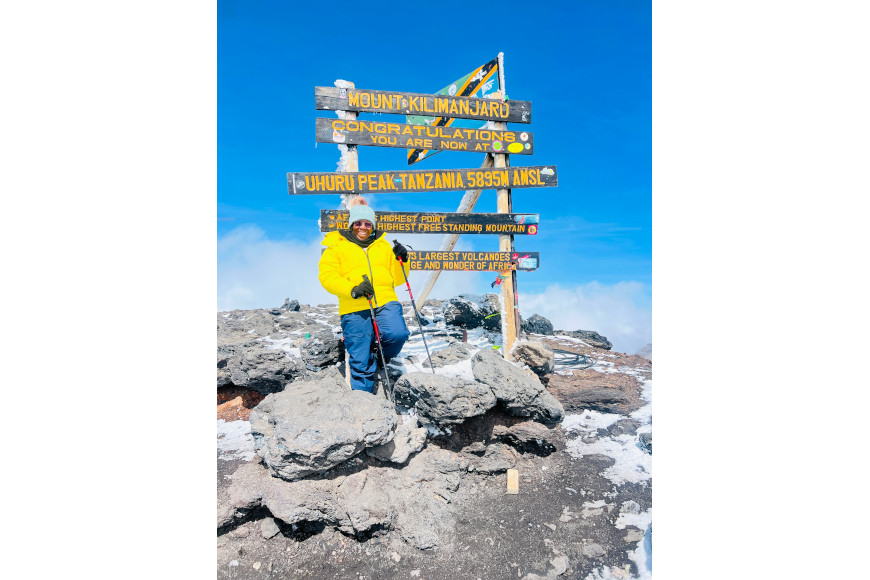
Dr Nonhlanhla Khumalo, a Writing Centre Practitioner at the Durban University of Technology (DUT) Midlands Campus recently summitted Africa’s highest peak and the world’s tallest free-standing mountain, Mount Kilimanjaro. She embarked on a six-day hike via the Machame Route to raise funds to purchase 50 pairs of school shoes for the children of Nkanyezi Youth Development Camp in Bergville, KwaZulu-Natal.
Dr Khumalo whose core mandate at DUT is to provide academic support to undergraduate and postgraduate students, as well as staff, through reading, writing, and research development said summiting Mount Kilimanjaro was also part of her birthday celebration.
“Celebrating another year was a significant milestone and a true blessing, which inspired me to celebrate in a way that was more meaningful than the usual self-indulgent options, such as going on holiday, hosting a lavish party, or dressing up for a themed celebration with friends. I wanted to do something purposeful, something that would allow me to give back to the community and make a positive impact on other people’s lives. Summiting Mount Kilimanjaro has long been a bucket-list goal for me, and this journey presented the perfect opportunity to hike for a cause,” shared Dr Khumalo.
For Dr Khumalo navigating Mount Kilimanjaro was incredibly challenging. She indicated that the most difficult memory was on Day 4 when they had to go from Barafu Camp (4673 metres above sea level) to the summit, Uhuru Peak.
“It was what was referred to as ‘summit day’, and the hike started at 12:00 midnight to arrive at the summit at sunrise. The trek towards Stella Point was the hardest part. It was the worst five kilo metres I have ever done as the walk took more than 6hrs. The extreme cold temperatures, fatigue and altitude played havoc with my brain as I wanted to sit and rest and just nap for at least five minutes but my Guide wouldn’t allow me to close my eyes. I kept asking him how long we still had to go. The standard response of ‘almost there’ started to irritate me as we kept walking for hours without seeing the end,” said Dr Khumalo.
When she got to Stella Point (one of three Kilimanjaro summits), Dr Khumalo said she was completely exhausted, but she had to dig deeper and remember why she was doing this. Thinking about those children at Nkanyezi Youth Camp ensured that she hiked the last 45 minutes to the Roof of Africa.
Getting to Uhuru Peak (5895 metres above sea level) was like going to war for Dr Khumalo. She had conquered Mount Kilimanjaro. Dr Khumalo said it was a proud moment that represented victory and gave her the belief that she could face all the challenges that the world threw at her. At that moment, she said it hit her that she could not take the ability to have the strength and health to do these types of activities for granted.
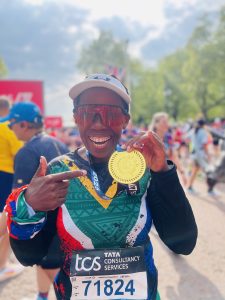
Dr Nonhlanhla Khumalo at the 2025 London Marathon.
“When I got to Uhuru Peak, I was overwhelmed with so many emotions and with this summit, the children of Nkanyezi Youth Camp were going to have school shoes because I had managed to reach the Roof of Africa. The Kilimanjaro Expedition was a challenge that required proper planning, physical fitness and mental strength. For me, as a hiker who has backpacked multiple trails in the Drakensberg mountains, and a social runner who has completed The 2025 TCS London Marathon and local races, I had the physicality to take on the biggest Mountain Peak in Africa on my terms,” excitedly shared Dr Khumalo.
As a hiker, Dr Khumalo realised that she was subject to the vagaries of nature and that she had to always remain calm. She indicated that it rained on the first day, nights were extremely cold and sleeping on the ground in a tent was not ideal. However, she shared that was the price she was willing to pay.
Elaborating on the role played by her family, friends and colleagues in achieving her goal, Dr Khumalo said: “My family, my close circle of friends and colleagues were 100% committed to this journey. They prayed for me and sent me countless messages of encouragement over the expedition days. It makes a big difference when you are on a mountain in a foreign country, and you get a video call from your daughter.”
Her advice was for people to chase their dreams, saying as long as they are alive, they must commit, follow through and execute.
Looking ahead, Dr Khumalo said the next decade will be a very interesting one, particularly with the impact of Artificial Intelligence on learning, teaching, administrative efficiency and data-driven insights. As academics, she believes they have an opportunity to drive that integration and ensure that the transformation is innovative, entrepreneurial, aligns with the regulatory framework and applies ethical standards.
Summing up her experience in one sentence, Dr Khumalo said: “To remain grounded and humble because life is not about status, positions and worldly accolades.”
Her mantra is: ‘I am, because we are.’ (Umuntu ngumuntu ngabantu)
Pictured: DUT’s Dr Nonhlanhla Khumalo at Uhuru Peak.
Simangele Zuma


