
South Africa must strengthen its approach to water security as it heads into a potentially warmer and drier summer, with a Durban University of Technology (DUT) water expert urging households, communities, institutions and industry to conserve water and explore alternative sources before supplies come under greater pressure.
Professor Sheena Kumari K Pillai, Full Professor at DUT’s Institute for Water and Wastewater Technology (IWWT) and the University’s SARChI Chair in Wastewater Treatment and Reuse says South Africa cannot afford to wait for water shortages to become a crisis before taking action.
“South Africa already faces severe water scarcity, with average rainfall around half the global average. As temperatures rise and rainfall declines, our water systems come under growing pressure from higher demand, increased evaporation and reduced water supplies. This is compounded by existing infrastructure challenges, including high levels of non-revenue water,” says Prof Kumari Pillai.
Her warning comes as El Niño conditions are established in the tropical Pacific, with forecasts pointing to a greater likelihood of warmer and drier conditions across much of South Africa.
The South African Weather Service has indicated that below-normal rainfall is the most likely outcome over most of the country from October to December 2026, accompanied by above-normal temperatures. A similar outlook has been issued for November 2026 to January 2027. While El Niño does not automatically result in drought, the conditions can place additional pressure on already stressed water resources.
Prof Kumari Pillai says KwaZulu-Natal is not immune to these pressures. Reduced rainfall can affect dams, rivers, agriculture and water supplies, while higher temperatures can increase evaporation and water demand.
“We cannot wait for dams and rivers to run dry before we act,” she says.
As the University’s SARChI Chair in Wastewater Treatment and Reuse, Prof Kumari Pillai’s work focuses on developing sustainable approaches to water and wastewater management, including the treatment and reuse of wastewater as an alternative water resource.
She says South Africa needs to move beyond relying primarily on rainfall and make better use of available water resources.
“We can no longer rely on rainfall alone. To secure our water future, we must make better use of every drop,” adds Prof Kumari Pillai.
One of the key areas is wastewater reuse, which can provide alternative water for applications such as industry, agriculture and other non-potable uses. This can reduce pressure on freshwater resources while supporting communities and industries facing growing demand.
Prof Kumari Pillai says sustainable water management must also address fundamental challenges such as repairing leaks, reducing pollution and ensuring that wastewater is properly treated before being released into the environment.
“Wastewater is not waste. It is a valuable resource that can help secure our water future.”
Through the IWWT and its research programmes, DUT is contributing to research aimed at addressing South Africa’s water and wastewater challenges. The Institute’s work includes developing and evaluating technologies for wastewater treatment and reuse, water quality monitoring and exploring sustainable approaches to water resource management.
Prof Kumari Pillai says universities have an important role to play in developing practical solutions while building the skills needed to address the country’s long-term water challenges.
“Universities can turn research into practical solutions by working with municipalities, government, industry and communities,” she says.
She also encourages households and institutions to take immediate steps to reduce unnecessary water consumption by fixing leaks, using water efficiently and, where appropriate, reusing greywater and harvesting rainwater.
For institutions such as DUT, she says water efficiency should form part of broader sustainability efforts across campuses and surrounding communities.
The experience of the 2018 Day Zero crisis in Cape Town, she notes, demonstrated how quickly water security can become a national concern when resources come under extreme pressure.
As South Africa enters summer, Prof Kumari Pillai says action should begin before water restrictions become necessary.
“Every litre saved today strengthens our water security tomorrow. Save water. Reuse where possible. Protect every drop.”
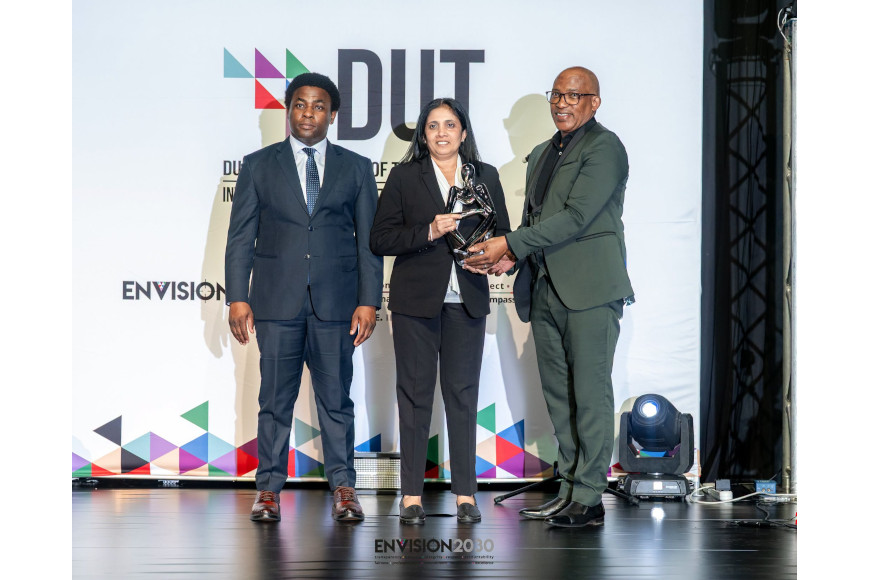
Pictured: Prof Sheena Kumari K Pillai, DUT water expert, pictured in the centre with Prof Fulufhelo Nemavhola, DVC: RIE, and Prof Thandwa Mthembu, Vice-Chancellor and Principal.
Photographer: S’bonelo Dlamini
Tiyani Mboweni.


