
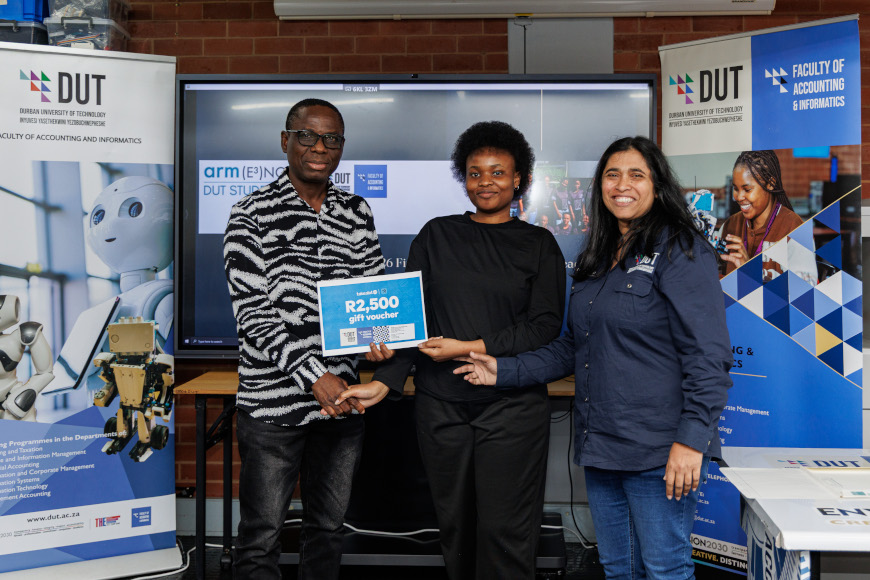
Dakalo Mutswaletswale has been named the inaugural champion of the Faculty of Accounting and Informatics Engineering Practice Innovation Project (FAI-EPIP) Student Challenge 2026, following the final held at the ARM Laboratory on DUT’s Ritson Campus on Tuesday, 29 September 2026.
Mutswaletswale claimed the overall title with Cyber Ready SA, a data analysis project examining cybersecurity readiness among small and medium-sized enterprises (SMEs) in South Africa. She also won the Data Analysis and Virtual Reality (VR) track, demonstrating how students can apply their academic knowledge to practical challenges.
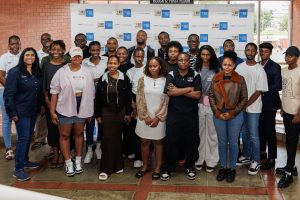
Executive Dean Prof Oludayo Olugbara joined EPIP representatives, judges, and students at the final EPIP Student Challenge.
The final featured nine finalists who progressed through the different stages of the competition, presenting their projects to a panel of judges comprising academics, industry professionals, postdoctoral fellows and students. The challenge forms part of the Faculty’s commitment to the EPIP model, which places practical experience, innovation, collaboration and problem-solving at the centre of student learning.
FAI-EPIP Student Coordinator and challenge host Kwanele Mazibuko, a Master’s student in Internet of Things, explained that the idea for the competition grew from her exposure to practical learning approaches during a data analysis and visualisation programme in China.
“I would like to make it my vision as well for our students to have something practical like that that we can do,” she said, reflecting on the inspiration behind the initiative.
The challenge was initially opened to students across DUT, with organisers targeting 210 participants. Following registration and the subsequent stages of the competition, nine finalists progressed to the final.
Before the presentations, FAI-EPIP Technical Champion Fanie Ndlovu introduced the EPIP vision and the people behind the initiative, highlighting the importance of preparing students for the world beyond university through practical learning.
Professor Oludayo Olugbara, Executive Dean of the Faculty of Accounting and Informatics and founder of the EPIP paradigm, explained that the model seeks to bridge the gap between acquiring knowledge and applying it to real-world problems.
He said traditional approaches to education often place considerable emphasis on examinations and academic performance, while EPIP encourages students to demonstrate what they can do with what they have learnt.
“Start with skill. And then when you can do something, you can explain what you have done,” he said.
Through experiential and project-based learning, students work on projects that can develop into products, services, research outputs and entrepreneurial opportunities. The model also encourages collaboration among students, academics, mentors and communities to address real-world challenges.
Prof Olugbara emphasised that practical skills and academic knowledge should be complemented by an entrepreneurial mindset, encouraging students to consider creating opportunities rather than focusing solely on finding employment.
“Practical skills with academic knowledge plus entrepreneurial mindset is what you need,” he said.
The nine finalists put this approach into practice through their project presentations, with the judges assessing their ideas and potential for further development. Beyond selecting the winners, the challenge also created opportunities for academic advancement. All nine finalists will be allocated supervisors to help them develop their projects into research papers, with the students expected to play a leading role in the publication process.
The winners were announced alongside additional awards recognising innovation, creativity, sustainability and research potential. According to Mazibuko, the finalists had not initially been informed that prizes would be awarded, making the announcement an unexpected highlight of the event.
Mutswaletswale received a R2,500 Takealot voucher for winning the overall challenge and the Data Analysis and VR track.
Meluleki Shandu was named the IoT and 3D Printing Track Champion and received a R1,500 Takealot voucher, while Xolile Zikhali won the Artificial Intelligence Track and received a R1,000 voucher.
Olwethu Ntshangase was named the Language Technology Track Champion. Makhosazane Sefako received the Best Research Potential award, while Tobias Eddie Mabilu won the Best Innovation, Creativity and Sustainability award. Both received R500 Takealot vouchers.
Reflecting on her achievement, Mutswaletswale said winning had been unexpected, although preparing and presenting her project had strengthened her confidence.
“It’s unexpected, but then while presenting, while preparing, I kind of already told myself, I’m going to take first place,” she said.
Cyber Ready SA focuses on collecting and analysing data to assess cybersecurity readiness among small and medium-sized enterprises in South Africa. Rather than concentrating on developing a website, Mutswaletswale focused on using data to generate insights that could support the project’s objectives.
FAI-EPIP Model Engagement Champion Ugeshni Moodley thanked the students, judges, mentors and organisers for their contributions to the inaugural challenge. She praised the finalists for remaining committed to their projects while balancing lectures, assignments and other academic responsibilities.
Moodley also recognised Mazibuko and Ndlovu for their work in taking the initiative from its early stages to the final. Their contribution was acknowledged with a special prize shared between them.
She said the challenge was part of the Faculty’s broader effort to strengthen practical learning, with the aim of helping students develop their ideas beyond prototypes and into research outputs and potential entrepreneurial ventures.
The next phase will see all nine finalists join the organising and execution team for the 2027 challenge. Organisers also intend to extend participation beyond DUT, creating opportunities for students from other universities to contribute their ideas and experiences.
For the inaugural finalists, the challenge therefore marks the beginning of another stage in their development. With supervision, mentorship and opportunities to turn their projects into research publications, they will continue building on the work presented at the ARM Laboratory.
As the FAI-EPIP Student Challenge prepares for its second year, its focus remains on encouraging students to move beyond theory, develop practical solutions and turn their ideas into work with the potential to make a difference.
Pictured: Executive Dean Prof Oludayo Olugbara with the Faculty’s Technician and Engagement Officer Ms Ugeshni Moodley congratulating Ms Dakalo Mutswaletswale who was named the inaugural champion of EPIP Student Challenge 2026.
Photographer: Mandisi Mvunelo.
Sinamile Sithole


