
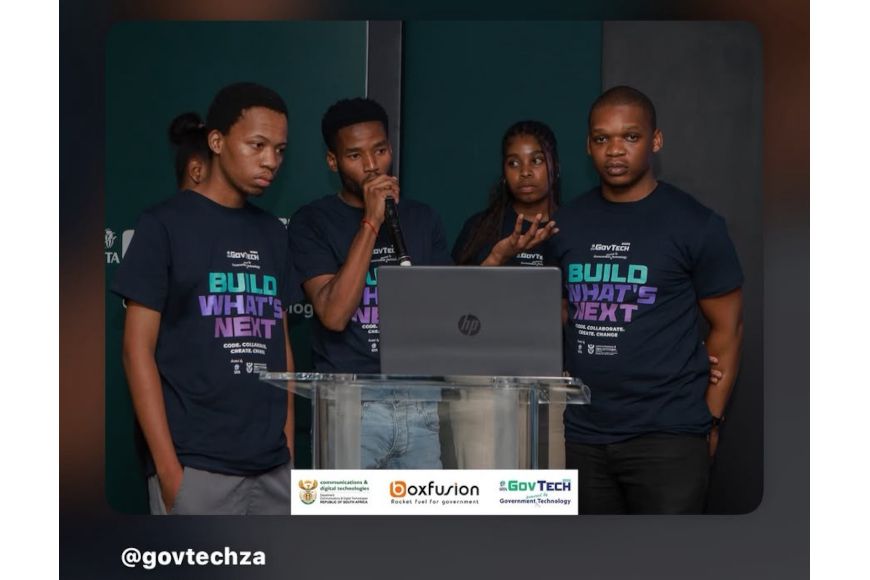
Once again demonstrating the power of innovation and collaboration, students from the Faculty of Accounting and Informatics (FAI) have emerged victorious at a national innovation competition, claiming first place at the GovTech Hackathon recently held at the Durban International Convention Centre.
The achievement adds to FAI’s growing record of success in innovation and technology competitions, with students continuing to turn their academic knowledge into practical solutions for real-world challenges.
Competing as the MAK DEE Group against 33 teams, the FAI students developed a digital solution aimed at strengthening reporting, monitoring and financial oversight within the public sector. Their achievement was formally recognised at the SITA GovTech 2026 Awards on 21 September 2026.
The team was challenged to find a way of strengthening reporting, monitoring and financial oversight within a government department. Their response was a digital platform designed to provide a more structured way of capturing, consolidating and presenting information to support oversight and decision-making.
The platform allows relevant organisations to submit information relating to financial performance, progress and reporting requirements, while authorised officials can access consolidated information through an oversight dashboard. It also flags matters requiring attention, helping officials identify areas that may require further review or action.
Rather than focusing on technology alone, the team first sought to understand the underlying problem and how a digital solution could make existing processes more structured and useful for decision-makers. This approach allowed the students to combine financial, governance, business-process and technology perspectives when developing their solution.
A key strength of the project was its interdisciplinary approach. The team brought together students from Financial Accounting and Information Technology, allowing them to draw on different areas of expertise. The Financial Accounting perspective contributed knowledge of financial reporting, accountability and controls, while the Information Technology students brought digital development and problem-solving skills.
The competition also gave the students an opportunity to apply what they had learned in their respective programmes to a real-world challenge. Their biggest challenges included understanding a complex public-sector problem within a short period, identifying the most important requirements and developing a solution that could realistically be demonstrated during the competition.
For Advanced Diploma in Accounting student Mohau Kabini, the opportunity to continue developing the solution following the competition is both exciting and significant.
“We were extremely excited because it meant that the project could potentially move beyond being a competition prototype. At the same time, we understood that it also brought greater responsibility,” said Kabini.
Kabini said the next phase will provide the team with an opportunity to engage further with stakeholders, refine the requirements, strengthen the technology and assess whether the solution can deliver meaningful value in practice.
For team leader Sicelo Mkhize, the experience extended beyond winning the competition. It demonstrated the value of applying classroom knowledge to real-world challenges and opened up new possibilities for how students can see themselves contributing to society and the workplace.
Reflecting on the experience, Mkhize said the competition showed that students do not have to wait until graduation or until they have years of professional experience before making a meaningful contribution to solving real-world problems. He added that the experience had expanded his thinking about his career and the opportunities that exist at the intersection of technology, finance, entrepreneurship and innovation.
He encouraged other young people to take advantage of opportunities such as the GovTech Hackathon, highlighting that competitions of this nature expose students to experiences that cannot always be recreated inside a classroom.
Echoing these sentiments, Professor Ferina Marimuthu, Head of Department of Financial Accounting, commended the team for their visionary approach.
“This outstanding achievement underscores the immense value of bridging accounting theory with real-world technological solutions. In an era where governance, transparency, and accountability are paramount, seeing our students collaborate across disciplines to build a tool that strengthens public-sector oversight is truly inspiring. Mohau and the entire MAK DEE team have demonstrated that when accounting acumen meets digital innovation, our students can drive transformative change well before they graduate. We are exceptionally proud of their dedication and look forward to seeing this platform evolve to make a tangible impact in our communities and public institutions.”
Similarly, the Head of the Department of Information Technology congratulated the students on securing first place at the GovTech Hackathon 2026. He noted that their achievement reflected innovation, teamwork, dedication and the successful application of academic knowledge to solve real-world challenges. He expressed pride in their success and commended the manner in which they had represented the Department of Information Technology, the Faculty of Accounting and Informatics, and the Durban University of Technology. He further wished the team continued success as they advance the project and continue making a meaningful impact through technology and innovation.
Adding to this, Freedom Khubisa, a lecturer in the Department of Information Technology, highlighted the importance of competitions such as the GovTech Hackathon 2026 in preparing students for industry.
“Competitions such as the GovTech Hackathon provide an invaluable opportunity for students to experience the demands of real-world software development. Working under pressure, collaborating across disciplines, managing competing requirements and delivering a functional solution within a limited timeframe are competencies highly valued in the technology industry. Their success reinforces our commitment to developing graduates who are not only technically capable but also adaptable, innovative and prepared for the professional environment,” said Khubisa.
The team will now move towards a more structured development and pilot process, which is expected to include stakeholder engagement, refinement of the system architecture and workflows, consideration of information-security and governance requirements, user testing and the incorporation of feedback.
The winning team comprises Kabini from the Department of Financial Accounting, together with Information Technology students Sicelo Mkhize, Nondumiso Ncgcobo, Owethu Hlongwane and Nomvelo Ndlozi from the Department of Information Technology.
The achievement is another example of FAI students using interdisciplinary collaboration to move beyond theoretical learning and apply their knowledge to real-world challenges. For the team, the victory demonstrates the value of creating opportunities for students from different fields to work together towards a common objective.
With the project now moving beyond the competition environment, the students have an opportunity to further develop their solution while gaining practical experience in innovation, technology and public-sector problem-solving.
Pictured: Members of the MAK DEE Group presenting their hackathon solution at the GovTech competition.
Picture: Supplied
Sinamile Sithole


