
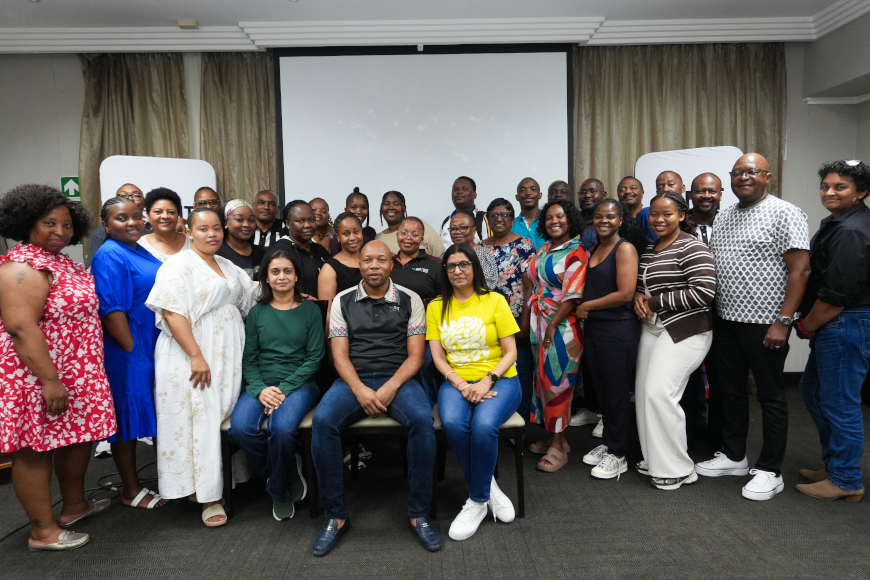
The People and Operations Division at the Durban University of Technology (DUT) held a two-day planning workshop from 1 to 2 October 2026, setting the foundation for its priorities and plans for 2027.
The workshop followed Council’s approval of the Extended Annual Performance Plan (EAPP) at its meeting on 19 September 2026 and provided an opportunity for the Division to reflect on its 2026 performance while preparing for the year ahead.
In 2026, the Division used Strategic Objective 7, Distinctive Education, as the overarching framework for its activities. This reflected the collective responsibility of its various units to cultivate a human face at DUT and create an environment in which students, staff and Council members choose to engage with the University by design, rather than by default.
The approach was also aimed at laying a strong foundation for a transformative People and Operations Division as DUT moves into the Transformed Phase of ENVISION2030 in 2027.
Themed “From Strategy to Execution”, the workshop brought together leaders of business units, their direct reports and secretaries.
Opening the session, Acting Deputy Vice-Chancellor: People and Operations, Dr David Mohale, explained that the broader composition of participants was informed by the principles of scenario planning. The approach brings different perspectives into the planning and ideation process, regardless of formal hierarchy.
Dr Mohale also emphasised the strategic role of secretaries, noting that their contribution extends beyond providing administrative support to managers. By involving them in strategic discussions and decision-making processes, they are better positioned to understand the priorities of their managers and contribute meaningfully to their implementation.
The two-day engagement also provided an opportunity for participants to assess the Division’s performance in 2026. Of the 39 commitments recorded in the EAPP, 16 have been completed and are progressing well, 11 are partially progressing, three have shown insufficient progress, while nine have no record or reporting.
The assessment was used as a starting point to encourage collective accountability and identify areas requiring greater attention.
Beyond the commitments contained in the EAPP, the Division highlighted a number of initiatives and interventions undertaken during the year. These included the Young Workers Webinar and the Institutional Lecture, which provided platforms to explore and advance the concept of Distinctive Education.
The Division also reported progress in reducing vacancies and addressing audit findings. Consequence management was implemented during the year, contributing to a significant reduction in emergency procurement transactions compared with previous years. Improvements were also made in ensuring that the University is charged according to the correct bill of quantities.
Each unit was tasked with outlining its contribution to the achievement of the University’s statement of intent as articulated in ENVISION2030. Participants demonstrated how their plans, initiatives and day-to-day operations support the broader institutional vision and contribute to the delivery of the University’s strategic objectives.
The first session of day one was facilitated by Ms Helen Mogorosi, Director: Organisational Development and Talent. She reminded participants that 2027 marks the first year of the Transformed Phase of ENVISION2030 and encouraged active participation throughout the planning process.
Discussions focused on the University’s strategic context, with particular emphasis on Stewardship and Systems and Processes as key enablers of institutional success.
Ms Yvonne Nhlapo, Institutional Planning Analyst, provided an overview of the University’s performance, highlighting key achievements, outstanding commitments, performance gaps and lessons that could inform the 2027 planning process.
Building on this presentation, Dr Kavita Beemsen, Senior Director: IPME, unpacked the pre-work methodology and the use of common planning templates. She also provided an overview of the ENVISION2030 strategic perspectives and highlighted the mindset and operational shifts required as the University moves into the Transformed Phase.
Closing the two-day engagement, Dr Mohale emphasised the important support role played by the People and Operations Division in enabling the University to deliver on its academic project.
He noted that by convening the planning session early in the first quarter, the Division is now in a stronger position to begin the 2027 individual contracting process during the current year.
This was one of his key aspirations when he took over the portfolio in January, and he thanked the team for their commitment and hard work in making this possible.
The early planning process is one of several ways in which People and Operations is seeking to demonstrate new and transformative ways of working while setting an example for the broader University.
Pictured: Attendees at the two-day planning workshop.
Nikiwe Sukazi


