
The Department of Human Resource Management (HRM) at Durban University of Technology (DUT) recently hosted its 3rd Annual Work Integrated Learning (WIL) Excellence Awards at Ritson Hall, Ritson Campus.
The awards recognise the contribution of host companies and mentors who supported DUT students during their WIL placements in 2025, providing them with practical workplace experience and opportunities to apply what they have learnt in the classroom.
The ceremony was officially opened by Professor Matthys Swanepoel, who welcomed industry partners from both the private and public sectors, as well as other guests.
Professor Swanepoel spoke about the important role mentors play in helping students transition from university into the workplace. Reflecting on his own experience, he shared a lesson from his former supervisor, who encouraged him not to be afraid of change, new challenges or new technologies, and to apply his mind.
“That is all part of the work that a mentor does. You have to take people out of university who might have all the technical knowledge and give them real life experience and tell them, this is the way, you will apply your knowledge,” said Professor Swanepoel.
He thanked the WIL partners for opening their workplaces to DUT students and for the role they play in preparing students for the world of work.
Mrs Mercillene Matthews addressed the guests on behalf of the Head of Department for Human Resource Management, Dr Wiza Munyeka. She expressed appreciation to the industry partners for their continued contribution to the WIL programme.
“We look forward to growing our partnership as we try to achieve not only DUT’s ENVISION2030, but also as we try to uphold the Living Values Framework of the Durban University of Technology,” said Mrs Matthews.
She also conveyed Dr Munyeka’s gratitude to the WIL partners for opening their organisations to DUT students and contributing to their development.
Dr Nojiyeza from the DUT Business School delivered a message of support, thanking employers and mentors for their contribution to student employability. He said the partnership between universities and industry helps students develop the competencies, knowledge and practical skills needed to build successful careers.
“The type of skill that we teach as an institution and the type of skill that you require there must be that synergy between what we are teaching as academics and what you need as the industry in terms of practical exposure,” said Dr Nojiyeza.
DUT alumnus and AmaZulu representative, Mr Philani Ndlela, delivered the keynote address. Reflecting on his first year at DUT, he shared a message that was displayed on the door of his residence room: “Be nice to people on your way up, because you might need them on your way down.”
Ndlela spoke about the importance of WIL placements in giving students an opportunity to experience the workplace, apply what they have learnt and understand the expectations of their chosen professions.
“A classroom can teach a student the principles of communication, but the workplace teaches that student how to communicate with a frustrated client and remain professional under pressure,” Ndlela said.
He said strong partnerships between institutions and companies give students a more complete educational experience.
“When institutions and companies work together consistently, students benefit from a more complete and meaningful educational experience. They don’t just graduate with certificates. They graduate with stories of what they have done, challenges they have overcome and evidence of what they can contribute.”
Ndlela encouraged companies to view WIL placements as more than a social responsibility initiative, but as an investment in the future of their organisations and industries.
“By hosting students, employers help to develop the next generation of professionals. They also gain an opportunity to identify talented individuals who will become leaders and innovators,” he said.
The value of WIL was also demonstrated through the experiences of two DUT students, Mr Lwazi Mtshali and Mr Akhile Xulu, who shared testimonies from their placements in the private and public sectors respectively. Both students secured permanent positions after completing their WIL placements with their respective host organisations.
The HRM WIL Excellence Awards also introduced three new categories aimed at recognising organisations that have made a significant contribution to student placement and employment. The categories considered factors such as the number of students placed and the absorption of students into permanent positions or contracts following their placements.
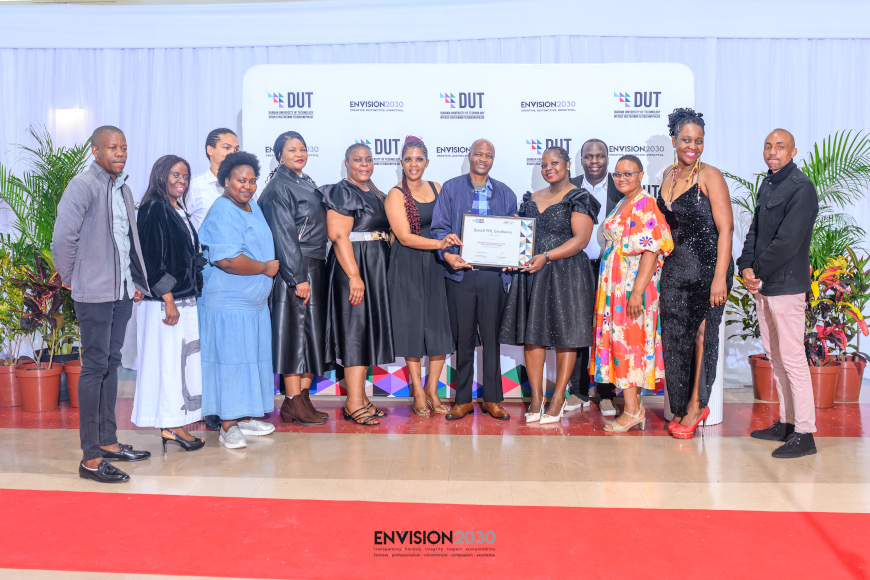
The Distinct Public Sector Excellence Award was presented to the KwaZulu Natal Department of Agriculture and Rural Development, KwaZulu Natal Department of Health, District Office, and eThekwini Municipality, HCCE.
The Creative Private Sector Excellence Award was presented to Netcare Group and Pedros Chicken.
The Impact Newcomer Award was presented to Mdalisu and Icebolethu Group.
The ceremony concluded with a vote of thanks from Dr Sifiso Myeni, who expressed appreciation to the WIL stakeholders, DUT colleagues and the WIL team, led by Dr Tatenda Chikukwa, for their contribution to the success of the awards.
The 3rd Annual WIL Excellence Awards highlighted the importance of sustained partnerships between DUT and industry in preparing students for the workplace and creating pathways from practical learning into employment.
Pictured: The KwaZulu Natal Department of Agriculture and Rural Development team receiving the Distinct Public Sector Excellence Award.
Photographer: S’bonelo Dlamini.
Nosihle Mthembu


