The Durban University of Technology recently hosted the Inaugural Lecture of Professor Nalindren Naicker at DUT’s Hotel School, Ritson Campus, an occasion marked by creation, perseverance, and intellectual excellence.
The ceremony commenced with opening remarks from Professor Siphamandla Ncube welcoming distinguished guests, members of the University executive, staff, students, friends and the family of Professor Naicker to witness this significant academic milestone.
Setting the tone for the important event, the Programme Director, Professor Tlou Masenya, invited guests to reflect on the true meaning of professorship, posing the profound question “What exactly does it mean to be a full professor?”
The address challenged typical perceptions of the title. Is it merely about reaching an academic destination? Is it measured by publishing a greater number of research papers, mentoring and supervising the next generation of scholars, or having piles of books overflowing to the point where even weekends turn into working days?
She concluded that being a professor is far more than a triumph in academics; it is a calling. As she eloquently stated, “When scholarship becomes a calling, knowledge becomes a seed, mentorship provides nourishment, and future generations become the intellectual forest that grows from it.”
The formal introduction of the inaugural lecturer was delivered by Professor Oludayo Olugbara, Faculty Head of Accounting and Informatics.
Professor Olugbara stated that the occasion celebrates not only Professor Naicker’s promotion to Full Professor, but also a distinguished body of work in Information Systems and significant contributions to society.
He described the celebration as one of intellectual leadership, relentless curiosity and sustained commitment to the pursuit of knowledge and skill.
Tracing Professor Naicker’s academic journey, Professor Olugbara highlighted that Professor Naicker joined the University in 2010 as a lecturer in Information Technology. Over the years, he rose to become the academic head of the Department of Information Systems, NRF C2-rated researcher and now Full Professor.
His academic work, Professor Olugbara stated, has not only expanded the frontiers of scholarship through impactful research on intelligent web and mobile applications and transformative methods in cloud computing, but has also deeply impacted students, the University and the broader community.
Through his inspiring list of publications and mentorship roles, Professor Naicker embodies the true spirit of academic integrity, industry collaboration and public service. Professor Olugbara then invited Professor Nalindren Naicker to the podium to deliver his inaugural lecture.
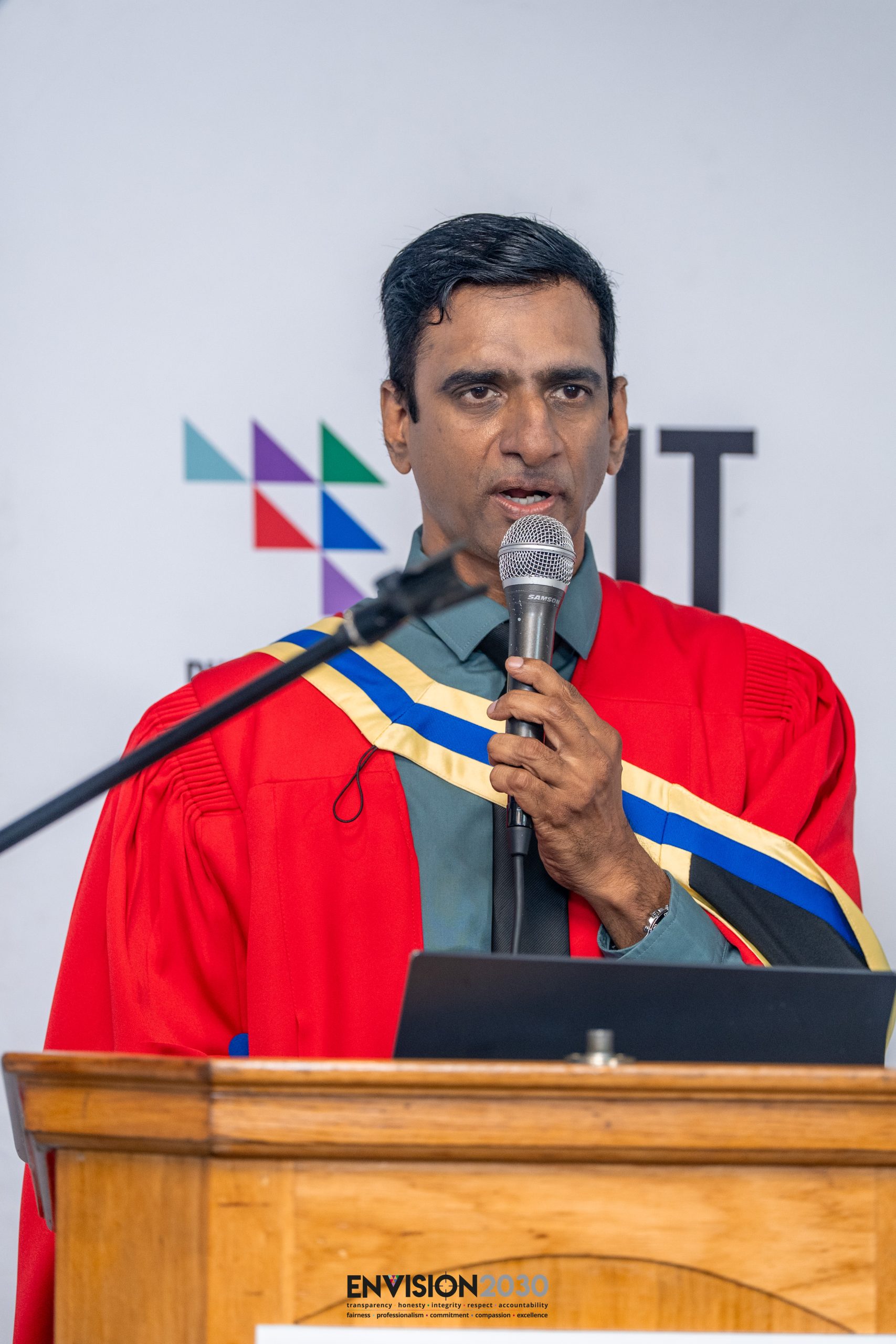 Professor Naicker sees himself as both a scientific researcher and a software engineer. His academic research and areas of interest lie in Information and Communications Technology.
Professor Naicker then outlined his lecture, which covered his teaching and learning philosophy, his publications, his research-based software development projects, data bias, which he noted is prevalent in AI today, future predictions for data, and finally acknowledgements.
On his teaching and learning philosophy, Professor Naicker explained that he adopted a philosophy of “engineering practice of innovation project”, which represents a shift from traditional teaching methods towards a practice-based, innovation-driven approach.
In demonstrating his research application, Professor Naicker explained how topic modeling could be done using a computer science algorithm. The algorithm was able to produce helpful analytics on a collection of documents and is thoroughly useful for systematic reviews. Showing its practical use, he explained an example using his own research on industrial wastewater. He outlined the process, which involves shortlisting a collection of documents and then subjecting it to the algorithm. The outputs included a donut chart showing topic composition by percentage, a visualisation of topic overlap, defining keywords for each topic, corresponding word clouds, and a breakdown of how each paper distributes across topics, leaving it to the researcher to interpret the emerging themes. He then detailed the underlying data engineering pipeline, where data in different formats is ingested into a data lake comprising raw and curated folders before moving into staging tables for modelling and analysis through ETL (Extract, Transform and Load) beginning with an initial full load followed by periodic incremental loads capturing only changed data.
For warehousing, his work adopts the Kimball model, which involves selecting business processes, declaring the grain, and identifying dimensions and facts using a star schema with a central fact table and peripheral dimensional tables. To illustrate the practical application, he referenced the Seta Data Lakehouse Project for MICT SETA, which followed a data refinement theory of data injection, preparation, modelling, meaning extraction, analytics and delivery, and employed a three-tier client-server architecture with React for front-end for reports. This solution, built for MICT SETA, was presented in Cape Town on 29 May to the Honourable Minister of Higher Education and is now being expanded to onboard other post schooling education and training sectors onto a single unified platform. Prof Naicker predicts in the information age more and more data is being stored on the cloud. The astronomical rise of big data will make data engineering a niche and in demand discipline for students to follow.
In his closing remarks, Deputy Vice-Chancellor: Research, Innovation and Engagement Professor Nemavhola, on behalf of the university, thanked Professor Naicker for sharing his scholarship, describing the lecture as an enjoyable and insightful session that highlighted the practical application of knowledge to solve real world challenges.
Recognising the commitment required in academia and the support of Professor Naicker’s family, “Professorship can be very demanding at times, you know, sometimes we use our weekends, holidays, and sometimes we neglect even family time,” Professor Nemavhola acknowledged.
He further thanked guests, colleagues and students for their presence and thoughtful attention, and encouraged continued dialogue and collaboration.
“I’d like to encourage that we keep this conversation going through your collaborations. A question that we’ve raised tonight may become new research ideas as we move forward.”
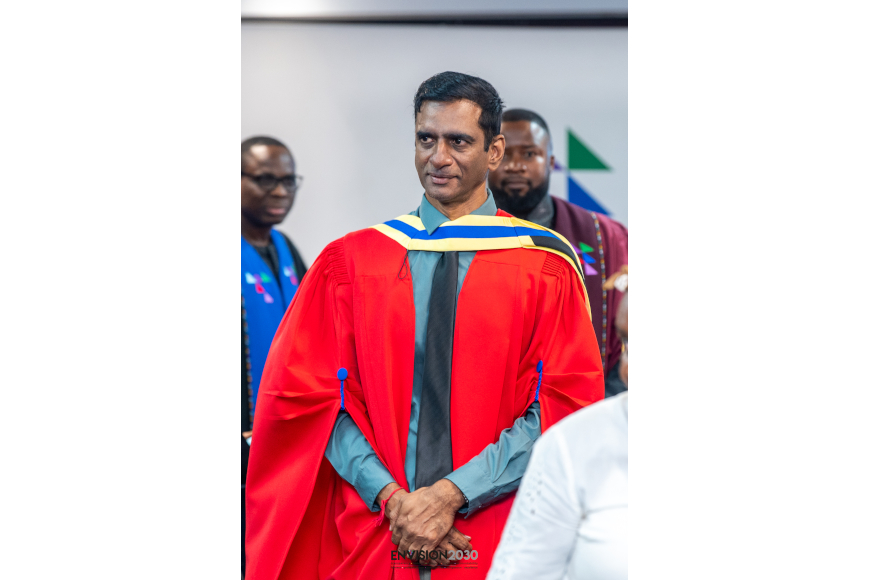
Pictured: Professor Nalindren Naicker
Nosihle Mthembu


