
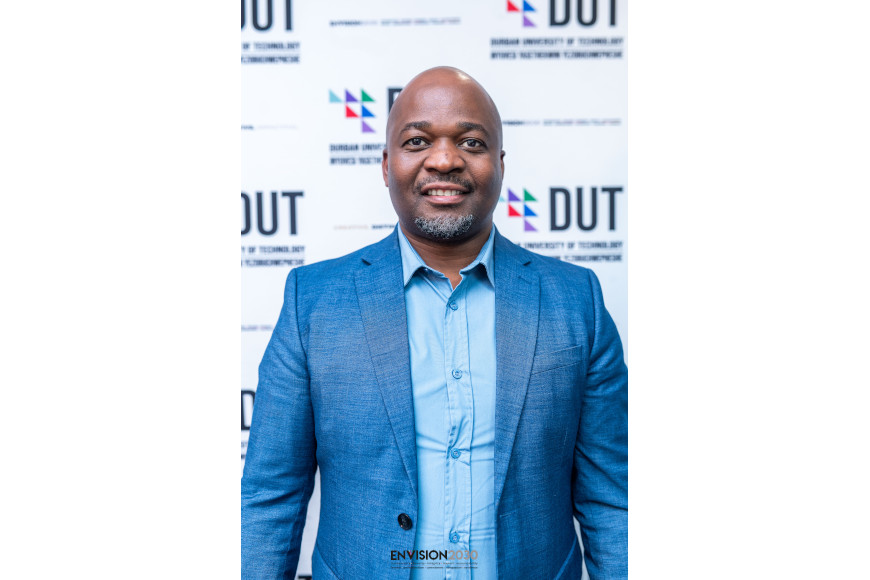
The ability to detect and remove harmful pollutants from water is essential to protecting environmental health and safeguarding water resources. At the Durban University of Technology (DUT), Professor Somandla Ncube is investigating how specialised materials known as molecularly imprinted polymers could contribute to more precise pollution monitoring and remediation.
Professor Ncube, a Professor of Environmental and Analytical Chemistry in DUT’s Department of Chemistry, will explore this research in his inaugural lecture, titled “From Pollution to Precision: Harnessing Imprinted Polymers for Environmental Solutions”, on Monday, 26 October 2026.
Molecularly imprinted polymers are specially designed materials that can selectively recognise and capture particular chemical substances. This makes them promising tools for detecting specific pollutants, including those present at very low concentrations in complex environmental samples. By improving the selective extraction and detection of contaminants, these materials could contribute to more targeted approaches to environmental monitoring.
Professor Ncube’s research focuses on contaminants of emerging concern in aquatic environments and food sources, including pharmaceutical residues, pesticides and per- and polyfluoroalkyl substances (PFAS). These substances present analytical challenges because researchers need reliable methods to identify and measure them in complex samples.
One example of this research is a published study investigating the removal of efavirenz, a pharmaceutical compound, from wastewater using a hybrid material combining a magnetic molecularly imprinted polymer and titanium dioxide. The research explores the potential of combining selective contaminant capture with photocatalytic degradation, an approach that uses light-driven processes to break down pollutants.
This work illustrates the broader direction of Professor Ncube’s research, which extends beyond identifying contaminants to investigating technologies that could support their removal. However, translating laboratory research into practical environmental applications requires further consideration of performance, reliability, sustainability and the conditions under which these technologies can be used effectively.
“Environmental pollution requires more than identifying contaminants. We need reliable and selective methods that help us understand the risks and develop practical solutions to protect our water resources and the environment.”
During his inaugural lecture, Professor Ncube will examine the scientific principles behind molecularly imprinted polymers, their potential applications and the challenges involved in translating laboratory innovations into practical environmental solutions. The lecture will also consider the importance of analytical reliability, material selectivity and sustainability in developing approaches that contribute to environmental protection.
“Through research in molecularly imprinted polymers, we are exploring ways to move beyond simply detecting pollutants towards more targeted approaches to environmental monitoring and remediation. The challenge is to translate scientific advances into solutions that can deliver meaningful environmental and societal benefits.”
“In South Africa, protecting water resources requires us to understand not only the pollutants we can readily detect, but also contaminants that occur at very low concentrations. Research into selective detection and remediation methods can help strengthen the scientific evidence needed to address these challenges.”
Beyond pollution monitoring, Professor Ncube’s research also explores the use of artificial intelligence and machine learning to improve analytical methods, supporting more efficient and data-driven scientific investigations. Through his research and postgraduate supervision, he contributes to developing scientific expertise in environmental monitoring, analytical chemistry and pollution remediation.
Professor Ncube joined DUT in November 2022 as a Senior Lecturer and was promoted to Professor of Environmental and Analytical Chemistry in December 2025. He holds a Master of Science in Chemistry, awarded cum laude in 2016, and a PhD in Chemistry, obtained in 2018, from the University of the Witwatersrand. He has a C3 rating from the National Research Foundation and is registered with the South African Council for Natural Scientific Professions.
The inaugural lecture will take place at the DUT Hotel School, Ritson Campus, at 17:30 for 18:00. It will also be livestreamed on the DUT Multimedia Department’s YouTube channel
Pictured: Professor Somandla Ncube.
Tiyani Mboweni


