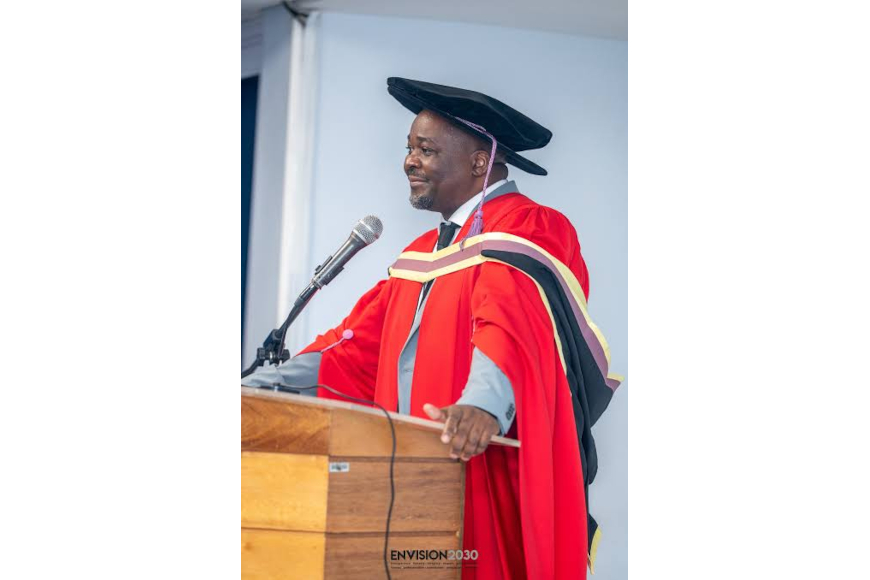
Analysing and remediating water contamination across natural and engineered systems forms the core of Professor Somandla Ncube’s academic vision. A Professor of Environmental and Analytical Chemistry in the Department of Chemistry at the Durban University of Technology (DUT), Professor Ncube officially marked his transition to full professor by delivering his inaugural lecture, titled “From Pollution to Precision: Harnessing Imprinted Polymers for Environmental Solutions.”
The prestigious event took place at the DUT Hotel School, Ritson Campus, on Monday, 26 October 2026.
The sterling lecture highlighted the potential of molecularly imprinted polymers (MIPs) to transform how environmental contaminants are selectively detected, monitored, and removed, while illustrating the broader, vital role of chemistry in responding to pressing global environmental challenges.
The evening was guided by Programme Director Dr Pinkie Ntola, the Interim Director of Technology Transfer and Innovation (TTI). As a past researcher and collaborator in the water research sector, Dr Ntola fondly reflected on her time working alongside Professor Ncube.
“I truly appreciate the importance of his work in advancing research on water quality, wastewater treatment, and overall environmental sustainability,” she shared warmly.
In his welcome remarks, Professor Fulufhelo Nemavhola, Deputy Vice-Chancellor for Research, Innovation, and Engagement (DVC:RIE), extended his warmest congratulations, focusing on Professor Ncube’s indelible mark as an educator.
“Mentorship is an act of intellectual generosity,” Professor Nemavhola stated.
“It requires us to cultivate minds capable of exceeding our own horizons. The students you guide will carry your influence into questions, institutions, and circumstances you may never encounter. Their independence will become an enduring testament to your mentorship.”
He concluded with inspiring words to Professor: Mncube, saying: “As you mark this milestone, may distinction deepen your curiosity and accomplishment preserve your capacity for wonder. May your growing authority remain accompanied by epistemic humility, the wisdom to recognise the limits of what one knows. Above all, may your scholarship continue to unite intellectual audacity with humane purpose.”
Introducing the inaugurand, Professor Tukayi Kudanga, Acting Executive Dean of the Faculty of Applied Sciences, described him as a scholar of exceptional focus. “The scientist we honour is, above all, a chemist of precision, a researcher who has made it his life’s work to find what others cannot see,” he shared.
He mapped out Professor Ncube’s rapid academic ascent, noting that he obtained his Master of Science in Chemistry cum laude in 2016 and his Doctor of Philosophy in 2018, both from the University of the Witwatersrand (Wits). His doctoral research laid the groundwork for his current expertise, focusing on novel extraction techniques to isolate polycyclic aromatic hydrocarbons in wastewater and sludge.
Today, Professor Ncube is a registered scientist with the South African Council for Natural Scientific Professions (SACNASP) and was recently awarded a C3 rating by the National Research Foundation (NRF), cementing his status as an established researcher with a proven track record of quality scholarship. His prolific portfolio includes 4 book chapters and 55 peer-reviewed articles in top-tier Q1 and Q2 journals spanning environmental science and pollution management. To date, his work has garnered over 2,500 citations, yielding an impressive h-index of 28 on Google Scholar.
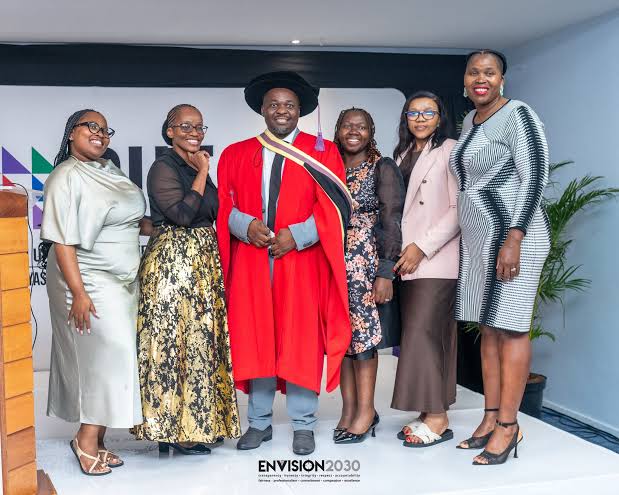 Professor Kudanga also emphasised Ncube’s dedication to capacity building. By supervising students across complex domains like pharmaceutical pollution and smart materials, he actively equips the next generation of scientists with the critical-thinking skills required to develop evidence-based environmental solutions.
Taking the podium, Professor Ncube detailed the progression of his research on what happens to the pollutants that enter rivers, and how can science use these same systems to engineer solutions.
“Environmental pollution presents a persistent challenge to water security and public health,” Professor Ncube explained.
“Conventional monitoring approaches face increasing demands to detect contaminants occurring at trace concentrations in highly complex environmental matrices.”
His research champions the use of Molecularly Imprinted Polymers (MIPs). Describing them, he explained, “These tailor-made synthetic materials are designed to recognise and selectively bind specific target molecules, much like a lock recognises its matching key. They enable us to move away from indiscriminate pollutant capture and toward highly selective environmental monitoring and remediation.”
Demonstrating his commitment to his students, Professor Ncube shared the spotlight with the next generation of researchers he has mentored. He highlighted the work of his graduated PhD students, Dr Sinegugu Khulu who developed an MIP-based passive sampler to monitor pharmaceuticals in surface water, as well as Dr Bonke Mahlangu’s innovative, Artificial Intelligence (AI)-driven reaction models.
Looking ahead, Professor Ncube revealed that the future of his research lies in transitioning from traditional laboratory frameworks toward Artificial Intelligence (AI) and Machine Learning (ML)-driven system designs. This cutting-edge shift is already underway through international collaborations, most notably with Professor Stanislaw Waclawek and Mohammad Gheibi of the Technical University of Liberec in the Czech Republic.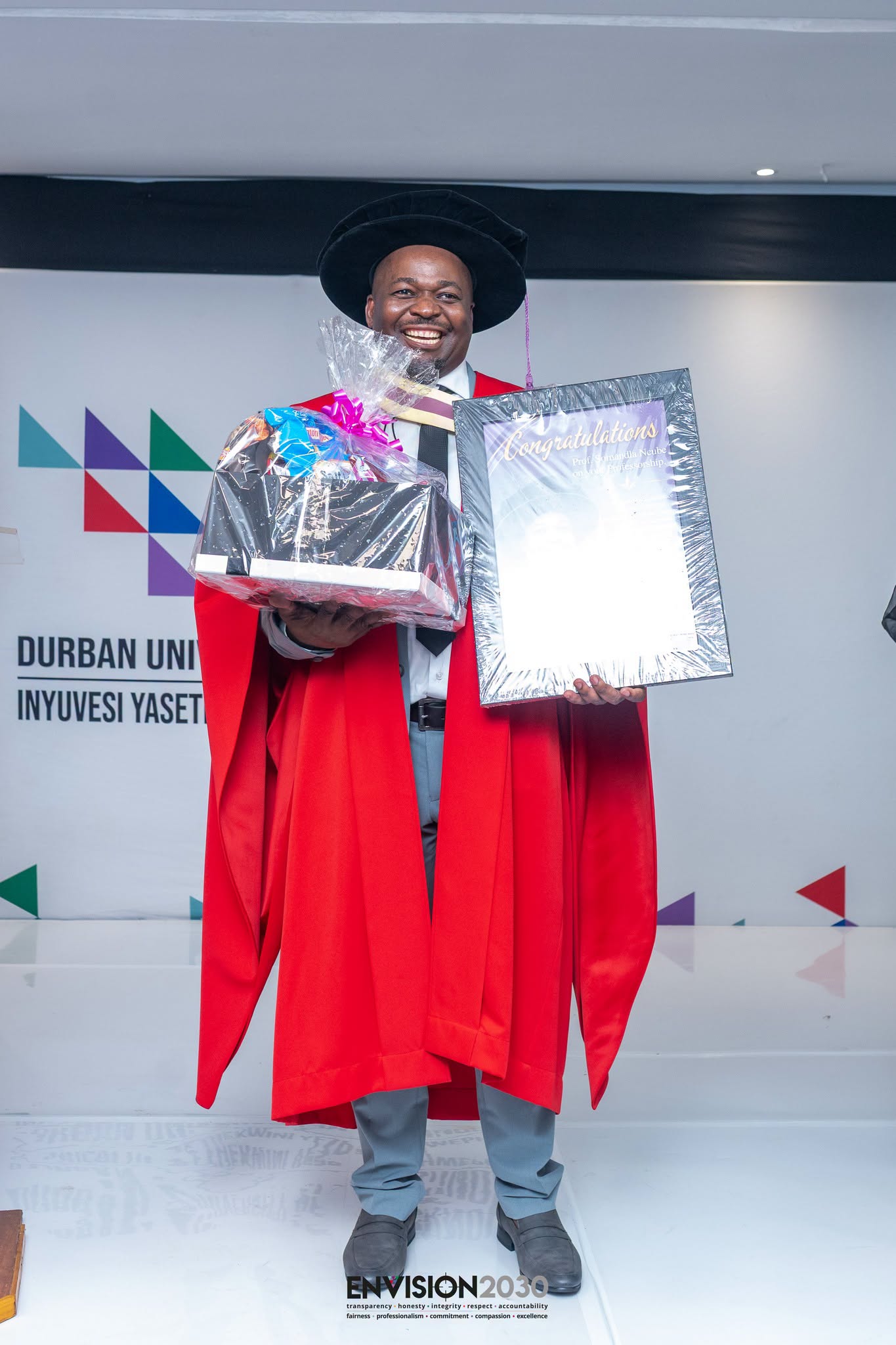
“These partnerships extend beyond direct collaborations,” Ncube noted. “They bring together broader networks of researchers, strengthening opportunities for interdisciplinary research, postgraduate co-supervision, international funding, and joint knowledge exchange.”
Professor Ncube concluded his lecture by expressing deep gratitude to his mentors, his institutional and global colleagues, and his family, paying a special tribute to his dynamic mother, who helped pave the path for his remarkable success.
Closing the evening, Professor Makwena Justice Moloto, Acting Head of the Department of Chemistry, thanked the university executive, staff, and students for gathering to celebrate their colleague.
“This exceptional advancement speaks volumes about his consistent hard work, unparalleled work ethic, and immense dedication to environmental analytical chemistry,” he said.
Professor Moloto said that the entire DUT Department of Chemistry community celebrates this monumental achievement. He expressed that Professor Ncube’s academic leadership and scientific breakthroughs continue to elevate the stature of the university.
Pictured: Professor Somandla Ncube
Waheeda Peters


