
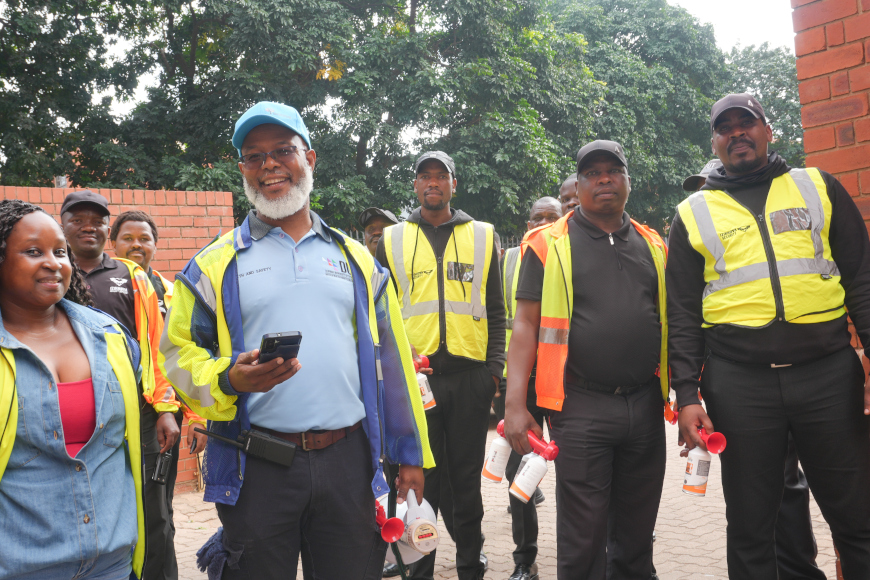
The Protection Services Unit at the Durban University of Technology (DUT) conducted a fire drill at the Steve Biko and Ritson campuses, aimed at strengthening fire safety awareness and assessing the university’s readiness to respond effectively to an emergency.
The drill brought together students, staff, visitors and contractors, with the participation of the Durban Metro Police, who assisted with escorting participants and maintaining safety measures during the exercise.
The fire drill was designed to familiarise members of the DUT community with emergency evacuation procedures, including emergency exits, escape routes, assembly points and the roles of emergency personnel. Fire drills are conducted throughout the year to provide students, staff and visitors with an opportunity to practise evacuation procedures and become familiar with appropriate emergency responses.
Due to the size and layout of the buildings, the exercise at Ritson Campus was conducted in two groups to facilitate an orderly evacuation. The first group evacuated towards the eastern direction, completing the evacuation in approximately 10 minutes, while the second group, which assembled near the Faculty of Accounting and Informatics building, evacuated towards the western direction in approximately 15 minutes.
Commenting on the significance of the exercise, Mr Lehlohonolo Mokhohlouloane, Specialist: Safety, Health and Environment, said the drill had several objectives, including ensuring a safe and orderly evacuation, familiarising occupants with emergency procedures and assessing the effectiveness of the university’s emergency response plan.
The exercise also assessed coordination between Protection Services, health and safety officers, fire wardens and emergency services, while measuring evacuation times and identifying areas for improvement. It further sought to promote fire safety awareness and reinforce the importance of following emergency instructions and complying with occupational health and safety requirements.
The Health and Safety team also incorporates evacuation training into staff inductions, student orientations and contractor safety briefings. Evacuation support plans are in place for people with disabilities, visitors and individuals who may require additional assistance.
DUT has also implemented evacuation maps, emergency exit signs, assembly point information and safety notices across classrooms, offices, laboratories, residences and public areas to assist members of the university community during an emergency.
According to Mokhohlouloane, the fire drill met his expectations, with the majority of DUT staff members responding positively to the exercise.
“We normally time ourselves between seven to 10 minutes, though we understand that the size of our buildings may contribute to the time taken,” he said.
He added that drills such as these are important in identifying areas that may require further attention and ensuring that members of the university community understand their responsibilities during an emergency.
Mokhohlouloane thanked the Durban Metro Police and the South African Police Service (SAPS) for their contribution to the exercise. He said their assistance included monitoring traffic movement on the roads and within the Ritson Campus, as well as helping to maintain security during the drill.
The exercise forms part of DUT’s ongoing efforts to strengthen emergency preparedness and promote a safe learning, working and living environment for students, staff and visitors.
Pictured: The Protection Services Team during the fire drill.
Nikiwe Sukazi


