
The Durban University of Technology (DUT) has made a significant improvement in the Times Higher Education (THE) World University Rankings 2027, moving up 209 places globally and strengthening its position among universities worldwide and being ranked in the Top 10 in South Africa.
DUT is now ranked in the 1201 to 1400 band, improving from the 1501+ band in the previous ranking. The movement places DUT at number nine amongst all South African universities.
DUT has also recorded a 5-point improvement in its overall score, with research performance accounting for 78% of the gain.
The result comes as DUT continues to strengthen its research and innovation profile. It follows the University’s third consecutive National Research Foundation (NRF) Focused Research Advancement Award in 2026, where DUT emerged as the top achiever among Universities of Technology. The award recognises sustained growth in research productivity and research support over a five-year evaluation period, including doctoral staff capacity, postgraduate outputs, research productivity, NRF investment and growth in NRF-rated researchers.
DUT’s research capacity has also expanded significantly. The University now has 11 South African Research Chairs Initiative (SARChI) Chairs, covering areas including sustainable protein innovation, wastewater treatment and reuse, smart manufacturing, inclusive entrepreneurship, social justice and education, bipolarization, digital transformation and sustainable construction and infrastructure development.
The University will further strengthen this research ecosystem today, 30 September 2026, with the official launch of 18 new Research Institutes alongside its 11 SARChI Chairs.
The launch event brings together DUT researchers, academic leaders, industry partners, government representatives, students and other stakeholders. The new Research Institutes will provide platforms for collaboration across disciplines and support research that responds to regional, national and global challenges.
The ranking improvement comes against this backdrop of continued investment in research and innovation. Research metrics contributed 3.9 points to the University’s overall improvement, accounting for 78% of its total score gain. Research Quality increased by 2.3 points, while Research Environment improved by 1.6 points.
One of the most notable improvements was in citation impact. DUT’s Citation Impact Score increased from 30.1 in 2026 to 36.2 in 2027, an improvement of 6.1 points. The University’s Field Weighted Citation Impact stood at 1.15, compared with a world median of 1.24.
Research productivity also emerged as a key contributor, with DUT recording a score of 65.8 and an improvement of 1.4 points.
DUT Deputy Vice-Chancellor: Research, Innovation and Engagement, Professor Fulufhelo Nemavhola, said the ranking movement is an encouraging indication of the progress being made in research and innovation at the University.
“The positive movement in the Times Higher Education World University Rankings is an encouraging indication of the progress being made in research and innovation at DUT. The fact that research metrics contributed 78% of our overall score improvement is particularly significant and reflects the work of our researchers, postgraduate students, supervisors, faculties, Research Institutes, SARChI Chairs and professional support teams,” said Professor Nemavhola.
He added, “Our three consecutive NRF Focused Research Advancement Awards, the growth of our SARChI Chairs and the establishment of our new Research Institutes are important milestones in strengthening our research capacity. As we continue to implement ENVISION2030, we will strive to focus on research excellence, developing the next generation of researchers and building partnerships that increase the impact and visibility of our work.”
The latest results also show progress beyond research. Teaching increased by 1.0 point, while the Industry pillar improved by 0.3 points. DUT also recorded scores above the world median in several individual metrics, including institutional income, international staff, research productivity, international co-authorship, doctorate staff ratio, research influence and industry income.
The 2027 ranking reflects the progress being made in strengthening DUT’s research and innovation capacity, while highlighting areas where further work is needed. The University’s global ranking movement, continued NRF recognition, 11 SARChI Chairs and the launch of 18 new Research Institutes mark an important period in the growth of its research profile.
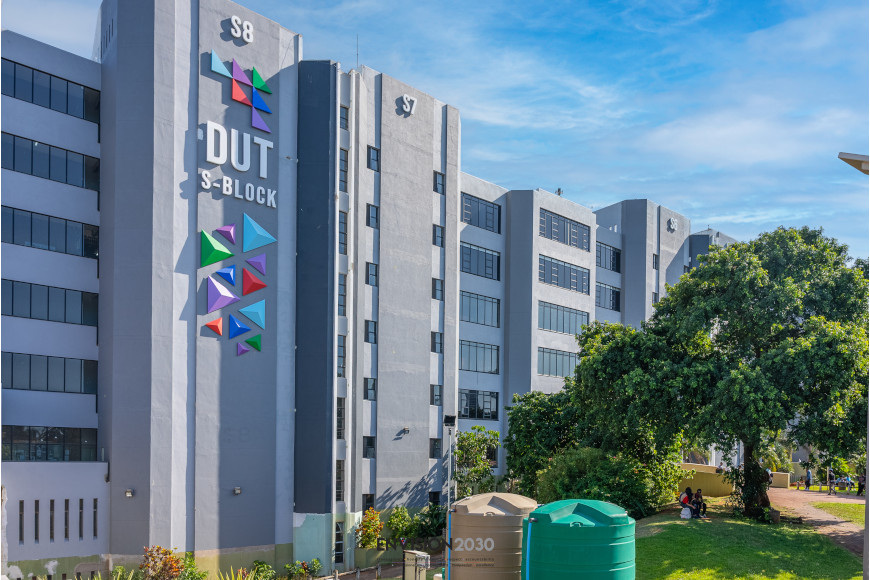
Pictured: DUT Steve Biko Campus.
Tiyani Mboweni


