
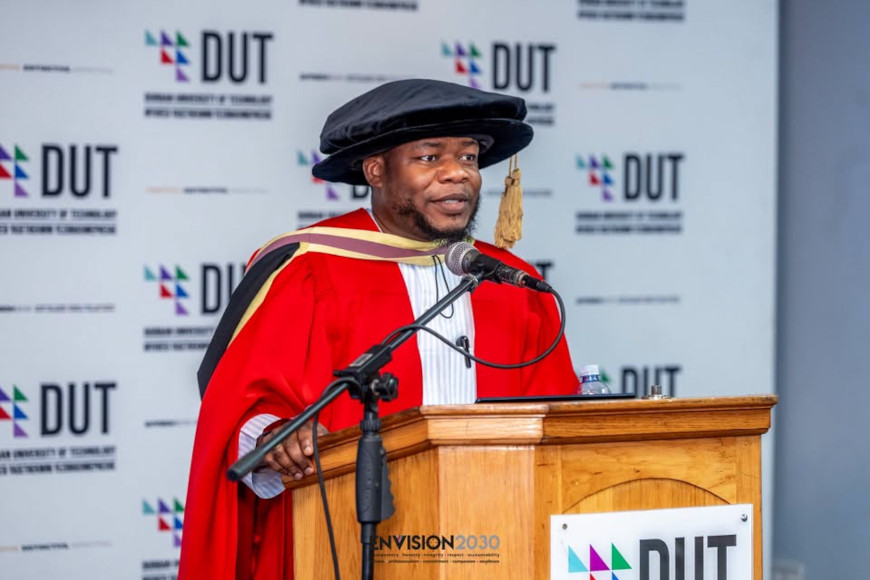
Professor Saheed Sabiu, Lead of the Computational and Systems Biology Research Group in the Department of Biotechnology and Food Science at the Durban University of Technology (DUT), delivered his Professorial Inaugural Lecture titled “Romancing the Heroes for the Unsung Heroes: All for the Love of Metabolites” at the DUT Hotel School, Ritson Campus, on Tuesday, 29 September 2026.
The lecture marked an important milestone in Prof Sabiu’s academic career following his promotion to Associate Professor in 2023 and Full Professor in 2025, after four years as a Senior Lecturer at DUT.
The Programme Director, Prof Pfano Mashau, Director of the DUT Business School, congratulated Prof Sabiu on attaining the academic milestone and wished him well as he continues his work in academic leadership, research, teaching and mentorship.
In his welcoming remarks, Prof Feroz Swalaha, Head of the Department of Biotechnology and Food Science at DUT, said Prof Sabiu’s progression from Senior Lecturer in 2019 to Full Professor in 2025 reflected his work ethic and the strength of his research agenda.
“On behalf of the Department of Biotechnology and Food Science, it is my distinct privilege and profound pleasure to extend our warmest congratulations to you on the occasion of your inaugural lecture. Your promotion to Full Professor marks a significant milestone in what has already been a stellar academic journey, and it is a moment of great pride for all of us in the Department,” said Prof Swalaha.
Prof Tukayi Kudanga, Acting Executive Dean of the Faculty of Applied Sciences, also congratulated Prof Sabiu and highlighted his academic achievements, research excellence and contributions to DUT.
Prof Kudanga said Prof Sabiu completed his PhD in Biochemistry at the University of the Free State (UFS) in Bloemfontein in 2017. He subsequently held a postdoctoral research fellowship at UFS, first in the Department of Biochemistry and later at the UFS Next-Generation Sequencing Unit, before joining DUT in 2019.
At DUT, Prof Sabiu established and continues to lead the Computational and Systems Biology Research Group. The group mentors postgraduate students and emerging researchers in the bioprospecting of secondary metabolites and active pharmaceutical ingredients (APIs), with a focus on identifying novel small-molecule drug targets for communicable and non-communicable diseases (NCDs).
Through his funded research projects, Prof Sabiu has supervised 11 Master’s and seven doctoral students to completion, hosted seven postdoctoral fellows and is currently supervising more than 15 postgraduate students at Master’s and doctoral levels.
“His inclusive approach and ability to engage with diverse audiences have been remarkable. Prof Sabiu has also been pivotal in several scientific programmes that have culminated in capacity building among postgraduate students and young scholars,” said Prof Kudanga.
Prof Kudanga also highlighted Prof Sabiu’s contribution to scholarly research, noting that he has produced two provisional patents, three books, more than 20 book chapters and over 100 journal articles, predominantly in Q1 and Q2 journals. His publications have attracted more than 3 000 citations, with an h-index of 29. He has also delivered invited and keynote presentations at more than 35 national and international scientific conferences.
Delivering his inaugural lecture, Prof Sabiu, a National Research Foundation (NRF) C-rated researcher, reflected on his scientific journey and research contributions, as well as the personal significance of reaching the milestone.
The occasion was attended by members of his family, including his wife, four daughters, mother and mother-in-law. Prof Sabiu also remembered his late father, whom he said he wished could have been present to witness the occasion.
He expressed his gratitude to those who had contributed to his academic and professional development, particularly Prof Taofik O. Uthman whom he credited with playing an important role in his decision to move to South Africa.
Prof Sabiu’s research expertise spans Computational and Systems Biology, Phytotherapeutics and Phytopharmacology, Metabolomics, Metagenomics, Natural Product Chemistry and Health Innovations.
During his lecture, he explained how his research group investigates the potential of medicinal plants and the opportunities they present for further research in Southern Africa. He noted that more than 75% of economically viable plants remain unexplored, creating opportunities for postgraduate researchers to investigate novel compounds with potential therapeutic applications.
“Healing with plants is as old as mankind itself. Until the advent of iatrochemistry in the 16th century, plants had been the source of treatment and prophylaxis for many diseases. Unlike conventional drugs, medicinal plants have metabolites working together catalytically and synergistically to improve health and well-being. The combined actions of these metabolites tend to increase the activity of the main constituent by speeding up or slowing down its metabolism in the body,” said Prof Sabiu.
He further explained how advances in bioinformatics and computational systems biology have accelerated research into novel metabolites and APIs from plants. These technologies have enabled researchers to conduct comprehensive metabolite annotation and dereplication using metabolomics, link disease symptoms to epigenetic modifications and other factors influencing gene expression, identify potential drug targets, predict and refine drug candidates, and assess health impacts and the potential development of drug resistance.
“Coupled with the application of machine learning (ML) and artificial intelligence (AI), these advances have revolutionised the field of API development. This lecture presents how they are being embraced in bioprospecting secondary metabolites against communicable (microbial) and non-communicable (type 2 diabetes) diseases for new small-molecule target discovery. This approach is strategically aligned with both global and continental priorities for health innovations and development, positioning it as a high-impact investment,” added Prof Sabiu.
In concluding his lecture, Prof Sabiu returned to the central theme of his research, highlighting the importance of medicinal plants and the metabolites responsible for their therapeutic properties.
In his closing remarks, DUT Deputy Vice-Chancellor: Teaching and Learning, Prof Vusi Gumede, congratulated Prof Sabiu on his achievement, recognising his dedication, perseverance and academic contributions.
He noted that professorship is a prestigious academic distinction awarded to scholars who demonstrate excellence in teaching, research, innovation and engagement.
“It is a testament to dedication and outstanding scholarship. A high point in the life of any academic is being invited to deliver an inaugural lecture to present to the university community and the public an insight into his/her research and publications, as well as the teaching and learning that culminates into full professorship,” said Prof Gumede.
Pictured: Prof Saheed Sabiu delivering his Professorial Inaugural Lecture.
Photographer: S’bonelo Dlamini
Simangele Zuma


