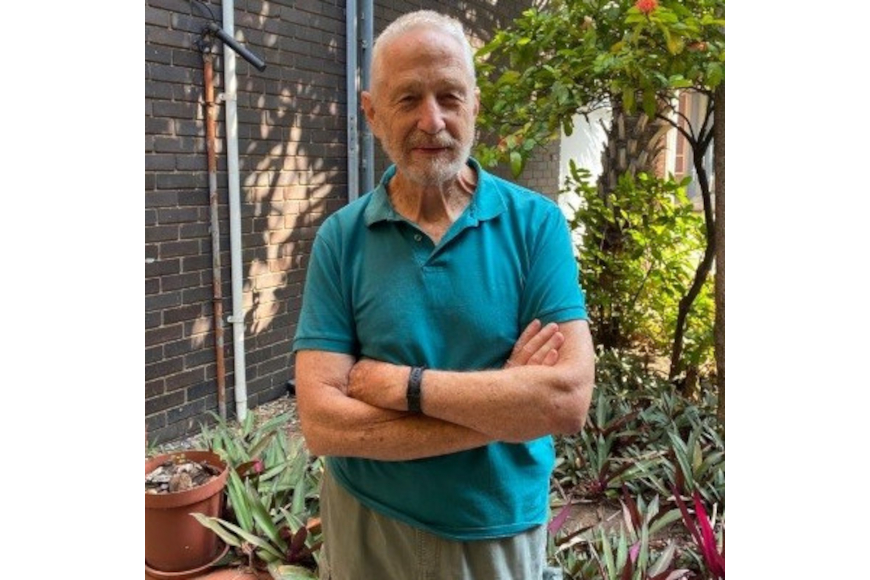
Professor Geoff Harris, an avid researcher at the International Centre of Nonviolence (ICON) /Peacebuilding Programme at the Durban University of Technology (DUT), is bridging the gap between complex academic theory and practical, community-level conflict resolution. Through impactful action research, the Adjunct Professor and seasoned researcher is dedicated to presenting new findings that advance knowledge in his discipline while raising global awareness of peacebuilding.
In alignment with DUT’s ENVISION2030 strategy of driving an impactful society, Professor Harris recently embarked on publishing a brand-new journal: the Great Lakes Journal of Peacebuilding.
“We (ICON) have much experience in the Great Lakes region, which includes Burundi, DR Congo, Rwanda, Tanzania, and Uganda. The aims of the Great Lakes Journal of Peacebuilding are to publish some of the great research being carried out in the region and to provide a resource for the increasing number of peace studies students there,” shared Prof Harris.
To ensure the research is accessible to all, articles in the journal will be published in both English and French and will be entirely open access.
With a distinguished academic career spanning over 50 years, Professor Harris came to South Africa from Australia in 1999 to take up a chair in economics at the University of Natal (now UKZN).
“My broad area of specialisation was the economics of developing countries, and part of that involved researching aspects of military expenditure. I could never understand why developing countries, with all their challenges, would want to waste money on military forces and to be so ready to use them when the outcomes were so devastating,” he explained.
This realisation led him straight into the area of nonviolence and the discipline of peace studies. For Professor Harris, teaching peace quickly became his true calling in life.
His current research at DUT focuses on restorative justice and its practical, real-world application.
“Restorative justice contrasts with the current retributive emphasis, which focuses primarily on punishing people who break the law,” he noted.
His work promotes sustainable rehabilitation and community healing, proving that true institutional excellence starts with restoring human connection. Professor Harris has three PhD students currently working on building the motivation and ability of prison officers to contribute to the rehabilitation of inmates.
“Many of ICON’s graduates have become peace studies academics in their own countries. In Zimbabwe, for example, there are at least 10 universities offering peace studies and most of their staff are ICON graduates,” he noted.
Looking ahead, Prof Harris highlighted his ongoing commitment to demilitarisation, warning that modern warfare continues to prove both costly and ineffective.
“All the evidence is that war is very costly and highly ineffective in achieving its goals,” Prof Harris said.
“Think of Russia-Ukraine, Israel/US-Iran, and Sudan, each going nowhere. But leaders are impatient and stupidly optimistic that their war will meet its goals. It won’t, but it will cause much suffering.”
He emphasised the urgent need for a shift in political mindsets toward peaceful conflict resolution.
“We have to educate leaders to recognise that nonviolent ways of handling differences, in which long-term dialogue is likely to be central, are far superior to war,” he stated.
As global tensions rise, Prof Harris noted that ICON holds a unique and critical position in the country’s academic landscape.
“It simply must be retained and strengthened,” he concluded.
Pictured: Professor Geoff Harris, a leading researcher at the DUT International Centre of Nonviolence (ICON), whose latest work is transforming peace studies across the African continent.
Photography: Google Images
Waheeda Peters


