

Dr Thulile Mofokeng, a charismatic lecturer in the Department of Entrepreneurial Studies and Management at the Durban University of Technology (DUT) and Mr Nyane Mofokeng, a lecturer in the Department of Applied Management, excitedly shared their remarkable achievement of contributing to EDHE’s first open access book, Innovative Pedagogies for Entrepreneurship Education: Insights from South Africa.
Together, they contributed a chapter that presented a living case study of multidisciplinary teaching and purposeful external engagement. What began as innovative classroom practice and deep industry collaboration evolved into a recognised research output. They documented their impact, theorised it, and transformed it into a permanent contribution to the body of knowledge in entrepreneurship education.
Dr Mofokeng, who has more than 13 years of experience in higher education, specialises in sustainable development, ecotourism, tourism, work-integrated learning, curriculum innovation, and entrepreneurship education.
Her research focuses on advancing entrepreneurship within the service sector, with a particular emphasis on ecotourism as a catalyst for inclusive economic development. She has published in DHET-accredited journals, with contributions spanning community-based tourism, sustainable enterprise development, and innovative pedagogies in entrepreneurship education. She now co-authored a chapter in EDHE’s first open access book, published by Springer in 2026.
The research is centred on context-responsive entrepreneurship pedagogy, exploring how innovative teaching methods can bridge the gap between theory and practice in environments shaped by inequality and limited opportunities. Together with Mr Mofokeng, they transformed their winning case study, which ranked first at the 2023 EDHE Entrepreneurship Teaching and Learning Excellence Awards among 26 universities, into a publishable research output. This recognition validated the impact of their work and provided a platform to elevate it into scholarly discourse. Having the chapter published by Springer, one of the world’s most prestigious academic publishers, is a milestone achievement. Springer’s open access model ensures that their insights are accessible not only to academics but also to educators, policymakers, and practitioners across Africa, the Global South, and beyond.
The contribution was born out of the DUT Ngodini Bunduz Entrepreneurship Advancement Project, a collaborative initiative across multiple departments, including the Department of Applied Management, Ecotourism, Entrepreneurial Studies and Management, the Faculty of Management Sciences and Horticulture, and the Faculty of Applied Sciences.
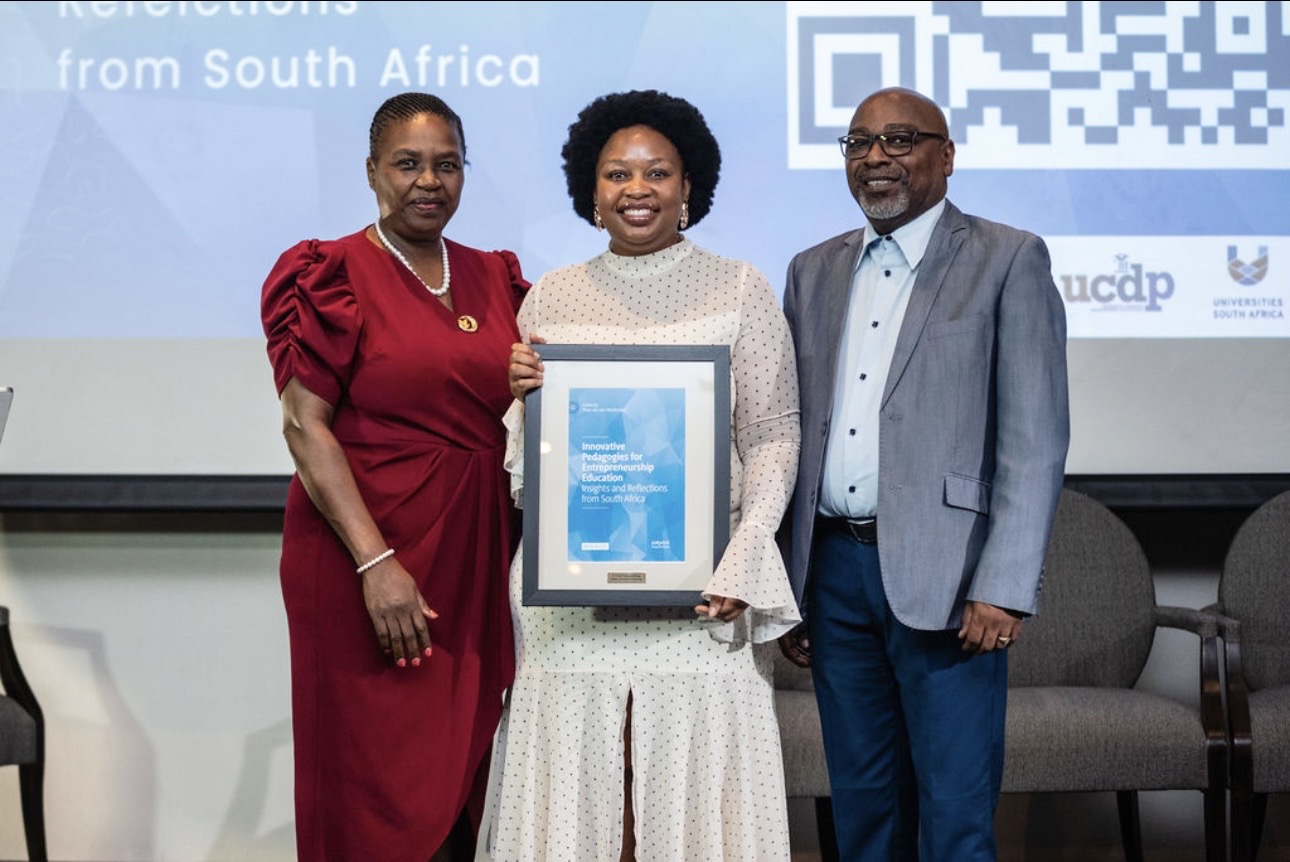
Pictured: The initiative scoops first position for Excellence in Entrepreneurship Teaching and Learning at the 2023 EDHE Awards.
Dr Mofokeng emphasised that the contribution came to fruition through dedication, collaboration, and the belief that entrepreneurship education must extend beyond the classroom to create meaningful, sustainable change in communities. The project provided entrepreneurship training and capacity-building workshops that equipped local entrepreneurs with the skills and capabilities to grow their businesses. Its impact was nationally recognised when the initiative scooped first position for Excellence in Entrepreneurship Teaching and Learning at the 2023 EDHE Awards.
This award-winning case study became the foundation for their chapter in EDHE’s first open access book. Transforming the project into a scholarly output ensured that their insights were not only celebrated nationally but also disseminated globally, accessible to educators, policymakers, and practitioners across Africa and beyond.
Dr Mofokeng said that it was important as project leaders to ensure that all contributors were appropriately recognised. She highlighted that the chapter demonstrates how entrepreneurship education can serve as a bridge between potential and prosperity, showing how DUT can empower students to become job creators. This strengthens sustainability by nurturing resilient livelihoods and contributes to economic development by embedding entrepreneurial thinking into higher education.
The research aligns with the objectives outlined in the DUT ENVISION2030 strategy. ENVISION2030 emphasises innovation, inclusivity, and sustainability. The research promotes pedagogies that empower students to innovate, engage inclusively with diverse communities, and contribute to sustainable economic growth. It positions DUT as a leader in entrepreneurship education within the Global South.
Collaboration has been central to the work, with industry partners providing real-world context for students, while fellow researchers offered theoretical and methodological insights. The EDHE Community of Practice created a national platform for sharing and refining ideas, ensuring the work was not siloed but part of a broader movement to transform entrepreneurship education.
Looking ahead, Dr Mofokeng intends to deepen the exploration of inclusive entrepreneurship education, particularly in under-resourced communities. She aims to expand collaborations across institutions and industries to create scalable models of pedagogy that can be replicated nationally. This will further align with DUT’s vision of being a people-centred and engaged university contributing to sustainable development.
Dr Mofokeng expressed pride in representing DUT and the Faculty of Management Sciences on this national stage. The open access publication ensures that their insights reach educators, policymakers, and practitioners across Africa and beyond. She emphasised that this milestone belongs not only to the authors but to every lecturer, student, and industry partner who believes in the transformative power of entrepreneurship education.
Pictured: Dr Thulile Mofokeng
Waheeda Peters


