
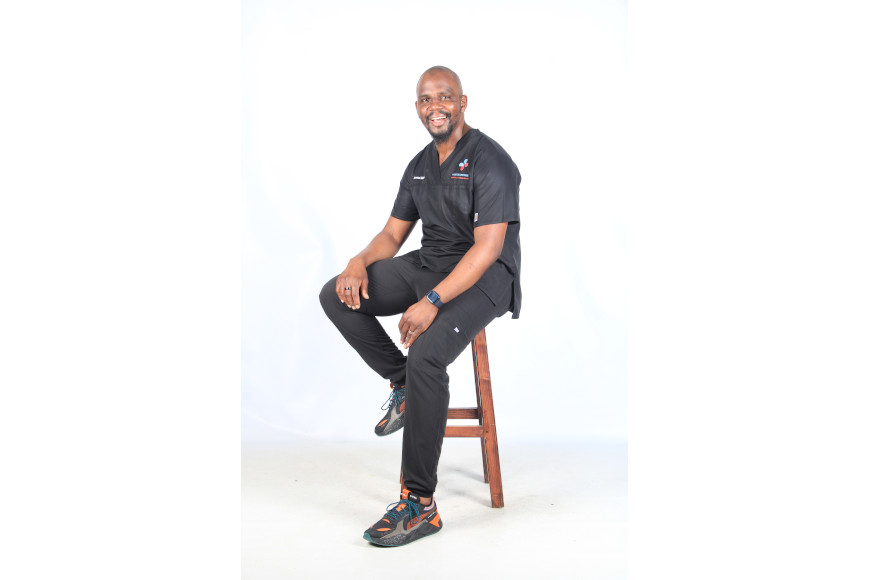
Phumlani Mtshali’s journey to obtaining a Master of Health Sciences from Durban University of Technology (DUT) has been shaped by perseverance, personal experience and a desire to contribute to the early detection and management of chronic kidney disease.
The 37 year old Nephrology Clinical Technologist, originally from Ulundi in Mahlabathini, will graduate from the Department of Biomedical and Clinical Technology at DUT’s 2026 Spring Graduation ceremony, taking place at the Olive Convention Centre on Thursday, 17 September 2026.
A father of two, Mtshali has always had a passion for education. His academic journey at DUT began with a Bachelor of Health Sciences in Clinical Technology, and he has continued to carry the institution’s Living Values into his professional career.
His master’s dissertation, titled “Assessment of Beta 2 Microglobulin, Serum Creatinine, and Creatinine Clearance in Chronic Kidney Disease Patients in KwaZulu Natal,” investigated the effectiveness of different biomarkers in detecting and monitoring chronic kidney disease.
The study found that Beta 2 Microglobulin, known as B2M, is a sensitive early stage biomarker for chronic kidney disease in KwaZulu Natal, outperforming Serum Creatinine in early detection and disease monitoring, particularly among patients with hypertension and diabetes.
The research is particularly significant given the growing burden of chronic kidney disease globally and in South Africa.
“Chronic Kidney Disease (CKD) is a major and escalating global health burden, disproportionately impacting low and middle income countries such as South Africa,” said Mtshali.
His interest in kidney disease research was also deeply personal. Having witnessed a loved one live with the disease, he became increasingly interested in how kidney disease could be detected earlier, particularly through the use of biomarkers.
“I have gotten so fascinated with the effectiveness of the process involved in detecting the risk factors, and when one would be able to know if they are at risk of getting chronic kidney disease, since it’s a fast growing global emergency, and my biological father was diagnosed with stage 5 chronic kidney disease and was on dialysis treatment for about seven years,” he shared.
The journey towards completing his master’s degree was not without challenges.
Mtshali had to balance his academic commitments with demanding professional responsibilities while also raising two young children. His research further required collaboration between DUT and the University of KwaZulu Natal, where his laboratory work was conducted.
He credits his supervisors, family, colleagues, friends, church and the institutions involved for providing the support that enabled him to persevere.
“My journey has been nothing short of ups and downs, trials and lots of success. Most importantly and remarkably, throughout the journey, there has been consistent support from my incredible supervisors Dr SC Benjamin, my institutional supervisor, and two co-supervisors, Professor AGH Assounga and Professor ND Madala, family, institution, local church, colleagues, and friends,” he said.
He also credits the experience with developing his time management, organisational and critical thinking skills as he coordinated meetings and correspondence between three supervisors while managing the demands of his professional and personal life.
“The journey has taught me independence and greater confidence, even in critical decisions, enhancing my critical thinking. Towards the end of this beautiful journey, one realises that, initially, the learning and pruning were so necessary; the dedication and many sacrifices wouldn’t have been excluded from the main ingredients of this journey,” he added.
Financial constraints presented another significant hurdle. His laboratory research required the purchase of specialised kits, each costing approximately R10 000, with at least eight kits required for the study.
While departmental financial support from DUT assisted with some of the costs, Mtshali had to personally finance the balance.
Another challenge was finding sufficient time to conduct his research while working full time. At the time, his responsibilities included leading a renal unit, performing daily chronic haemodialysis and acute haemodialysis, while raising two toddlers.
“I chose to quit my job and take a haemodialysis post, where I found a bit of time, and in this way, I could prioritise my studies and complete my tasks in time for my academic supervisors,” he explained.
Despite the challenges, Mtshali’s research journey has already opened doors beyond his master’s degree. His abstract has been accepted at two international congresses this year.
He was invited as an e Poster speaker at the 63rd European Renal Association Congress, held in Glasgow and virtually. His research will also feature at the International Society of Peritoneal Dialysis Congress, held in conjunction with the South African Renal Congress in Cape Town from 28 September to 3 October 2026.
For Mtshali, the master’s degree is not the end of his academic journey, but another step towards his long term ambition of advancing nephrology research and clinical practice.
“My primary career aspirations are to advance my academic and clinical research in nephrology by pursuing a PhD and engaging further in research and publications, to make a global medical contribution or impact, and to advance community health and clinical leadership through involvement in the education and training of aspiring leaders in renal care and abroad,” he said.
Reflecting on his journey, Mtshali encourages students who aspire to pursue postgraduate studies to remain focused on their goals and to appreciate every milestone along the way.
“Students must please make their academic journey a top priority. To be patient and keep the end goal in mind, always remember why you started in the first place. Enjoy each and every milestone and keep looking at the bigger picture in mind.”
He also emphasises the importance of faith throughout the academic journey.
“Last but not least, to trust and rely on God as the one who gives us strength, renews our hope, gives us peace and in the midst of uncertainty, calms every storm, gives us innovations and creativity.”
Mtshali’s journey from Ulundi to postgraduate researcher is one of resilience, sacrifice and academic growth, demonstrating how personal experiences can inspire research with the potential to contribute to improved health outcomes.
As he prepares to cross the graduation stage, he does so not only as a Master of Health Sciences graduand, but as an emerging researcher with ambitions to make a meaningful contribution to nephrology in South Africa and beyond.
We wish Phumlani Mtshali all the best for his graduation and future endeavours as he continues to uphold the DUT Living Values.
Pictured: Master of Health Sciences graduand, Phumlani Mtshali.
Photo: Supplied.
Sompisi Ntuli


