
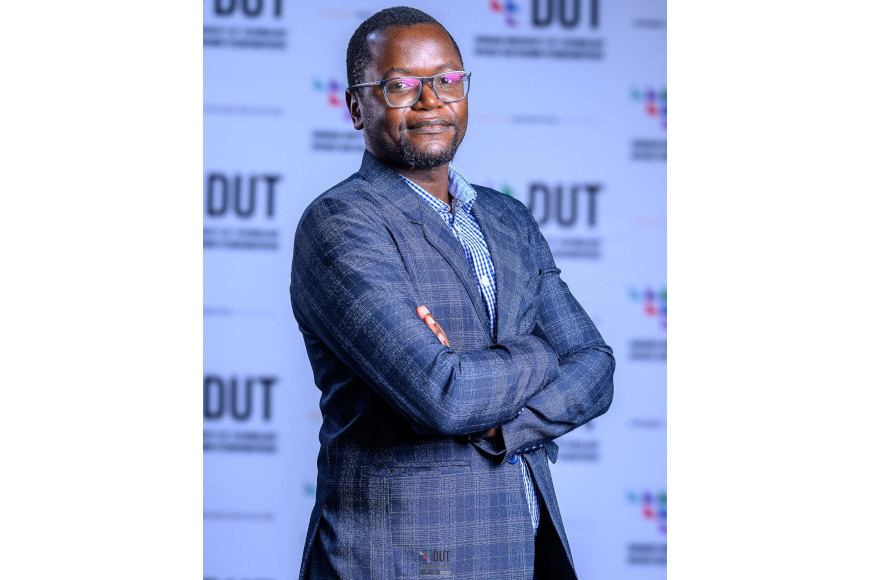
Professor Pfano Mashau, Director of the Durban University of Technology’s (DUT) Business School, has been appointed to the newly constituted Sustainable Development Goals Initiative (SDGi) Panel of Experts, convened by the Albert Luthuli Leadership Institute (ALLI) at the University of Pretoria.
The Panel brings together academic and non-academic specialists who will provide expert contributions and opinion pieces to inform policy products across various thematic areas. The initiative forms part of a partnership in which ALLI serves as Principal Investigator, in collaboration with the Presidency of the Republic of South Africa’s Policy and Research Services Branch and the Deutsche Gesellschaft für Internationale Zusammenarbeit (GIZ). The partnership seeks to strengthen evidence-informed policymaking in South Africa.
For Prof Mashau, the appointment provides an opportunity to contribute his expertise in youth employability, entrepreneurship, innovation, skills development and the changing world of work, with a particular focus on Sustainable Development Goal 8 (SDG 8), which promotes sustained, inclusive and sustainable economic growth, productive employment and decent work for all.
“This is an important opportunity to convert research into impactful action. Universities generate significant knowledge on unemployment, entrepreneurship, skills development and innovation, but the real value of that knowledge is realised when evidence informs decisions, programmes and policies that improve people’s lives and livelihoods,” said Prof Mashau.
Through the SDGi Panel, Prof Mashau will contribute to policy briefs and expert opinion pieces that translate research evidence into accessible policy insights. His contribution will draw on his research in areas including youth unemployment, entrepreneurship education, innovation, informal business development and enterprise competitiveness.
His research includes a 2015 study with Houghton on youth unemployment and informal business development in eThekwini Municipality, which examined the role of informal business activity in supporting local economic participation. The study highlighted the contribution of the informal economy to economic growth and job creation, while recognising that informal business development alone cannot resolve unemployment.
More recent research has examined the role of entrepreneurship education and innovation in higher education. Mtshali, Mashau and Gamede (2024) explored how entrepreneurship education can strengthen innovation among students at two KwaZulu-Natal universities, highlighting the importance of developing entrepreneurial mindsets and innovation capabilities. In related research, Mtshali and Mashau (2024) examined students’ attitudes towards innovation and entrepreneurship education and the role of universities in preparing graduates for changing labour markets and emerging economic opportunities.
Prof Mashau’s research also extends to innovation and enterprise competitiveness. Gonyora, Migiro, Mashau and Ngwenya (2022) examined open innovation challenges among South African automotive component manufacturers, while Gonyora and Mashau (2022) explored open innovation strategies and prospects for new product and process development. This body of research highlights the links between innovation capability, enterprise development, productivity and economic participation.
The relevance of these areas is underscored by South Africa’s current labour market and economic conditions. According to Statistics South Africa’s Quarterly Labour Force Survey for the second quarter of 2026, the official unemployment rate increased to 33.6%, from 32.7% in the first quarter. The number of unemployed people increased by 345 000 to 8.5 million, while employment decreased by 16 000 to 16.7 million. Among young people aged 15–34, the number of unemployed people increased to 5.0 million, with the youth unemployment rate rising to 47.4%.
South Africa’s economic growth environment also remains challenging. Real GDP contracted by 0.2% in the second quarter of 2026, following growth of 0.4% in the first quarter. Against this backdrop, productive employment, entrepreneurship, innovation, skills development and inclusive economic participation remain important to the country’s development agenda.
For DUT, Prof Mashau’s appointment highlights how expertise and research generated within the University can contribute to broader national conversations on employment, entrepreneurship, economic development and policy.
The appointment also aligns with DUT’s ENVISION2030 strategic intent, particularly its emphasis on innovation, entrepreneurship and research that creates meaningful societal impact. It demonstrates how academic scholarship can extend beyond publication to contribute to evidence-informed discussions and practical responses to real-world challenges.
“DUT is committed to producing knowledge that responds to the challenges facing society and contributes to meaningful change,” said Prof Mashau. “Participation in initiatives such as the SDGi Panel creates an opportunity for our research and expertise to engage directly with national policy conversations and contribute to solutions that support inclusive economic participation.”
Through the SDGi Panel, Prof Mashau will bring his experience in entrepreneurship, youth employability, innovation, small-business development, local economic development and inclusive economic participation to discussions linked to South Africa’s development priorities and the Sustainable Development Goals.
His appointment provides an opportunity for the DUT Business School and the broader University community to demonstrate the value of research that is connected to real-world challenges and contributes to evidence-informed policy and societal impact.
Pictured: DUT Business School Director, Professor Pfano Mashau.
Zinhle Rashee


