
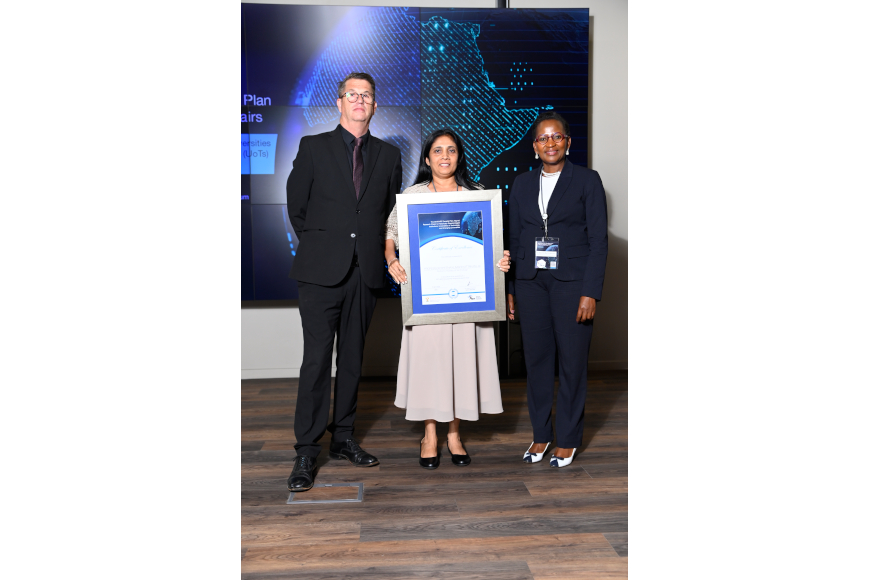
Professor Sheena Kumari Pillai is a Full Professor and the newly appointed DSTI/NRF SARChI Chair in wastewater research at the Durban University of Technology (DUT).
Describing her sterling journey, Prof Pillai said that her journey at DUT began in 2008 when she joined the then Centre for Water and Wastewater Technology, which has since evolved into the Institute for Water and Wastewater Technology (IWWT), a leading hub for applied research in water and wastewater field.
“Over the past 18 years, I have progressed through various academic and research ranks, culminating in my promotion to Full Professor in 2023 and my recent appointment as NRF/DSTI SARChI Chair in 2026. This progression reflects a sustained commitment to both research excellence and capacity development in the water sector,” she said.
From the beginning, her research has focused on sustainable wastewater treatment, an area that directly aligns with the IWWT’s mission to deliver innovative, practical, and environmentally responsible solutions. “Our work emphasises the development and optimisation of advanced treatment technologies, resource recovery processes, and green energy integration, all aimed at addressing pressing water challenges faced by industries and communities,” added Prof Pillai.
“Being part of an institute that prioritises both international competitiveness and local relevance has enabled me to pursue research that is not only scientifically rigorous but also socially impactful,” she highlighted. Ultimately, her journey has been shaped by a commitment to translating research into real-world solutions that contribute to sustainable water management and improved quality of life.
Professionally, her appointment as SARChI Chair represents a significant milestone, reflecting sustained research excellence demonstrated through publications in leading peer-reviewed journals, a recognised NRF rating, and meaningful contributions to human capital development, including the supervision and training of more than 40 postgraduate students across different faculties (Applied Science, Engineering and Health Science) within DUT.
“Personally, this role carries a deeper sense of purpose. It provides a platform I am fully committed to leveraging; advancing world-class research and cultivating the next generation of scientists and engineers, to address one of South Africa’s most urgent challenges: the escalating water crisis,” explained Prof Pillai.
The Chair’s five-year research programme is strategically structured into integrated work packages that address the full spectrum of sustainable water and wastewater management.
The first focuses on the development of advanced detection and remediation approaches for emerging micropollutants, including microplastics, pathogens, and antibiotic-resistant genes, which pose increasing risks to water quality and public health.
The second drives the advancement of innovative, pilot-scale treatment technologies for resource recovery, with a strong emphasis on processes such as anammox, anaerobic digestion, and algal systems.
The third work package is dedicated to translating research into tangible societal impact through postgraduate training, targeted school outreach, and strategic industry partnerships. This is enabled through a Living Lab framework that serves as a dynamic interface between cutting-edge research and real-world implementation, ensuring solutions are both practical and scalable.
“My work directly responds to national priorities by reframing wastewater not as a liability, but as a strategic resource within a closed-loop circular economy. This perspective aligns closely with South Africa’s Decadal Plan for Science, Technology and Innovation, which positions science and technology as central to addressing the country’s intensifying water scarcity and advancing sustainable development,” she expressed.
Prof Pillai shared on the industry impact she aims to achieve in the next five to 10 years.
She relayed that the Chair’s research programme is strategically positioned to deliver sustained and meaningful impact across several interconnected domains. In the area of resource recovery, the work moves beyond laboratory proof-of-concept toward pilot- and demonstration-scale implementation of sustainable technologies.
“These approaches fundamentally reconfigure conventional, energy-intensive wastewater treatment processes into low-cost, resource-efficient systems, transforming wastewater from a disposal burden into a productive source of clean water, renewable energy, and recoverable nutrients that can be reintegrated into the economy,” she added.
From a public health perspective, Prof Pillai said the programme will generate robust, evidence-based insights to inform policy and strengthen decision-making.
Prof Pillai’s research is deeply rooted in the realities of the water crisis confronting KwaZulu-Natal and, more broadly, South Africa, and is explicitly designed to deliver solutions that are both locally relevant and scientifically robust. Through sustained collaboration with municipalities, water boards, and industrial partners, the programme is embedded within the very institutions responsible for large-scale water and wastewater management.
“This close alignment ensures that research is co-developed with end users, enabling context-specific innovation and accelerating uptake. As a result, the programme prioritises translation alongside discovery, moving beyond academic outputs to produce practical, implementable interventions that can be deployed within existing infrastructure and governance systems. This approach not only enhances the research’s real-world impact but also strengthens institutional capacity to respond to current and emerging water challenges,” she conveyed.
A central pillar of the Chair’s mandate is the deliberate cultivation of the next generation of water scientists, engineers, and research leaders. Over the course of her career, she has supervised approximately 20 doctoral and 20 master’s graduates with more than 60% of these students being female, making a sustained contribution to South Africa’s scientific human capital and strengthening the national capacity to address complex and evolving water challenges.
The SARChI Chair provides a substantially expanded platform to deepen and scale this commitment to capacity development. It enables strategic recruitment and sustained support for a larger, more diverse cohort of postgraduate students and early-career researchers, including postdoctoral fellows from across the globe.
Prof Pillai expressed her plan to mentor the next generation of researchers, particularly from underrepresented backgrounds.
“A particularly meaningful aspect of this work is seeing my postgraduate students gain recognition on international platforms. Recent achievements within my group include two NRF NGS awards, the SA Fulbright Scholarship, the L’Oréal Women in Science Award, and participation in international student Exchange (SA-Germany, SA-USA) Programme,” she shared happily.
At the postdoctoral level, Prof Pillai has mentored more than 15 fellows, guiding them through the critical and often demanding transition from doctoral graduate to independent researcher. “My approach extends beyond scientific supervision to include the development of competitive grant-writing skills, the establishment of strong publication records, strategic navigation of academic career pathways, and the cultivation of distinct research identities. Many of these fellows have progressed to secure academic appointments, lead their own research programmes, and contribute independently to the water science community; outcomes I regard as among the most meaningful indicators of success in my career,” she commented.
Prof Pillai shared that as the Chair she recognises that scientific excellence alone is insufficient if promising technologies remain confined to laboratory settings.
“Beyond advancing individual technologies, the Chair actively fosters an entrepreneurial culture among postgraduate students and researchers. The aim is to equip them with the skills and mindset to think beyond publication and consider the broader commercial and societal value of their work. Through strategic engagement with industry partners, technology transfer offices, and innovation funding mechanisms, the programme strengthens the institutional linkages required. These efforts help accelerate the transition from research discovery to market-ready solutions,” she said.
By 2030, Prof Pillai indicated that the SARChI Chair is well positioned to play a defining role in strengthening the DUT’s standing as a leading centre of excellence in water and wastewater research, both nationally and on the global stage.
“This ambition is underpinned by a strong and demonstrable research track record. To date, Prof Pillai’s research has generated over 150 peer-reviewed publications in high-impact international journals (>90% in Q1/Q2), attracting more than 8,500 citations and achieving a Google H-index of 44 and Scopus H-index of 39. She has also secured more than R15 million in research funding from a range of national and international funding agencies. These metrics collectively reflect the sustained impact, visibility, and scholarly uptake of this body of work within the global scientific community,” she added.
At the conclusion of the Chair’s five-year tenure, success will be assessed across three interconnected and mutually reinforcing dimensions: scholarly impact, research transformation, and human capital development.
“The first dimension, academic excellence, will be demonstrated through a sustained output of high-impact, peer-reviewed publications that advance the global frontiers of water and wastewater science. This will be complemented by the successful graduation of highly skilled postgraduate students and emerging researchers who have been rigorously trained, mentored, and intellectually developed within a research-intensive environment. Collectively, these outcomes will reflect both the quality and international relevance of the Chair’s scholarly contributions,” highlighted Prof Pillai.
She further said that the second, and most consequential, dimension is the tangible contribution of the Chair to transforming wastewater management in South Africa.
“This includes advancing innovative, evidence-based approaches that support the safe reuse, recovery, and reintegration of treated wastewater into the broader economy. The third dimension focuses on human capital development and sectoral transformation. A robust, diverse, and highly capable pipeline of researchers, engineers, and water sector professionals will be cultivated through the Chair’s programme. These individuals will be equipped not only with advanced technical expertise, but also with the leadership capacity, innovative mindset, and ethical grounding required to drive the next phase of South Africa’s water science and management agenda. Together, these outcomes will ensure that the Chair’s legacy extends beyond academic outputs, shaping a new generation of leaders committed to innovation, equity, resilience, and sustainability in the water sector,” she concluded.
Pictured: Professor Sheena Kumari Pillai is the newly appointed DSTI/NRF SARChI Chair in wastewater treatment and reuse at DUT.
Waheeda Peters


