
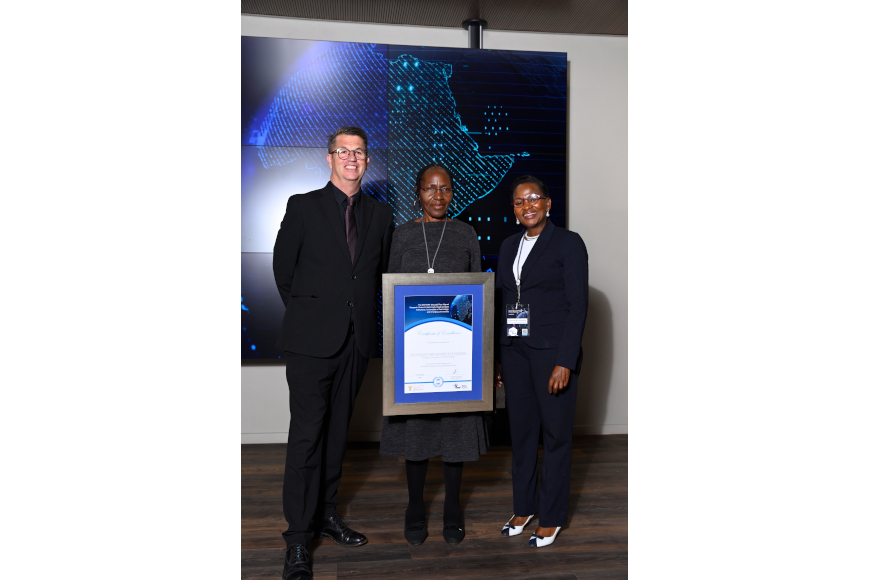
The Durban University of Technology (DUT) has strengthened its commitment to socially responsive research and educational transformation through the appointment of Professor Tabitha Grace Mukeredzi as the South African Research Chairs Initiative (SARChI) Chair in Social Justice, Education and Society: Inclusive Education in Rural Schools.
Prof Mukeredzi, in the School of Education under the Faculty of Arts and Design is among eight South African Research Chairs Initiative (SARChI) Chairs awarded to DUT by the NRF under the Department of Science, Technology and Innovation (DSTI) Decadal Plan Aligned Research Chairs for Historically Disadvantaged Universities, Universities of Technology, and Emerging Universities.
She is a respected scholar whose academic journey spans more than four decades. She has dedicated her career to advancing teacher education, inclusive education, rural schooling, teacher professional development, and socially responsive pedagogies.
Reflecting on her research journey, Prof Mukeredzi explained that her scholarly focus was shaped by years of engagement with teachers and schools located in under-resourced and socially unequal communities.
“My journey into this research focus emerged from years of engagement with teachers and schools located in under-resourced and socially unequal contexts, particularly rural communities. Through this work, I became increasingly aware that educational inequality is not merely about access to schooling, but also about whose knowledge, identities, languages, and learning needs are recognised and accommodated within educational systems,” she said.
At DUT, her work has evolved into a sustained research engagement examining teacher learning, mentoring, inclusion, rurality, and context-responsive pedagogy. Her scholarship also draws significantly on educational psychology, diversity, and inclusive education.
Beyond research outputs, Prof Mukeredzi has played a critical role in developing future scholars and researchers through postgraduate supervision, co-supervision, research mentorship, cohort sessions, and academic workshops. Her efforts have contributed to the successful graduation of close to two dozen Doctoral students in DUT.
Speaking about her appointment as a SARChI Chair, Prof Mukeredzi described the position as both an honour and a profound responsibility.
“Professionally, this appointment affirms the value and relevance of socially responsive educational research, particularly research that foregrounds rurality, inclusion, and equity within the South African context. Personally, the appointment is deeply evocative because it provides an opportunity to contribute meaningfully towards transforming educational experiences for learners and teachers who have historically been marginalised,” said Prof Mukeredzi.
According to Prof Mukeredzi, the Chair’s research agenda is grounded in social justice and inclusive education, with a strong emphasis on understanding how teachers conceptualise and enact inclusion within rural and unequal schooling contexts.
Its core priorities include teacher understandings of diversity and inclusion, inclusive pedagogical practices in rural schools, teacher professional learning and development, rural education, mentoring, equity and social justice in education systems, and the schooling experiences of learners with behavioural, cognitive, physical, and social diversities.
Prof Mukeredzi explained that the Chair also prioritises generating contextually situated knowledge that can inform educational policy, teacher education programmes, and professional practice within South Africa and comparable global contexts.
The work of the Chair aligns closely with South Africa’s Decadal Plan for Science, Technology and Innovation by contributing to human capital development, social innovation, and knowledge production aimed at addressing educational inequality and exclusion.
“Our research addresses systemic barriers affecting rural communities and seeks to produce evidence-based interventions that improve educational participation, teacher capacity, and learner support,” she noted.
Over the next five years, Prof Mukeredzi envisions the Chair contributing significantly towards transforming educational spaces into more inclusive, equitable, and socially just environments where all learners are able to participate meaningfully and succeed.
Prof Mukeredzi also highlighted the importance of strengthening university-school partnerships and developing contextually relevant teacher education models grounded in reflective practice and micro-teaching.
Additionally, Prof Mukeredzi said the Chair’s work is particularly relevant within KwaZulu-Natal, where many schools continue to experience challenges linked to poverty, rurality, language diversity, infrastructure limitations, and unequal access to educational resources.
“Our work focuses on understanding the lived experiences of teachers, learners, and communities, particularly in under-resourced schools. We aim to strengthen teachers’ abilities to enact inclusive pedagogies that respond meaningfully to learner diversity and contextual constraints,” she explained.
Capacity development forms a central pillar of the Chair’s vision. Prof Mukeredzi emphasised that postgraduate students, postdoctoral fellows, early-career researchers, rural teachers, and teacher educators will all benefit from structured mentorship and collaborative research opportunities. She further indicated that the Chair will support emerging scholars through research methodology development, academic writing support, conference participation, collaborative projects, scholarly networking, and opportunities for co-authorship and co-supervision.
Prof Mukeredzi also underscored the importance of creating supportive and intellectually stimulating environments that attract and retain young scholars in the field of education research.
“Importantly, the Chair seeks to cultivate scholars who view research not only as an academic activity, but also as a vehicle for social transformation and educational justice,” she said.
While the Chair is primarily socially and educationally oriented, Prof Mukeredzi believes its innovation lies in developing transformative and contextually responsive approaches to inclusive education and teacher professional development.
“The Chair aims to innovate through new models of inclusive pedagogy for rural contexts, teacher professional learning frameworks, community-engaged educational interventions, and digital teacher support platforms. It also holds significant potential to contribute to educational consultancy, mentoring programmes, and strategic partnerships with organisations such as the ETDP SETA,” she added.
Looking ahead to 2030, Prof Mukeredzi sees DUT strengthening its position as a leading University of Technology that produces socially responsive, community-engaged, and globally recognised research.
“Through initiatives such as the SARChI Chair, DUT has the potential to become a significant contributor to educational transformation research within South Africa, the African continent, and the Global South,” she said.
For Prof Mukeredzi, success at the end of her tenure would mean establishing a sustainable and internationally recognised research programme that contributes meaningfully to inclusive education, teacher development, rural education, postgraduate growth, and social justice scholarship.
Ultimately, she hopes the Chair will contribute towards transforming education systems into spaces where dignity, participation, equity, inclusion, and meaningful educational opportunities are realised for all learners and teachers.
Pictured: Professor Tabitha Grace Mukeredzi, the SARChI Chair in Social Justice, Education and Society: Inclusive Education in Rural Schools.
Simangele Zuma


