
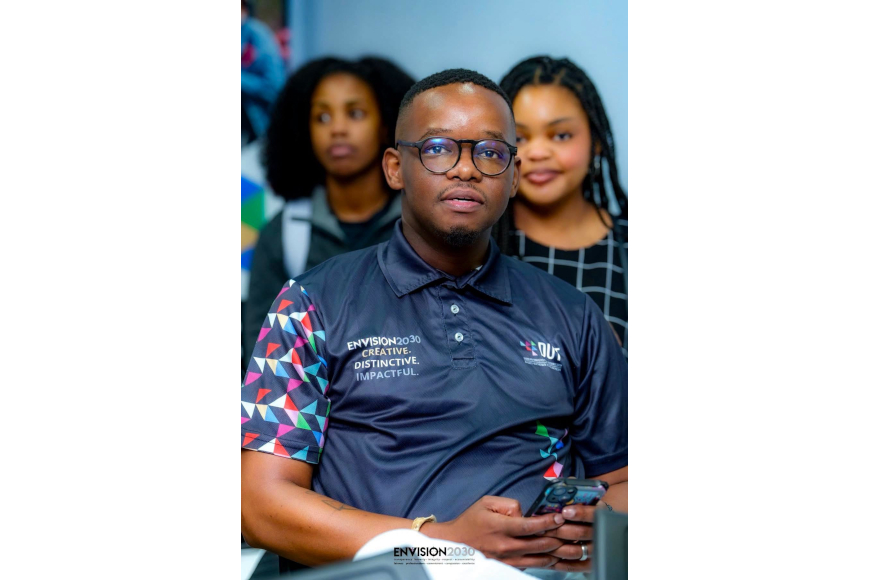
Professor Ndumiso Daluxolo Ngidi, Director of the International Centre of Non-Violence (ICON) at the Durban University of Technology (DUT), has called for a fundamental shift in how Black boys and young men are understood, urging scholars, policymakers and society to move beyond narratives of violence and crisis towards recognising their ongoing struggle for dignity, healing and human becoming.
Professor Ngidi delivered the opening keynote address at the Black Men and Masculinities in Post-Colonial Southern Africa Symposium, hosted by Stellenbosch University in partnership with the University of Cape Town. The symposium brought together leading scholars from across Southern Africa to explore contemporary debates on Black masculinities, gender justice and social transformation.
In his keynote, titled Beyond Crisis: Black Masculinities, Space, Violence and the Struggle for Human Becoming in Post-Apartheid South Africa, Professor Ngidi drew on more than a decade of qualitative, ethnographic and participatory visual research conducted with children and young people in township and peri-urban communities across KwaZulu-Natal.
His presentation examined how Black masculinities are shaped by the intersecting influences of colonialism, apartheid, spatial inequality, schools, peer cultures, neighbourhoods and intimate relationships. Rather than portraying Black boys solely as perpetrators or victims of violence, he encouraged audiences to consider the complex social realities that shape their lives.
Opening his address with the story of “Fanele”, a 15-year-old participant in a year-long participatory visual research project exploring violence in schools, Professor Ngidi reflected on how the young boy’s experiences of abuse, neglect and sexual victimisation fundamentally reshaped his understanding of Black boyhood.
“Too often we ask why Black boys are violent,” said Professor Ngidi. “A more important question is: What kinds of worlds make it difficult for Black boys to remain human?”
Throughout his keynote, Professor Ngidi emphasised that many Black boys navigate deeply unequal social environments while searching for safety, recognition, dignity, love and belonging. He argued that many expressions of aggression cannot be separated from experiences of grief, trauma, neglect and emotional invisibility, highlighting the need to better understand the social and historical conditions that influence boys’ lives.
He further explained that schools, communities and everyday social spaces play a significant role in shaping masculinities. At the same time, these environments can become places of healing when boys are given opportunities to speak openly about violence, vulnerability and hope.
Drawing on his concept of reflective masculinities, Professor Ngidi demonstrated how many boys challenge dominant expectations of masculinity through care, empathy, friendship, spirituality and ethical reflection. He noted that these everyday acts of humanity present meaningful opportunities for violence prevention, peacebuilding and gender transformation.
Concluding his address, Professor Ngidi said; “The struggle facing many Black boys is not only about becoming men. It is also about becoming fully human in societies where violence, inequality and neglect often deny them safety, dignity and recognition.”
The keynote forms part of Professor Ngidi’s broader research programme, which examines childhood, masculinities, violence and peacebuilding in Southern Africa. His work seeks to contribute to more nuanced, African-centred understandings of Black boys’ lives by foregrounding their agency, vulnerability and capacity for care, while advancing evidence-informed approaches to violence prevention and social transformation.
Professor Ngidi’s participation at the symposium reflects DUT’s growing reputation for research excellence and engaged scholarship. Through the International Centre of Non-Violence (ICON), the University continues to generate impactful research that addresses some of South Africa’s most pressing societal challenges, including gender-based violence, school violence, youth development and peacebuilding.
By centring the lived experiences of children and young people, DUT contributes to national and international conversations on social justice, human dignity and sustainable peace while advancing the University’s ENVISION2030 strategy of producing innovative, socially responsive and transformative knowledge.
Pictured: Professor Ndumiso Daluxolo Ngidi
Tiyani Mboweni


