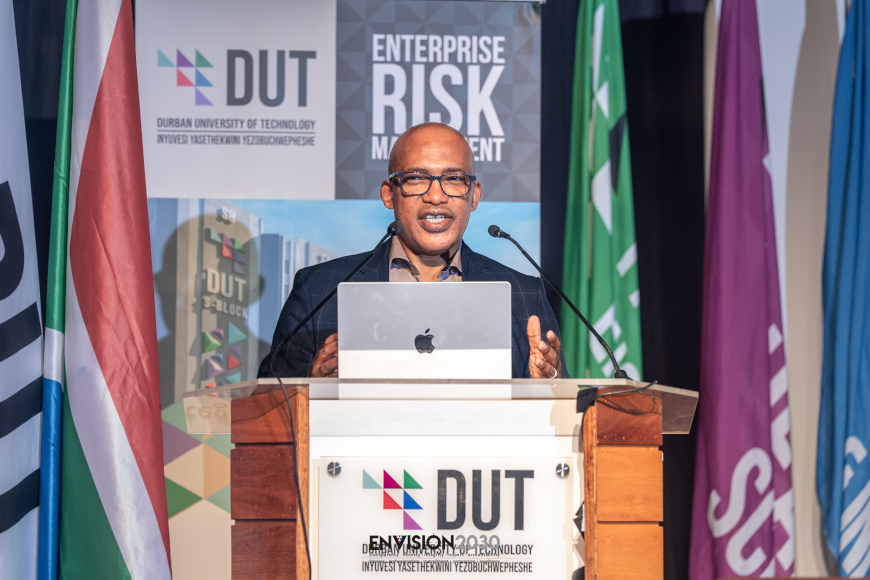
Theme: Weaving the Governance Fragility with Authoritative-Gentleness: A Hill Too Steep to Climb?
Prof Thandwa Mthembu
Vice-Chancellor and Principal, Durban University of Technology
Programme Director, Mr Alan Khan; Retired Chief Justice Raymond Zondo; Auditor-General of South Africa, Ms Tsakani Maluleke; former Statistician-General, Dr Pali Lehohla; CEO of the Institute of Risk Management South Africa; CEO of Universities South Africa, Dr Phethiwe Matutu; fellow Vice-Chancellors: former Vice-Chancellor of my dear alma mater, the University of Fort Hare, Prof Sakhela Buhlungu, and fellow Vice-Chancellor, Prof Puleng LenkaBula; Distinguished fellow Vice-Chancellors, Deputy Vice-Chancellors and senior university leaders; Representatives of government, professional bodies, industry and civil society; Members of the DUT Executive Management Committee; Colleagues, students, distinguished guests, ladies and gentlemen.
Good morning.
FROM ZONDO TO MADLANGA: FOUR YEARS ON
This 2nd Chapter of the DUT International Fraud and Corruption Risk Conference convenes, once again, to punctuate International Fraud Awareness Week. It does so a stone’s throw from International Anti-Corruption Day on 9 December 2026, whose spirit I hope will also shape our deliberations.
When we first gathered in November 2022, our theme was Reshaping the Quality of Conversations, Deepening the Sense of Accountability, in Re-tilting the Socioeconomic Landscape. The Judicial Commission of Inquiry into State Capture had just handed the final part of its report to the President. Chief Justice Zondo, we are honoured to have you with us again. Following your report, some of us dared to hope that the country was turning a corner already then.
Four years later, let us be honest with ourselves. The quality of our conversations has, at best, stood still; at worst, it has deteriorated. And we gather this year and this week while yet another commission sits: the Madlanga Commission into criminality, political interference and corruption in the criminal justice system. Given what is unfolding in our own sector, I would not be surprised if, at some point, a Commission of Inquiry into Higher Education Capture were constituted.
So, rather than add one more inventory of financial fraud, corruption and financial losses emanating from them, I want to ask why these financial losses keep recurring despite our policies, our audits and our commissions. The answer I venture is that we have been prioritising and counting the wrong losses first. Before the money goes and the books are cooked, the values and principles are eroded. Before the values and principles are eroded, the conscience is crooked. And before the conscience is crooked, the soul has long been sold to the devil. I shall call this moral fraud and corruption, and I shall argue that it is the seedbed of the financial and resource-based fraud and corruption we all know.
THE LANDSCAPE, BRIEFLY
Many speakers will fill in the details. Let me sketch only four features of our reality.
First, the Association of Certified Fraud Examiners (ACFE) estimates that organisations lose about 5% of their revenue to fraud each year.[1] In a university, that revenue is government subsidy, tuition fees and third-stream income: public money, and very often the money meant for students from poor families. A typical occupational fraud runs for about a year before it is detected. And, troublingly for the higher education sector, the ACFE consistently finds that losses grow with the perpetrator’s level of education, with postgraduate holders inflicting the largest. Put plainly, the people who educate and those they educate are in collusion. They are often the people best equipped to defeat the controls. The digital specialist engineers the cyber fraud; the accountant engineers the financial collapse. How self-defeating for a sector meant to enlighten and improve society!
Second, technology has armed the fraudster. As organisations digitise (Ms Nokuthula Ngonyama’s reflections on PRASA’s ERP journey this morning will be instructive), the attack surface widens, and artificial intelligence is being used to outsmart the very controls meant to detect fraud: an unholy partnership between cyber-risk and AI, waged against good governance. Our sector is not immune. Reports of academics putting their names to over a hundred papers in a short period force the question: are we advancing scholarship, or manufacturing productivity at the expense of integrity?
Third, the pursuit of rankings has bred a climate in which cheating occurs at scale, yet ranking bodies have no consistent formula for adjusting a university’s position when its science is retracted for fraud.[2]
Fourth, there is the human cost. The World Happiness Report 2026, which counts perceptions of corruption among its measures, places South Africa 101st of 147 countries, ten places lower than in 2022.[3] Corruption is not merely an accounting problem; it is eating away at the happiness of our people.
THE FRAUD THAT LEAVES NO AUDIT TRAIL
Ladies and gentlemen, to the heart of my address. We typically define fraud as intentional deception for unjust gain, and corruption as the abuse of entrusted power for private gain.[4] Note that word: entrusted. What is entrusted to us in an organisation is not only money and assets. It is also a set of values and principles we must live by as employees, managers and leaders of that organisation, based on its people’s consciences and souls.
At DUT, through ENVISION2030, our community has committed itself to five values, namely transparency, honesty, integrity, respect and accountability, underpinned by five principles: fairness, professionalism, commitment, compassion and excellence.[5] If you have no conscience and no soul, you will find it hard to live these. They are not corridor decorations but a covenant, entrusted to every staff member, student and Council member. When they are betrayed, something would have been stolen from the university even if not a single rand has left the bank. Think of the colleague who lies to a committee leading to a bad decision; the manager who bullies a junior into silence; the panellist in a recruitment committee who games a selection process for a comrade or a friend; or the manager or the leader who looks away from a wrong because the wrongdoer is powerful. That is moral fraud and corruption. It is non-financial. It leaves no audit trail, and most of our controls are blind to it.
Why should a fraud and risk conference care about something that never appears in the financial statements? Because research suggests this is where the problems in the financial statements begin. Consider three research findings.
The slippery slope. In a series of four studies, Welsh and colleagues found that people offered small opportunities to cheat, which then grew gradually, cheated at roughly double the rate of those faced with one large opportunity.[6] The mechanism is moral disengagement, if not moral erosion. We excuse the small transgression with “nobody got hurt” or “everybody does it”, and that excuse makes the next, larger transgression easier. Bernie Madoff[7] described his own fraud in exactly these terms: it started with a little, and then it snowballed.
The (whole) barrel, not only the apple. A meta-analysis spanning some thirty years of longitudinal research found that unethical choices at work are shaped by the individual, by the nature of the issue at hand, and by the organisational environment or culture that allowed such unethical choices to be made in the first place.[8] Organisational climate and culture matter a great deal. One bad apple spoils the barrel. Equally, a barrel of bad apples spoils the one good apple. In short, no organisation can afford to keep a bad apple. It must be removed immediately and without fail. This is why at DUT, courtesy of Jim Collins and Peter Drucker, we often talk about the right people, seating in the right seats, performing their right roles right. The problem, of course, is that our labour dispute system, especially at the CCMA, too often allows the bad apple to benefit somehow. We have a case of a DUT employee who admitted to having stolen, but was returned to service. Tellingly, an enforced code of conduct does far more than one that merely exists.
Contagion within the group. Experimental research shows that when people watch a valued member of their own group behave immorally, they are willing to excuse it at best and, at worst, become more willing to do the same themselves. When the transgressor is an outsider, insiders distance themselves from the behaviour, almost as if they do not dabble in it themselves.[9] Corruption became popular and widespread in South Africa precisely because, as we saw in the Zondo Commission, people in high places had been doing it openly, arrogantly and with gay abandon. In our universities, we are all insiders. So when moral fraud is committed by someone of high standing and goes unchallenged, it does not stay with that person. It becomes the norm. It becomes part of our institutional culture.
Put these three findings together and the pathway becomes visible. Moral fraud corrodes our values and principles. Corroded values and principles harden into institutional culture. And an institution robbed of its moral bearings becomes the most fertile soil imaginable for financial and resource-based fraud and corruption. By the time the forensic investigator arrives, the real damage was done years earlier. May I repeat what I said earlier: the people we educate are often the people best equipped to defeat the controls.
A national slippery slope, bad barrel and contagion all together. Let me hold one national policy up to this moral prism. The Black Economic Empowerment (BEE) deals of the mid-nineties and the Broad-Based Black Economic Empowerment (BBBEE) Act of 2003, promulgated in January 2004,[10] pursued a moral imperative: redressing apartheid’s economic exclusion. My quarrel is not with that purpose but with its dominant, self-interested, deal-driven form and its repercussions in our socio-economic environment. Assessed through the moral prism I have posited, its implementation rather was and is moral fraud and corruption. Black people in this country must not only be analytical, but practical about this.
When someone who has never been economically productive becomes a millionaire through deals rewarded for proximity, loyalty and cadre deployment rather than productivity and excellence, a nation steps onto the slippery slope and contagion. Southall, and Tangri and Southall, documented how the benefits flowed to a narrow, politically connected elite;[11] Moeletsi Mbeki described “a small class of unproductive but wealthy black crony capitalists” and a culture of cronyism and entitlement.[12] For over R1 trillion reportedly shared by white industry, what do black people have to show other than the elite cadre class flaunting their immoral gains. Where is new black owned industry to deal with the 36.7% or so unemployment rate of their brethren? This is why we have to be both analytical and practical with this lure of BEE including BBBEE.
All that black people have is contagion, which followed: possessing what you have not worked for, becoming rich without productivity, and treating theft, fraud and corruption as legitimate productive pursuits. No South African wants to be left behind in this moral fraud and corruption. This terrible situation we find ourselves in is no mere anecdote. Across 23 countries, Gächter and Schulz found that young people from societies with widespread corruption, tax evasion and political fraud were measurably less honest themselves.[13] Chief Justice, your Commission documented where that slope ends. And it is from this national barrel that our universities recruit their staff and enrol their students.
Let me now bring this back to our universities and other organisations with two concrete examples.
THE FORGED CREDENTIAL
The first is the faked qualification and academic credentials. A person who forges or misrepresents a qualification and their academic credentials in order to be employed has committed fraud before doing a single day’s work. When you employ them, you are employing fraud and corruption in person.
South Africa made the misrepresentation of qualifications a criminal offence in 2019,[14] yet the problem persists. SAQA has reported that of 1 776 qualifications it investigated, 1 276 or 72% were fraudulent,[15] and background-screening data indicate that between 8% and 11% of qualifications checked by employers show some form of misrepresentation.[16] At DUT in 2025, two professors, nogal, were found to have had fraudulent qualifications and academic credentials. The biggest irony is that some of these have since been employed by our sister universities. The right hand clearly refuses to know what the left hand is doing.
Even though we have institutional autonomy as universities, let us do something, fellow Vice-Chancellors and CEO of Universities: South Africa. Is it too much to ask that the sector start a national database of all employees found to have been fraudulent and corrupt in any university, so that they do not circulate in our system? As argued above, when they are allowed to circulate, they put the entire sector on a slippery slope leading to contagion amongst us as insiders.
Consider what such appointees do to an organisation. Their position rests on a lie that must be protected daily. They cannot afford colleagues who ask hard questions, so they surround themselves with people who will not; nor rigorous standards, so standards quietly fall. They have learnt, and they teach others, that deception pays. One forged certificate therefore does not produce one fraud. It breeds a fraud-tolerant ecosystem. And let us be candid: it usually requires accomplices, whether a recruiter, a selection panel or a line manager, who did not verify or chose not to. That, too, is moral corruption.
In short, such appointees embody all three of the findings I referred to earlier, which eventually find their way into the financial statements: the slippery slope, the bad apple barrel, and the contagion amongst the insiders.
And there is a victim we seldom name: the honest, qualified candidate who was not appointed. The loss of such an asset appears in no ledger. It may not even be referred to when the organisation starts to slide onto a slippery slope.
THE UNDESERVED MARK
The second example is closer to home. When a lecturer awards undeserved marks to a student teacher, whether out of laziness, favouritism, fear, a wish to inflate throughput or something worse, he or she defrauds the qualification, the institution, the profession and, above all, the children that student teacher will one day teach. The lecturer does not only ruin that student. Ultimately, the lecturer harms the nation.
That student teacher will graduate as “competent” and stand in front of classes for a career that could span forty years. In a high school, teaching several classes a year where they could come into contact with, say, 100 learners a year, it runs into 4 000 poisoned souls, who will poison thousands more souls and whatever working environment they will join One undeserved mark can, in this way, poison generations, leaving them unemployable, unproductive and inefficient, and thereby ultimately jeopardising the nation’s development and its economy.
This is not hypothetical. A nationally representative study found that 79% of South African Grade 6 mathematics teachers had content knowledge below the Grade 6/7 level they were teaching.[17] Not all of that is personal fraud, of course; much of it reflects the deep historical inequalities in teacher education. I argue, though, that this is national fraud, because our national system has bred it and continues to breed it through lowering the bar every time matric results must improve beyond 80%.. In this scheme of things, a 30% pass leading into a university system that accepts only 50% as a minimum pass is not just a contradiction, but national fraud.
Every unearned pass in a teacher education programme adds to the fraud and corruption. And the stakes last a lifetime. Longitudinal research following more than a million children found that a single year with a more effective teacher raised college attendance and adult earnings, and lowered teenage pregnancy.[18] If good teaching compounds over a lifetime, so does bad teaching, and so does the fraud that placed an unprepared teacher in the classroom.
I am, therefore, glad that on Day 3 we will hear from the KwaZulu-Natal Department of Basic Education on embedding a risk culture in schools in Mahlabathini and Bergville. That conversation must begin in the lecture halls where their teachers were assessed.
The same logic applies to the nurse, the engineer, the auditor and the accountant. Studies across several campuses have found that students who cheat at university are more likely to be dishonest in the workplace.[19] Universities are not only places where fraud happens. If we are careless, they are nurseries where it is learnt by teachers, nurses, engineers, auditors, accountants, you name them all.
A university that measures success through qualifications, publications and rankings while neglecting values and principles and character risks producing highly sophisticated crooks. That is precisely why DUT’s ENVISION2030 is a values-based strategy. After all, what is the value of producing highly skilled graduates who lack the moral compass to use their knowledge responsibly?
This, I believe, is the question underneath Day 3’s sessions on adaptive graduates and on pipeline leadership among students. I hope the sessions on student leadership will also confront the heightened levels of fraud and corruption among our students, for whom negotiating corrupt deals with unscrupulous landlords has become a norm and for whom academic cheating is fair game.
GOVERNANCE AS A SOURCE OF INSTITUTIONAL RISK
This brings me to governance, where our theme directs us. At a recent Universities: South Africa engagement, I reflected on the disturbing recent departure of nine Vice-Chancellors from our sector. Across the globe, university leaders find themselves under attack, sometimes from the very structures entrusted with safeguarding their institutions. Being a Vice-Chancellor has, it seems, become an occupational hazard.
Vice-Chancellors are not beyond reproach. Far from it. But we must distinguish legitimate accountability from the deliberate destabilisation of leadership and management. When governance structures become areas of cadre deployment for those who missed the BEE deals, when they undermine the institutions they are meant to safeguard, governance itself becomes an institutional risk. I wonder, Chief Risk Officers, whether this institutional risk is firmly on every university’s strategic risk register every year.
Councils, or some of their members, develop an appetite for management and sometimes the university’s resources. In this environment, managers are held to account for decisions they are no longer empowered to make because Councils want to make them, instead. Universities, thus, become arenas for political, factional and commercial interests. The academic project becomes peripheral. The university gradually becomes what it is not.
I want to suggest that this, too, is moral fraud and corruption. A Council member who uses an oversight seat to pursue a private, political, economic or factional agenda may not have stolen a rand. But he or she has abused entrusted power for private gain, which is, word for word, how corruption is defined. The same holds when, in the name of decoloniality and other pet pursuits of the sector, we surrender academic freedom and autonomy to forces that dictate what knowledge is pursued, by whom and for whose benefit. Should the fraud and corruption of a university’s intellectual independence not concern us as much as the corruption of its finances? I trust that this morning’s panel on Universities as Besieged Entities will take this further.
Nor are the gatekeepers of our systems immune. Auditors continue to face litigation and admissions of wrongdoing around the world, which is why this afternoon’s session on the auditing-skills factory floor matters: technique without integrity merely produces more skilful concealment. Some of us have been hounded through bogus forensic audits by auditors. The outcomes of those forensic audits are ostensibly bought for a fee and pre-determined by those commissioning the audits. I have experienced this several times in my career, the last time being 2023-2024 right here at DUT.
I suspect that the Auditor-General’s reflections tomorrow, on why gear-shifting so often yields only sub-optimal impact, will lead us back to the same root cause: people, who are the source not only of progress but of retrogression, and degeneration too, as Pascal Finette[20] would have.
WHAT AUTHORITATIVE-GENTLENESS DEMANDS
What, then, does authoritative-gentleness mean in an environment where authority itself is sometimes appropriated for purposes other than those for which it was conferred? Gentleness must not be confused with weakness, just as authority must not become a licence for arbitrary conduct. In the context of moral fraud, I propose that it demands four things of us.
- Be authoritative about the small things. The slippery-slope research tells us that small lapses, addressed early, prevent large ones. A falsely excused deadline, a “small” favour in a selection process, a mark nudged upwards: these are where institutional cultures are made. We can be gentle in manner while remaining unbending in substance.
- Be gentle with those who speak up, and authoritative with those who silence them. If dishonesty spreads within the group through contagion among insiders, then those who refuse to conform are the institution’s antidotes and antibodies. We must also regard them as the entire sector’s antidotes and antibodies. The sector, Vice-Chancellors, CEO of Universities: South Africa, must therefore devise systems that provide soft landings for these invaluable people who find themselves thrown out of our system simply because they spoke up and spoke truth to power. In the early 2000’s, I was once branded persona non-grata in historically black universities, a very reliable source informed me then. If my other alma mater, Wits University, had not come to my rescue and employed me in 2002 after I had been thrown out by the then University of Durban-Westville, I would not be where I am today. Just be frank with me: why would Professor Sakhela Buhlungu, after remarkable and well-documented anti-corruption work he pioneered at the University of Fort Hare, be thrown out and left to the wolves, while fraudsters are allowed to circulate in our system? Those who speak truth to power and whistle-blowers, must be protected. Never thrown to the wolves.
- Enforce what we already have. The evidence is that enforced codes, not merely existing ones, shape behaviour. We have diagnosed our maladies, written policies and convened conferences repeatedly. Perhaps our problem is not a deficiency of governance instruments, but the people entrusted with implementing them.
- Put moral risk on the risk register. Qualification verification should apply to everyone, staff, executives and Council members alike, the Vice-Chancellor included. Assessment integrity should be treated as an institutional risk, not merely an academic matter. And combined assurance should extend to the ethical culture of the institution, not only to its financial controls.
After all, a university cannot be governed into excellence by individuals whose interests are fundamentally at odds with its academic purpose.
A HILL TOO STEEP TO CLIMB?
So, finally, is this a hill too steep to climb? The foreword to this year’s prospectus proposes that people are the root cause of our societal challenges, and also the source of progress and regeneration as alluded to earlier. The hill is steep. But it is not too steep, provided it is climbed by people whose values and principles are intact. It becomes too steep only when we try to climb it carrying forged credentials, undeserved marks, unearned fortunes and compromised consciences.
We gather to remind ourselves that professional responsibility ought still to trump populist positions and unsavoury posturing. The nobility of your presence, as speakers or delegates, lies in a personal commitment to being larger than yourselves as individuals, and loftier than your identity as teams of various strata. For you, this conference:
- should remind us that corruption starts at a much deeper, indivisible and indissoluble level of our hearts, souls and minds, long before it manifests in procurement and finance.
- should constitute a space for deeper thinking about the challenges our world, our country and our institutions face that have made us less than what we could be;
- should explore sustainable, glocal solutions to the challenges of our interconnected world and its interconnected sub-systems, be they in higher education or elsewhere;
- should test our collective resolve to marry the imagination of our minds with the purposeful implementation of policy; and
- should give us the courage to say: this far and no further. Meaningful change begins with me, with us, at an individual level, and it begins with the values and principles we keep when no one is auditing us.
The promise of our 2022 theme remains far from delivered. May this Chapter’s proceedings, rallied around Weaving the Governance Fragility with Authoritative-Gentleness: A Hill Too Steep to Climb?, move us measurably closer.
I thank you.
[1]ACFE. 2024. Occupational Fraud 2024: A Report to the Nations. Austin, TX: ACFE.
[2]Teixeira da Silva, J.A. 2024. Journal of Information Science, pp. 1–3.
[3]Helliwell, J.F. et al. (eds). 2026. World Happiness Report 2026. Wellbeing Research Centre, University of Oxford.
[4]Transparency International defines corruption as “the abuse of entrusted power for private gain”.
[5]Durban University of Technology. ENVISION2030 Living Values Framework.
[6]Welsh, D.T. et al. 2015. The slippery slope: How small ethical transgressions pave the way for larger future transgressions. Journal of Applied Psychology, 100(1): 114–127.
[7]Bennie Madoff was an American financier and con artist who orchestrated the largest Ponzi scheme in history, defrauding thousands of investors out of an estimated $65 billion, over R1 trillion or almost 50% of SARS net revenue in 2005/26 financial year.
[8]Kish-Gephart, J.J., Harrison, D.A. & Treviño, L.K. 2010. Bad apples, bad cases, and bad barrels. Journal of Applied Psychology, 95(1): 1–31.
[9]Vives, M.L., Cikara, M. & Feldman Hall, O. 2022. Following your group or your morals? Social Psychological and Personality Science, 13(1): 139–149.
[10]Broad-Based Black Economic Empowerment Act 53 of 2003 (Gazette 25899, 9 January 2004; in force 21 April 2004).
[11]Southall, R. 2004. The ANC & black capitalism in South Africa. ROAPE, 31(100): 313–328; Southall, R. 2007. Ten propositions about Black Economic Empowerment in South Africa. ROAPE, 34(111): 67–84.; Tangri, R. & Southall, R. 2008. The politics of Black Economic Empowerment in South Africa. Journal of Southern African Studies, 34(3): 699–716.
[12]Mbeki, M. 2009. Architects of Poverty: Why African Capitalism Needs Changing. Johannesburg: Picador Africa.
[13]Gächter, S. & Schulz, J.F. 2016. Intrinsic honesty and the prevalence of rule violations across societies. Nature, 531(7595): 496–499.
[14]National Qualifications Framework Amendment Act 12 of 2019, which provides for penalties of up to five years’ imprisonment.
[15]SAQA figures reported with the MIE 2025 Background Screening Index (IT-Online, 2026).
[16]Inderpal, L. 2026. Credential fraud is undermining SA’s workforce. Business Day, 7 April (citing MIE data).
[17]Venkat, H. & Spaull, N. 2015. What do we know about primary teachers’ mathematical content knowledge in South Africa? International Journal of Educational Development, 41: 121–130.
[18]Chetty, R., Friedman, J.N. & Rockoff, J.E. 2014. Measuring the impacts of teachers II: Teacher value-added and student outcomes in adulthood. American Economic Review, 104(9): 2633–2679.
[19]Nonis, S. & Swift, C.O. 2001. An examination of the relationship between academic dishonesty and workplace dishonesty. Journal of Education for Business, 77(2): 69–77.
[20]Finette, P. 2023. Disrupt Disruption: How to Decode the Future, Disrupt Your Industry, and Transform Your Business; see also Finette in How We Future (podcast, L.K. Solomon), S2 E7, 2025.


