
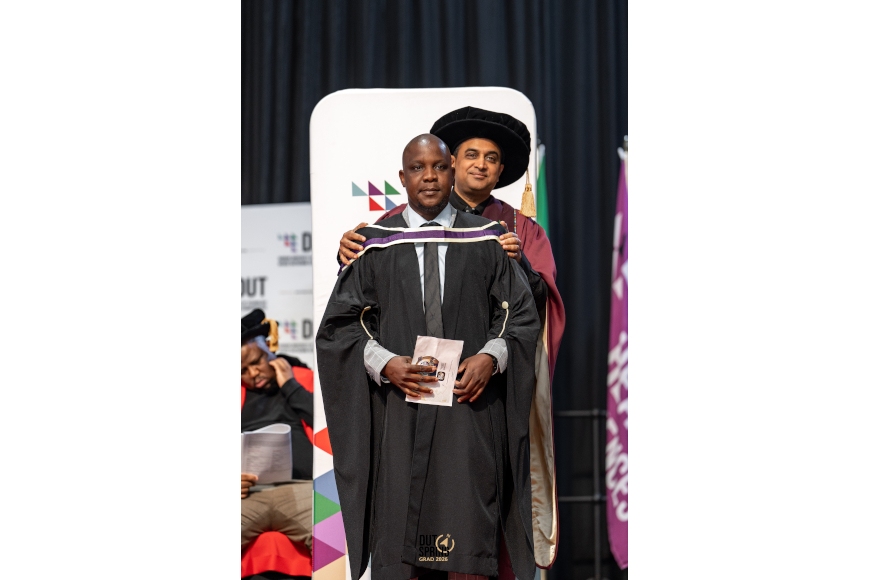
Siphelele Ngubane from Mtubatuba in rural KwaZulu-Natal has been recognised as one of the top achieversin the Faculty of Health Sciences. He graduated Cum Laude for his Master of Health Sciences at the Durban University of Technology (DUT) 2026 Spring Graduation, marking a remarkable academic achievement shaped by resilience and a deep commitment to empowering young people.
Siphelele’s achievement is significant given the personal challenge he faced towards the end of his academic journey.
In April 2026, just two months before completing his studies, he was diagnosed with avascular necrosis (AVN). Despite
this difficult setback, he remained focused on completing his Master’s degree.
“One thing that worked well for me was having a very supportive and dedicated supervisor, a family who supported
me and being committed to the timelines we set with my supervisor,” he said.
Reflecting on his journey, Siphelele described his experience at DUT as memorable, crediting the University’s administration and Faculty of Health Sciences staff for supporting him throughout his studies.
“I am thrilled to achieve a Cum Laude milestone. It is something huge for a young man from my background,” he
said.
His study, titled: Contextual Factors Influencing Youth Frontline Workers in Delivering Community-based HIV
Programmes for Young People in Rural, KwaZulu-Natal, South Africa, examines the critical role played by young frontline workers in HIV prevention and the contextual factors that either enable or constrain their participation.
His passion for the research topic stems from his belief in the potential of young people to contribute meaningfully
to community development when they are adequately empowered.
“Through my previous work experience, I learnt how young people contribute to community development programmes
when they are well empowered. This triggered my interest in investigating the role of youth frontline workers delivering
HIV programmes for young people,” he explained.
According to Siphelele, his qualitative study explored the experiences, perceptions and realities of youth frontline workers involved in HIV prevention programmes in the uMkhanyakude District of KwaZulu-Natal.
“The research found that youth frontline workers play a critical and multifaceted role in HIV prevention. Their
responsibilities include providing HIV education, peer counselling and psychosocial support, conducting awareness
campaigns, mobilising young people, facilitating linkage to care and providing follow-up services. Their proximity to and
understanding of young people in their communities enable them to communicate in relatable ways, build trust and
improve access to youth-friendly HIV prevention services,” explained Siphelele.
He further shared that the study also identified significant challenges affecting their work, including poverty, unemployment, transport difficulties, geographical isolation, stigma, limited access to healthcare and cultural silence around sexuality.
The research further highlighted gaps in the inclusion of some groups, including LGBTQI+ youth, young men, younger
adolescents and youth with disabilities.
Siphelele’s study concludes that youth frontline workers should not be viewed merely as implementers of HIV prevention programmes, but as agents of change who can strengthen community-centred and youth-responsive HIV prevention efforts.
Encouraging students embarking on postgraduate studies, Siphelele advised them to carefully choose a dedicated
supervisor, work consistently and honour the timelines agreed upon with their supervisors.
“They should never doubt their capabilities. I know at times it gets tougher, but it is possible. Know that you were born to live, but the decision on how you live lies with you. The future that you aspire to is in your hands,” added Siphelele.
Despite focusing on his wellbeing, Siphelele is looking towards the next chapter of his academic and professional
journey. His ambitions include pursuing a PhD and entering academia as a lecturer.
Pictured: Siphelele Ngubane
Photography: Sifundo Thwala
Simangele Zuma


