
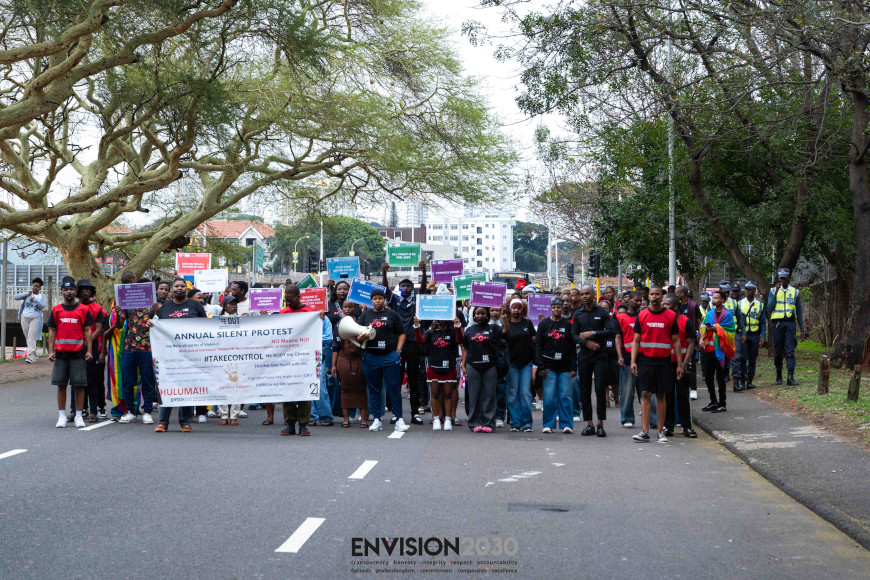
Taking a firm stand against Gender-Based Violence and Femicide (GBVF), the Durban University of Technology (DUT) community took to the streets as part of its 12th Annual Silent Protest March on Wednesday, 26 August 2026.
Staff and students from DUT’s Durban and Midlands campuses marched in silence along Steve Biko Road under the theme, “Silence Speaks: Standing Together Against GBV,” marking more than a decade of the University’s commitment to raising awareness and taking action against GBVF. The march was conducted under the supervision of law enforcement authorities.

DUT students during the Silent Protest March.
Following the march, participants gathered at the Fred Crookes Sport Centre on Steve Biko Campus in Durban for a formal programme. The annual Silent Protest March forms part of DUT’s ongoing efforts to raise awareness about GBVF, challenge the culture of silence surrounding violence, and contribute towards creating a safer, more inclusive environment for students, staff and the broader community.
Facilitating the programme, Dr Mzwandile Khumalo, Coordinator of the Student Academic Support and Development Unit at DUT, said the event formed part of the University’s contribution towards preventing GBVF within the institution and society.
In her opening remarks, the Interim Director: Student Services for the Midlands campuses, Ms Sithembile Mjadu, said the silence of the march spoke louder than words as participants honoured the pain of victims and called for justice.
“For many years, DUT has joined the annual Silent Protest, a protest against Gender-Based Violence, against femicide, against all forms of abuse that rob our people of their dignity and their lives. We do not protest as spectators. We protest as a university community that says: Enough. Enough is enough!” said Mjadu.
She said the DUT community stood in silence because victims and survivors of GBVF had been silenced for far too long. The march was an opportunity for participants to acknowledge their experiences, carry their stories and stand in solidarity with those who could not stand for themselves.
Mjadu noted that the Silent Protest March is guided by DUT’s Living Values, which include being people-centred, acting with integrity, fairness, embracing diversity and striving for excellence.
“People-centred: Every student, every staff member deserves to be safe, respected, and valued. Your pain is our pain. Your safety is our responsibility. Integrity: We commit to truth. To believing survivors. To not looking away when abuse happens in our residences, our classrooms, our offices, and our homes. Fairness: There can be no fairness when power is abused. Diversity: We acknowledge that GBV affects all, but disproportionately affects women, children, and LGBTQIA+ persons. Excellence: A truly excellent university is not measured only by research outputs, but by how safe its students feel walking home at night,” reiterated Mjadu.
Delivering a message of support, DUT Midlands Campus Director, Dr Nonhlanhla Mthiyane, recalled that President Cyril Ramaphosa had previously declared GBVF a national disaster. She expressed concern about the continued prevalence of GBVF and challenged the DUT community to move beyond awareness-raising towards finding practical and sustainable solutions to curb violence.
Sharing similar sentiments, Ms Philisiwe Mayeza, Student Representative Council (SRC) Social Welfare Officer in the Midlands, reassured survivors that they were believed and supported. She urged students and victims not to suffer in silence, emphasising that help is available.
Mr Oziel Mdletshe from Higher Health acknowledged the difficulty of addressing GBV as a man, particularly given the prevalence of male perpetrators. However, he stressed that men must take a leading role in confronting and preventing violence. He commended DUT for its continued efforts to combat GBV and create a safer campus environment for staff and students.
Delivering the keynote address, Dean of Students, Dr Clement Moreku, called on attendees to observe a moment of silence in honour of those who had lost their lives to GBV. He emphasised that GBV is not a women’s issue, but a societal failure that requires collective action.
“Awareness alone is not enough. What protects women are systems that work. Leaders who act and communities that refuse to normalise violence. This year’s theme, Silence Speaks: Standing Together Against GBV, invites us to pause, listen and reflect. Silence can sometimes mean everything is peaceful, but for GBV victims it can represent fear, shame, stigma and uncertainty about whom to trust,” said Dr Moreku.
Leading a dialogue focused on collective action was the Director of the International Centre of Nonviolence (ICON), Professor Ndumiso Ngidi. The panel discussion featured student activists Minenhle Zikhali of the Students with Disabilities Association (SWDA), Azole Shandu of LGBTQIA+, Nokwanda Shabangu of Qhakaza Ladies, Melisizwe Mncwango of Insika Men’s Network, Nompumelelo Duma, a Peer Educator, and Berea SAPS Communications Officer, Sergeant Nokuthula Dlamini.
The panellists encouraged students to speak out against GBV, support survivors and report incidents to the relevant authorities.
DUT Protection Services Director, Mr Charles Sehlogo, encouraged students to play an active role in their own safety and that of others. He urged students not to remain passive or expect others to act on their behalf, stressing that personal vigilance and speaking out are important in addressing GBV.
Psychologist in DUT’s Student Counselling and Health Unit, Ms Candice McCain, shared the 24-hour GBV helpline: 0800 150 150, which students can contact for assistance outside of campus hours. She said the unit prioritises GBV cases and encouraged students to seek help when needed.
McCain also advised friends and peers supporting victims to first ensure that the person is in a safe environment before seeking further assistance, noting that safety is the first priority when responding to trauma.
Sergeant Khumalo from Berea SAPS urged students to remain vigilant of their surroundings and the people around them. She encouraged students to take note of identifying features that could assist law enforcement when reporting an incident.
In closing, Mr Sihle Mbanjwa, Interim Director: Student Counselling and Health, expressed his appreciation to the event organisers from the HIV/AIDS Centre at DUT, under the leadership of Dr Thobile Zulu, as well as the supporting units for contributing to another successful Silent Protest March.
He also thanked the speakers, external stakeholders including the Department of Social Development and students for their participation and contribution towards making the event a success.
Through the annual Silent Protest March, DUT continues to affirm its commitment to challenging GBVF, amplifying the voices of survivors and promoting a university environment where safety, dignity, respect and accountability are upheld.
Pictured: The DUT community during the 12th Annual Silent Protest March.
Photographer: Sandile Lushozi.
Simangele Zuma


