RESEARCH
ADVANCEMENT

SDG 12: Responsible Consumption and Production


2026

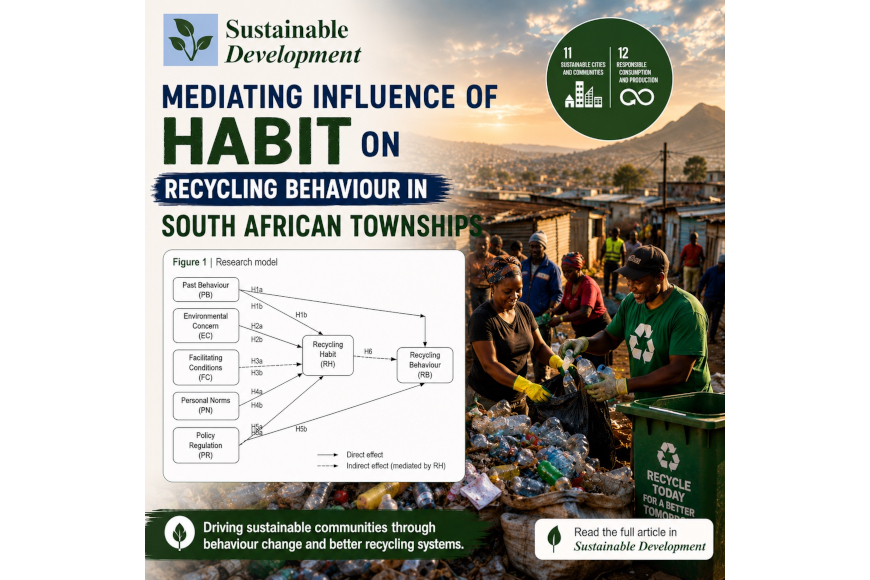
DUT STUDY FINDS RECYCLING STARTS WITH HABIT, NOT JUST AWARENESS


Why do some people recycle regularly while others do not? According to a new study by researchers from the Durban University of Technology (DUT), the Baden-Wuerttemberg Cooperative State University (DHBW) in Germany and Cape Peninsula University of Technology (CPUT), the answer may be simpler than we think: habit.


The study found that recycling is strongly influenced by people’s everyday routines and habits. In fact, habit emerged as one of the most important factors determining whether people recycle consistently.


While environmental awareness, personal values, government policies and access to recycling facilities all play a role, the research found that these factors are often not enough on their own. Instead, people are more likely to recycle when it becomes a normal part of their daily lives.


The findings suggest that creating lasting recycling behaviour requires more than education and regulation. Communities also need practical support and convenient recycling opportunities that help people develop positive recycling habits over time.


The study focused on recycling behaviour in South African township communities and provides valuable insights for policymakers, municipalities, environmental organisations and community leaders working to increase recycling participation and support sustainable development.


Lead researchers Professor Mercy Makhita and Professor Thomas Dobbelstein, who is based at DHBW in Germany and is also an Honorary Research Professor DUT,  said the findings highlighted the importance of making recycling easy, accessible and part of everyday life. Professor Dobbelstein currently also serves as Chairperson of the Advisory Board of the DUT Business School and as a Board Member of the Innobiz DUT Centre for Entrepreneurship and Innovation.


The researchers expressed their appreciation to both DHBW and DUT for supporting the project. The study contributes to growing efforts to promote sustainability and strengthen the circular economy in South Africa. The full research article is available as an open-access publication: CLICK HERE TO READ THE RESEARCH ARTICLE


Alan Khan

https://www.dut.ac.za/dut-study-finds-recycling-starts-with-habit-not-just-awareness/


DUT LAUNCHES MR PRICE FOUNDATION X EDHE WASTE INNOVATION CHALLENGE


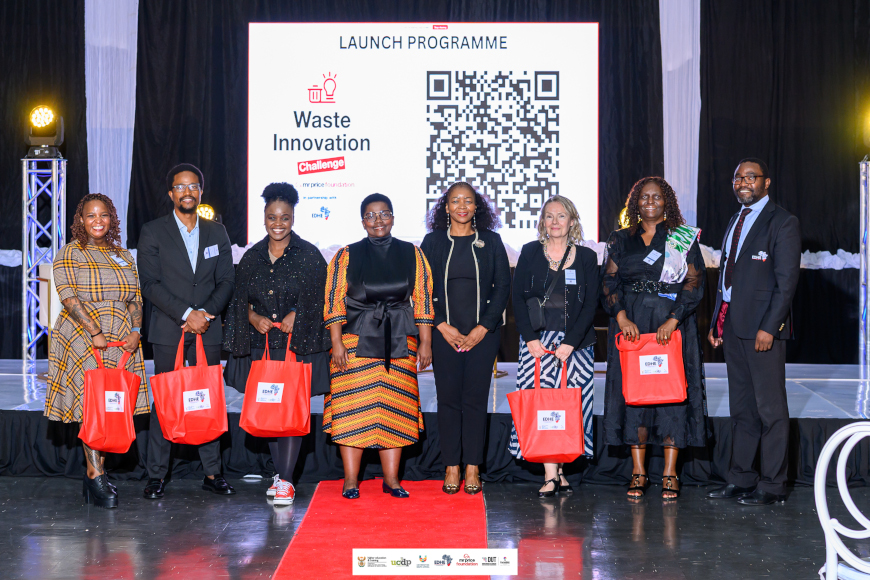
The Durban University of Technology (DUT), through its entrepreneurship nerve centre, the innobiz DUT Centre for Entrepreneurship and Innovation, successfully launched the inaugural Mr Price Foundation x EDHE Waste Innovation Challenge at the Indumiso Campus in Pietermaritzburg on Monday, 16 February 2026.


The groundbreaking competition will see students, researchers and innovators from across South Africa’s 26 public universities compete to develop the most innovative and socially impactful solutions using waste materials.


Participation is open to students and recent graduates aged 16 to 34 from South Africa’s public universities. Up to 400 qualifying participants will receive training in waste-to-value business models, circular economy principles, product development and pitching. From this cohort, 20 teams will be selected for an intensive bootcamp, culminating in presentations at the EDHE National Finals later in the year.


Brought about through the collaborative efforts of the Mr Price Foundation, Universities South Africa and the Entrepreneurship Development in Higher Education, the competition will see the country’s best innovative minds compete for a total prize pool of R245,000. Five winning teams will share the prize money, with R100,000 awarded to first place, R75,000 to second, R40,000 to third, R20,000 to fourth and R10,000 to fifth.


The victory will not only be financial, but will also provide mentorship, business development support, technical and sustainability training, and national exposure to partners and potential investors.


Mr Octavious Phukubye, Executive Director of the Mr Price Foundation, emphasised the importance of providing such platforms to young people, stating that it is the youth who will shape South Africa’s future. He added that universities, colleges and technical institutions are custodians of the human capital required to fully develop the waste innovation sector. Mr Phukubye noted that the challenge aims to promote a circular economy, create opportunities to reuse materials across value chains and build sustainable businesses.


In her message of support, Dr Phethiwe Matutu, Chief Executive Officer of Universities South Africa, said: “This waste innovation challenge encourages young people to develop solutions for real-life problems in South Africa and globally. With the challenges of waste, particularly plastic pollution in our seas, rivers and communities, initiatives such as this are long overdue.”


Dr Pinkie Ntola, Technology Transfer and Innovation Director at DUT, described hosting the launch as an honour, highlighting the significance of tackling waste, one of the world’s major environmental challenges.


“As DUT, we are proud to host this national launch because innovation, sustainability and engagement are central to our research agenda. Through our researchers, technology stations, innovation hubs and entrepreneurial support structures, we are committed to advancing solutions that contribute to the circular economy and environmental resilience,” said Dr Ntola.


Ms Nontokozo Ngcobo, Manager of the innobiz DUT Centre for Entrepreneurship and Innovation, said that hosting the launch recognised DUT’s ongoing work in green innovation, applied research and sustainable waste practices in KwaZulu-Natal.


“One of the innobiz Centre’s objectives, as outlined in DUT’s ENVISION2030 strategy, is the continuous prioritisation of environmental sustainability, with a focus on green ecosystems and sustainable energy practices, achieved through our university’s distinctive education which fosters ecological consciousness,” added Ms Ngcobo.


A student entrepreneur currently pursuing her Postgraduate Diploma in Business Administration at DUT, Ms Yenziwe Shabalala, shared her excitement at attending the launch and her interest in participating in the challenge. She is the founder of Sweet Green Holdings, which combines a coffee shop and a farm.


“Sweet Green Holdings links our farm to our coffee shop. The launch was informative and exactly what we needed. We are passionate about green sustainability and preserving our planet. I am excited about the competition, not only for the possibility of winning but also for learning how to grow our business through innovation and social impact,” said Ms Shabalala.


She added that her coffee shop uses a lot of plastic packaging, and through this competition she hopes to explore ideas to improve environmental impact. She is aiming to be among the Top 20 to present her idea and believes her experience in agriculture and hospitality gives her a strong chance to succeed.


Pictured: Distinguished guests at the launch of the Mr Price Foundation x EDHE Waste Innovation Challenge


Photographer: Khulasande Tshayile

Samkelo Mtshali/Simangele Zuma

https://www.dut.ac.za/dut-launches-mr-price-foundation-x-edhe-waste-innovation-challenge/


RESEARCH NEWS: PROFESSOR PILLAI’S ACADEMIC JOURNEY OF TRANSFORMING WASTE INTO WEALTH


Professor Santhosh Kuttan Pillai, a Professor in the Department of Biotechnology and Food Science in the Faculty of Applied Sciences, delivered his professorial inaugural lecture titled ‘The Invisible Engineers: Biocatalysts Shaping a Sustainable Future’ at the DUT Hotel School, Ritson Campus, on 28 August 2026.


The inaugural lecture stands as a celebration of a distinguished scholarly journey and the threshold of a consequential chapter in Professor Pillai’s career.
 

Congratulating Prof Santhosh Pillai were Professor Vusi Gumede, Deputy Vice-Chancellor: Teaching and Learning with Professor Fulufhelo Nemavhola, Deputy Vice-Chancellor: Research, Innovation and Engagement at DUT.


In his opening and welcome remarks, Professor Vusi Gumede, Deputy Vice-Chancellor: Teaching and Learning at DUT, said it was a privilege and honour to join the DUT community in congratulating Prof Pillai on attaining the prestigious status of full professor. He noted that professorships are awarded to academics who demonstrate excellence and scholarly achievement in teaching, research, innovation, and engagement.


“This is a well-deserved and remarkable achievement, and something to which all academics should aspire. It is a testament to dedication and outstanding scholarship. A high point in the life of any academic is being invited to deliver an inaugural lecture, providing an opportunity to present to the university community and the public insights into their research and publications, as well as their contributions to teaching and learning, which ultimately culminate in attaining full professorship. Today, you are being recognised for your dedication and hard work. We are proud of your achievement and wish you continued success and further knowledge generation,” said Prof Gumede, thanking Prof Pillai for the honour he has brought to DUT.


Introducing Prof Pillai, Acting Executive Dean of the Faculty of Applied Sciences, Prof Tukayi Kudanga shared that Prof Pillai began his academic journey at DUT in 2004 as a doctoral student and completed his Doctor of Technology (DTech) degree in Biotechnology in 2010. In the same year, Prof Kudanga said, Prof Pillai was appointed as a Senior Technician, marking the beginning of his transition into academia. He was appointed Lecturer in 2014 and steadily progressed through the academic ranks, becoming Senior Lecturer in 2016, Associate Professor in 2020 and Full Professor in 2025.


“Professor Pillai is an NRF C2-rated researcher and an integral member of the Enzyme Technology Research Group, specialising in the application of microbial systems for sustainable biotechnology. His work integrates microbial biotechnology, enzyme technology, biomass valorisation, bioactive products and sustainable bioprocessing, with a focus on converting underutilised biological resources and waste biomass into high-value products,” shared Prof Kudanga.


Highlighting Professor Pillai’s strong commitment to postgraduate training and mentorship, Prof Kudanga revealed that he has supervised 11 Master’s students and three doctoral candidates, and has hosted six postdoctoral fellows. He currently supervises 11 PhD and nine Master’s students, with three PhD and three Master’s theses currently under examination.


“Prof Pillai has published more than 80 peer-reviewed articles, primarily in Q1 and Q2 journals, as well as 19 book chapters. He has delivered nearly 50 presentations at national and international conferences. His work has attracted more than 3,800 citations and has an h-index of 29, reflecting the impact and influence of his research,” reiterated Prof Kudanga.


Professor Pillai delved into his presentation, speaking about how microorganisms have played a fundamental role in shaping the Earth’s biogeochemical cycles, maintaining ecological balance and driving biological processes that sustain life.


He indicated that despite their microscopic size, their metabolic capabilities offer opportunities to develop innovative solutions to some of the environmental, industrial and societal challenges facing the world.


“There is an entire world around us that we cannot see. It is ancient, extraordinarily diverse, and fundamental to our existence. Though invisible, they are the most important engineers of our planet,” he said.


Professor Pillai emphasised that, for centuries, humanity’s encounters with microorganisms were largely shaped by disease, epidemics and loss of life. He highlighted major historical examples, including the Plague and Cholera pandemics, which claimed millions of lives.


He also spoke on the COVID-19 pandemic caused by the SARS-CoV-2 virus, resulting in several million deaths, globally.


“Microorganisms have shaped human history, causing suffering, fear and enormous loss,” explained Professor Pillai.


He probed more on the microbes, saying only a small fraction of microorganisms are pathogenic, one in a billion (0.000001%).


“The vast majority are essential for life and offer extraordinary benefits. From threat to opportunity: microbes are nature’s most versatile bio-resources,” he shared.


He spoke of a world without microbial decomposers and what it would mean, indicating that, if they are present, they decompose, transform, recycle, fix, oxidise, reduce, and ferment.


Professor Pillai further highlighted how microorganisms function and how their remarkable capabilities can be harnessed to benefit humanity. .


He then explained his research and how his doctoral work laid the foundation for his journey in microbial biotechnology, enzyme technology, and sustainable bioprocessing. His research spans four interconnected themes: Industrial Biotechnology and Enzyme Technology; Sustainable Biorefineries and the Circular Bioeconomy; Food Microbiology and Functional Biomolecules; and Environmental Biotechnology and Bioremediation.


He showcased how his research is intertwined with the work of master’s and doctoral students like Ms Cherise Elisha, whose thesis focused on the antioxidant, antihypertensive, and antidiabetic activities of peptides from fish collagen and milk lactoferrin.


“Food proteins can serve as precursors of small bioactive molecules with potential antioxidant, antihypertensive and antidiabetic functions,” he said.


Another student, Mr Naveen Kumar’s,  PhD thesis focuses on the identification, purification, and characterisation of novel antimicrobial peptides from microorganisms.


His research entails integrating microbiology, genomics, bioinformatics, and experimental validation to accelerate the discovery of new antimicrobial molecules.


“The invisible engineers are still doing their jobs without any applause, and we ignore them, but we exploit them. So when we walk around, we are not ourselves; they are travelling with us. Infact: if you look at our body, they outnumber our own cells. So they are incredible architects, invisible architects who have ruled ever since the birth of the cosmos,” said Prof Pillai.


Prof Pillai’s research work seeks to connect microbial innovation with practical applications in waste valorisation, renewable energy, sustainable food systems and the development of bio-based products.


In his closing remarks, Prof Fulufhelo Nemavhola, Deputy Vice-Chancellor: Research, Innovation and Engagement at DUT, congratulated Prof Pillai on his significant and richly deserved academic milestone. He said Prof Pillai’s journey affirms the enduring wisdom that there is no elevator to the summit of scholarship; it must be reached through patient steps, disciplined labour and fidelity to purpose.


“As an NRF C2-rated researcher, with more than 80 peer-reviewed publications, extensive international collaborations and a growing global scholarly influence, Prof Pillai has made a formidable contribution to DUT’s research stature. Yet the true measure of a professor is not found in bibliometric figures alone. His legacy is therefore also written in the lives of the postgraduate students he has supervised, the emerging scholars he has mentored and the intellectual networks he has cultivated,” shared Prof Nemavhola.


He applauded Prof Pillai for his academic journey of perseverance and intellectual growth, wishing him well as the seeds of knowledge he has planted continue to grow into discoveries that advance science, strengthen society and contribute to securing a more sustainable future.


Pictured: Professor Santhosh Kuttan Pillai delivering his professorial inaugural lecture.


Photographer: Sandile Lushozi

Waheeda Peters/Simangele Zuma

https://www.dut.ac.za/research-news-professor-pillais-academic-journey-of-transforming-waste-into-wealth/
 

RESEARCH NEWS: NEW RESEARCH COULD HELP REDUCE ONLINE CLOTHING RETURNS


Anyone who has shopped for clothes online knows the frustration of ordering the wrong size. It’s a challenge that costs retailers millions every year and often leaves customers ordering multiple sizes just to be safe.


New research by Professor Thomas Dobbelstein, Honorary Research Professor at the Durban University of Technology (DUT) and Professor at the Duale Hochschule Baden-Württemberg (DHBW) Ravensburg in Germany, together with Professor Zielke and Dr. Ortlinghaus from Walbusch-Chair for Multi-Channel-Management at the University of Wuppertal, is helping to explain why.


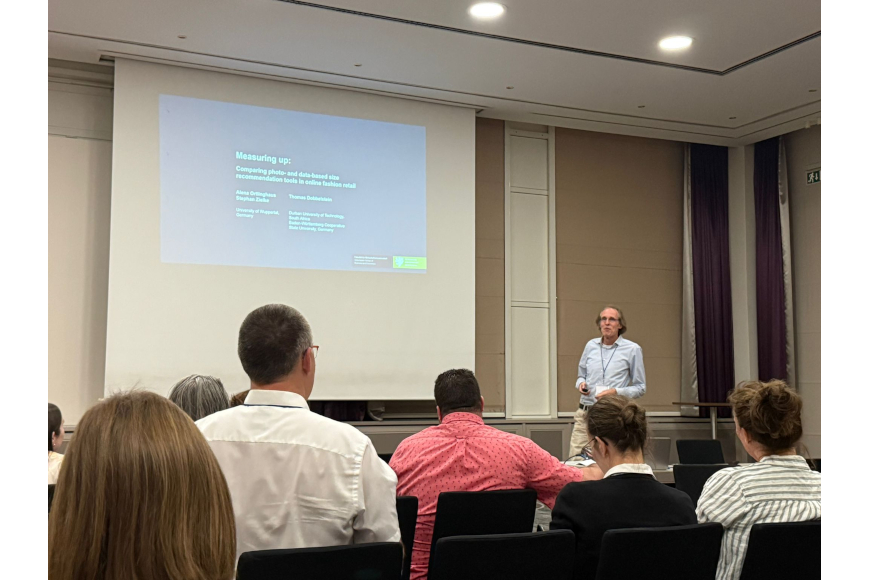
Professor Dobbelstein recently presented his work at the 32nd Recent Advances in Retailing and Consumer Science (RARCS) Conference in Berlin, one of the world’s leading conferences in the field of retailing and consumer science. The conference brought together researchers and industry experts from across the globe to share new ideas and discuss the future of retail.


Drawing on two studies involving 1080 participants in Germany, Professor Dobbelstein compared the different types of digital size recommendation tools used by online fashion retailers.


His research found that shoppers place greater trust in questionnaire-based size advisors than image-based systems or traditional size charts. Participants described these tools as easier to use, more reliable and better at giving them confidence that they had chosen the correct size.


The research also uncovered an interesting trend. When shoppers were advised to buy the size they would normally choose, they were happy to order just one item. However, when the recommendation differed from their usual size, many still ordered several sizes to try on at home. This suggests that size recommendation tools often reassure customers about decisions they have already made rather than convincing them to change their minds.


The findings offer practical guidance for online fashion retailers looking to improve customer confidence and reduce unnecessary returns, while creating a better shopping experience for consumers. In addition to his academic role at DHBW Ravensburg, Professor Dobbelstein is an Honorary Research Professor at DUT, Chairperson of the Advisory Board of the DUT Business School and serves on the Board of the Innobiz DUT Centre for Entrepreneurship and Innovation. Through these roles, he continues to support the DUT’s international research, innovation and sustainability agenda.


Pictured: Professor Thomas Dobbelstein presenting his research at the 32nd Recent Advances in Retailing and Consumer Science (RARCS) Conference in Berlin, Germany.


Alan Khan

https://www.dut.ac.za/research-news-new-research-could-help-reduce-online-clothing-returns/